Taking It to the Street (50)

Last Saturday I spent the day selling books and bowls and all sorts of other things at my sidewalk sale. I called it that in the craigslist post because I liked the sound of it. We don’t have a sidewalk along this property, but I spread blankets and sheets over the gravel where the sidewalk would be if we had one, and I lined up my boxes of books, my Tupperware, my clothes. I swept the street the night before, and after my 11-hour stint that Saturday, I swept it again, feeling small chills as I moved the broom across the asphalt, the precursors of heat stroke, I imagined. So yesterday when the neighbor’s gardener blew a bunch of debris into the gutter in front of my home, I was already in that mode. I headed out with my broom again. I swept the blacktop and remembered how in Todos Santos, people would rake the dirt road in front of their property. They carved neat tracks in the sandy dirt, and in the dry seasons they would hose it down, the water poking holes in the tidy grooves the rake had made. Downtown, where the roads are paved, shopkeepers would wash the sidewalks in front of their stores with soapy water. I remember being surprised, at first, and yet it seemed so natural, so right. Of course, I thought. Claro que sí. Of course we should each tend our own little section of the street.

Dreaming Home (46)

I’ve longed for ages for a home where I felt like I could spend the rest of my life. When I moved to Sonoma County, it was the first time I had that feeling about a place. I remember driving home from Santa Rosa on Guerneville Road past green farms, the oak-studded hills before me. Look where I live, I thought. When I moved into La Casa Azul in Todos Santos, it was the first time I had that feeling about an actual dwelling. Things went terribly awry with my landlord there, but I remember that giddy feeling, thinking I’d found the home of my dreams. I remember wondering if I’d be able to negotiate the wrought iron spiral staircase when I grew old.

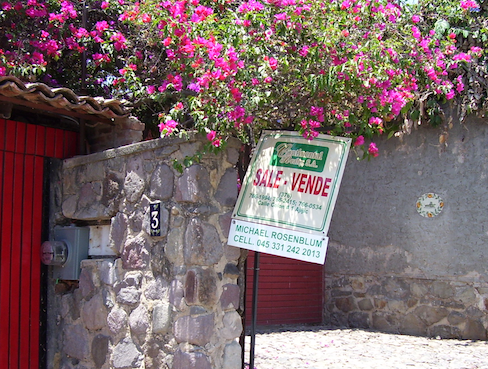
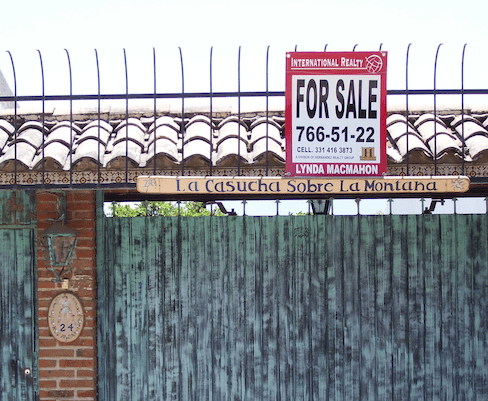
Over the years I’ve built a habit of studying the yards, examining the homes whenever I walk down the street. “Oh, I could live there,” I’d say to myself, caught by the wrap around porch or the climbing wisteria, both pleasure and longing evoked by my ritual, a bittersweet practice. When I lived in Ajijic where buying a home might have been one day more within my reach, I photographed for sale signs. I remember one advertising an empty lot of neatly turned earth, a beautiful brick wall surrounding it, a blue metal gate. I went as far as to look at two homes for sale up in the hills. One was all white and one was green, and they were both two stories tall with miradores that made them seem like three-story homes. I don’t remember any details about the houses themselves, only those marvelous rooftop patios, the views of the village spread out below them, the lake in the distance. I would have lived on those roofs.
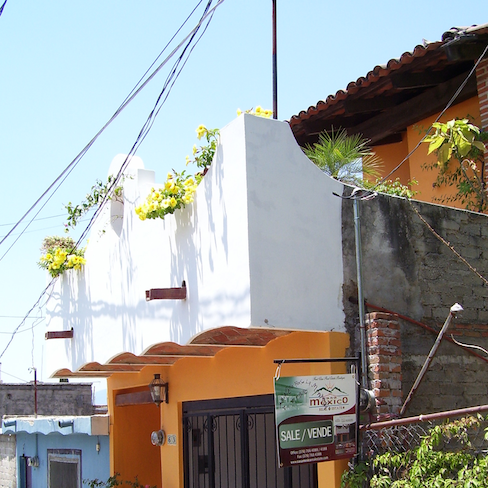
for sale sign, white veranda, yellow blossoms

for sale sign, metal gate

for sale sign, bougainvillea and rock wall

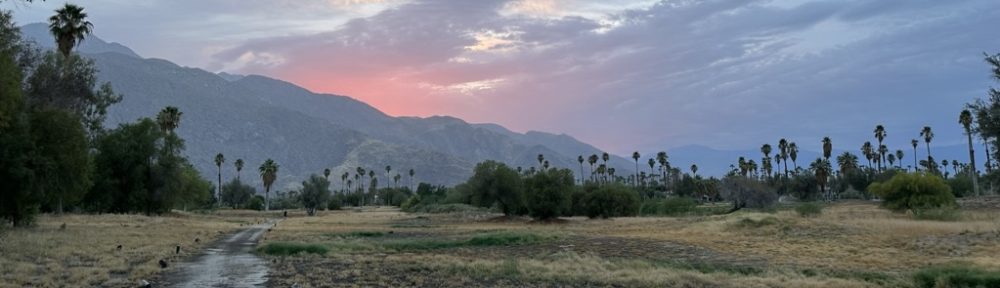
Now in my unexpected southern California life, thanks to two dear friends and the workings of a generous universe, I’m on the threshold of having my longing met in the old trailer home I’ve just bought. I don’t get to take possession of it, so to speak, until April, but it has possessed me from day one. It has grabbed me by my viscera, invoking big dreams of a magic home I can grow old in, tending my garden and writing my books, the stark place transformed little by little in the intervening years to lushness and color, where my birds will want to linger chatting together in the bougainvillea or the palos verdes. I can see myself sipping tea on my patio there years from now, watching the sun disappear behind my mountains, the sparrows and the mourning doves scritching among the leftover seeds in the late afternoon quiet. I don’t have words to say how grateful I am, how full this makes me, how much awe it awakens. But I seem determined to try anyway, to fall short but maybe brush the feathers of the thing in my attempt. Thank you, universe. Thank you, dwelling gods. Thank you, especially, my good friends. Thank you.
Closer to the Earth (44)

I’d pulled out the travel section of my L.A. Times a few weeks ago and set it aside unread. The cover story was about Mexico, about the northern village made famous for its pottery. Now the next generation are doing marvelous contemporary things with clay, and I’ve saved the photographs of big beautiful pots for my mother to see. There is one in particular I think she’ll enjoy that reminds me of some of her own large slab bowls. Nestled between the images of the pottery is a shot of one side of a village street, and I am transported. It could be any rural village in Mexico–the narrow, uneven sidewalk, the crumbling edges of things, the dirt road, the fading paint on the walls of the buildings. But what makes this so different from a dilapidated block in some U.S. town? Why does it awake a longing in me, a fondness, even, none of the aversion I might feel for the equivalent in this country? Is it the colors, the texture, the light? Is it the lack of despair in that Mexican air that weighs more lightly on the world? And why do I crave it?

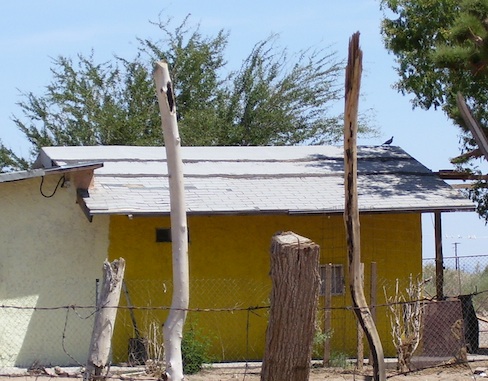
yellow house

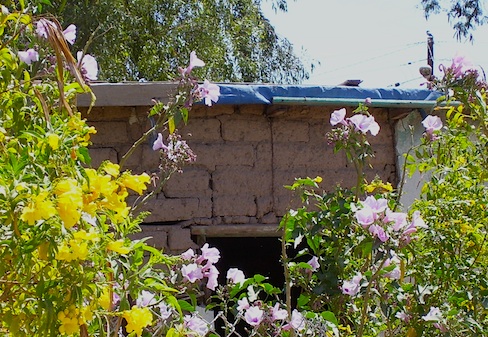
window and flowers

When I moved back to the States, I remember my shock at the clean, wide streets, the lavish landscaping. Now I teeter between pleasure in the places where this wealth allows for a clean beauty, the brick and the desert plants and vivid blooms a masterpiece, often echoing our Spanish roots here in the Coachella Valley, and my dismay and disconnection from the places where the clean wealth falls short of this art and only looks garish and sterile, even obscene. But when I see this photograph of the village street in the newspaper, I ache to be there, walking along the banqueta, the sidewalk, my sandals dusty, my skin drinking in that other sunlight, the colors and the textures akin to the earth, to life, to participating in the world in a different way. I can’t quite grasp the words to explain it even to myself. It is a knowledge and a memory of the body, I think, and the spirit, not the mind.

I can feel myself nodding to two women I pass on the street. “Buenas tardes,” I say.

They take me in with their eyes, nod, smile. “Tardes,” they say.

I Am the Invader (43)

Once I walked from Ajijic to Chapala and back. I don’t remember how many hours I spent doing it, but I remember being present for big chunks of time, taking it all in with new and thirsty eyes. I avoided the highway for all but a two or three block stretch in a couple of spots where it was the only choice. I walked through cobblestone streets in the villages, past horses and cows and goats on the dirt roads on the outskirts. More than once I sensed I was walking where gringos didn’t show up very often, and probably not on foot, a woman alone. I didn’t feel afraid, only conspicuous from time to time.

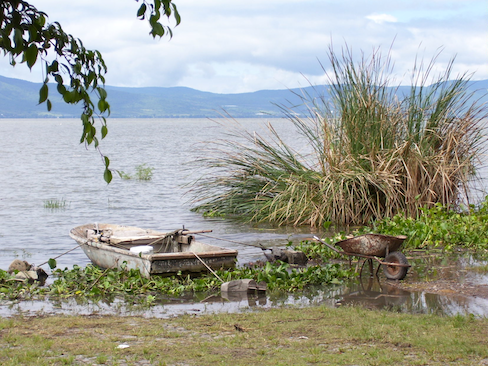
Shore of lake, old rowboat and wheelbarrow

I hugged the lakeside when I could. I passed old brick buildings, glassless windows, the courtyards swept clean, women doing laundry outside by hand, the cluck of chickens behind low brick walls with bougainvillea spilling over them. Once I stopped for a long time watching a heron standing still in the shallows near the shore, and I felt the richness of the life there, the birds, the water, the place where fertile earth and decay overlap, reminiscent of my visit to the deep south here, maybe Biloxi. I marveled at the idea of owning land beside this lake, how much that would mean to me, but wondering if it could feel like that same opulence to the locals in their poverty. East of San Antonio Tlayacapan there was a stretch where the road became more of a walking path than a road, dotted with shacks, more plywood lean-tos than dwellings. I passed a man and two children. They were sitting at the edge of the road, a piece of plywood for a table, a bag of bread between them, the makings of sandwiches. I remember the surprise on their faces when I appeared. I felt like I’d just walked uninvited through their living room. I can still see the man’s face. He is chewing, and he nods to me in response to my greeting. But his eyes are wary, resentful. I am the invader.

The Blind Man (42)

In Ajijic there was a blind man who I came to know a little. I can’t remember his name now. I’ve forgotten it, and the names of other people, names I thought would stay with me always. Was it Luis? The name pops up now, but I can’t be sure. He had a blind person’s cane, red and white, and carried a cup with him. I would see him at the Wednesday tianguis, the outdoor market, or standing in front of one of the supermercados that catered to the expatriates and the tourists. I don’t remember him ever asking for money. There were a few old women there who were pushy and demanding beggars, an odd entitlement I’ve never encountered before. But the blind man was only there with his cup, always cheerful, never pushy. I came to know him a little. We would talk about his family, about the thunder the night before, about what he might be able to do in order to still contribute to his family, about how much he’d like to learn how to play a musical instrument. I remember feeling good when he would recognize me. When I had the money, I would tuck a bill into one of this shirt pockets, tell him in a quiet voice how much I was sticking in there. Because I left so suddenly, I never said goodbye to him. It’s one of my small regrets. But I console myself with pictures of me finding him again one day, of him still remembering me, of being able to explain. “Lo siento mucho que no te dije adios, Luis.” I’m so sorry I didn’t tell you goodbye. “Yo te pensaba muchas veces desde me fui.” I’ve thought of you many times since I went away. I think of him still. I hope one day I find him well.

The Waxing Light (41)

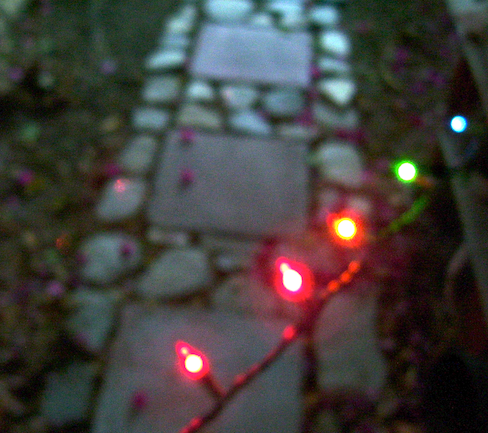
I am lying on my back on my yoga mat. I’ve come late to my practice today, so I’m on the living room floor, chased inside by the cold air. I move my head, and I can see the last light in the sky through the window, still visible in contrast against the darkness of the bougainvillea leaves in the late dusk. The white of the sky is a soft glow, like muted neon or dimmed florescence. I turn my head back, and my eyes sweep the little row of snow globes on the windowsill. There is something peculiar about them this evening, something caught in their curved glass. I check the sky again. Are there clouds up there, still lit by the sun long lost to our edge of the valley here beside the mountains? Sometimes the clouds are lit golden. But there are no clouds, and it’s too late really for them to still catch and hold the sun’s light from their heights. And then I realize what I’m seeing. It’s the Christmas lights I have woven around the bougainvillea trunk and branches. The green and blue and red and amber lights are showing up in my snow globes, five strands glowing there in miniature. I’ve always loved them, I think, in part because they’re little worlds, and they’ve never felt more like that than this moment with these tiny strings of lights alive in them.

Five colored lights against the stepping stones

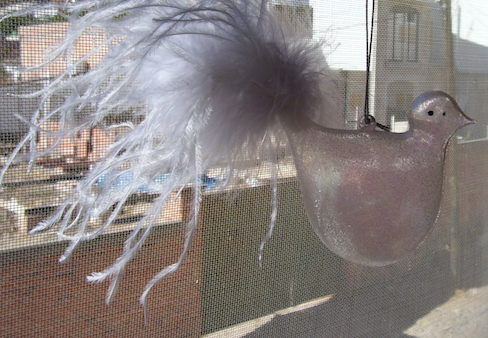
Glass bird in window with white feathers

I think of the lights I laced along the curtain rod in my Ajijic apartment, looping down into the windows so people would see them from the street below. I remember the white glass bird hanging there, a photograph somewhere, the white tail feathers floating against the window screen. I think of the rounded yellow bird so like that white one, that hung on my shower rod with three glass hummingbirds in Santa Rosa, and the shock of the crash when the rod gave way that afternoon, nothing but glorious shards left in the bathtub. I think of the new glass rooster on my patio table, sunlight through the red glass of his comb, his tail, his wattles. It is my love of color and light that leaves me always reluctant to take down my Christmas lights. I left them up late in Ajijic, too, though I felt self-conscious about it there. Would this be another mark of my crazy estadounidense self? Here I don’t seem to care what my neighbors think of me, the solar lights still sharp and vivid in the hedge beside the gate at night.

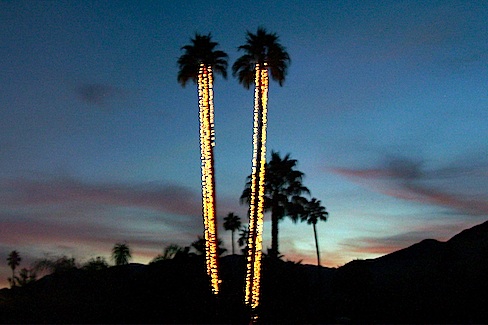
two tall palm streets strung with white lights

But I was glad all out of proportion to see two people in my neighborhood who still have their lights turned on, too. I asked Ana about it once, if people in Ajijic ever left their Christmas lights up despues del año nuevo, after the new year. She told me some people wait until after Candlemas to take them down. Candlemas is the Christianized name for one of the main pagan holidays on February 2nd. The Catholics call it the Feast of the Purification of the Blessed Virgin Mary. But as I understand it, we celebrate the waxing of the light. I told Ana I liked that idea, a kind of sanctioned extension of my pleasure in the lights. What better way to honor the growing light than with these bright colors in the dark? When I finish my yoga, I move on hands and knees to the windowsill, stare deep into the small glass globes. It is a wonder, I think, these tiny strands of light that stretch within them, sharp and clear and luminous. I bow to the light in each and every one of us. Namaste, indeed.

New Year’s, Too (40)

I don’t remember the noise of New Year’s Eve in Ajijic. But after October with the steady rotation of the statue of Guadalupe from church to church, rockets marking the progression every morning at 5am, and the two weeks of our saint’s festival, culminating in whole days of almost ceaseless explosions–not to mention having lived through the rainy season with the cascading thunder (!)–I am betting New Year’s Eve seemed quiet there in comparison.

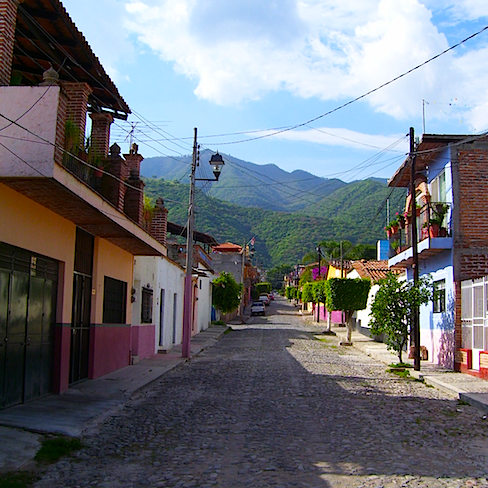
Cobblestone street in Ajijic

I do remember walking through the village on New Year’s Day, spying the evidence of street fires in every neighborhood. Everything was rather impressively cleaned up, no trash or half-burned logs or even big ashes left in the road from the last embers. But you could see the charcoal remains dusting the cobblestones every block or two, and you could feel the quiet, everyone asleep after the big night. Later I learned from Ana they would make tamales and have a fire in front of their own house on Zapata. They would stay up all night, eating and drinking and enjoying each other, the family, the neighbors, nearby friends. Staying up all night seemed to be part of the tradition, though I didn’t ask why. One truly greets the new year that way, I am thinking, more than only marking midnight.

Now every year I picture them together in the street on New Year’s Eve, the firelight dancing on brown faces, dark shining hair. I imagine Rodolfo has made his pipián, and there is a big metal pot filled with homemade tamales, and the corn husk wrappers pile up beside it as the night moves toward the dawn. I can almost taste the masa, can almost hear them singing. Happy new year, everyone.