I have a history of dead ones, a habit of coming upon them. There was a span of time when I lived in L.A. where I would find dead animals while I was driving. I would stop to move them to the side of the road. It must have happened twenty times in as many months. I don’t like that we kill them and drive on, leaving their dead bodies to get hit again and again, turned to mangled meat on the asphalt. I’ve cried over dead deer, over the bird I hit who screamed when he died, over the cat who leaped into the path of my car one night in the rain. When I lived in Sebastopol I found a grey squirrel dead on the edge of the road where it bends. I studied it for a long time, marveling at the way the morning mist clung to its plumed tail, iridescent, feather-like. The next day I looked for the squirrel’s body and found a pellet instead. Finding it felt like a gift, being able to know the little one had provided a meal for a bird of prey. I have three squirrel bones, scoured almost white in the bird’s gullet, tucked away in a matchbox, sacred treasure.
The pellet may have been left by a turkey vulture. We had a lot of them there. But I secretly hoped it was from one of my favorite red-shouldered hawks, though I don’t even know if they eat carrion. There was a mated pair who lived on my hill, who would allow me to stand beneath their perch when I saw them, who would tolerate me speaking to them without flying away. One day I found one of them dead beside the road at the bottom of the hill. It was the female, I think, so big and beautiful, gone now. I brought stones to her, my big quartz crystal, a chunk of amethyst, my offerings for her lying in. I am convinced one of my neighbor’s took her body for the feathers. She took my stones, too. It was hard to forgive myself for telling her the bird had died, letting her know where her body was. Later, I saw the male hawk teaching their offspring to fly, one larger bird and one tiny one, only dark specks against the white sky, across the valley from my home. But their calls were unmistakable. I broke open with grief for their loss, with joy at knowing the male was not alone, touched and humbled by their bravery, going on without her. The memory of the two of them flying together, widower father, orphaned son, still makes me want to cry.
I came upon another of my memorable dead in Todos Santos. I found her on my walk just south of the village. I loved that road through the desert, nothing but the sun and the crunch of the sandy soil beneath my sandals as I walked, and then the sound of the sea in the distance. But just outside of town you had to pass a dumpsite. It looked to me as though the garbage washed in with the floods, branches and plant debris mixed up with the trash. But then people would add to it, and the flies would come. I would hold my breath until I’d passed, trying not to look and yet looking anyway, some weird impulse like passing a car accident and slowing down, craning to see. Sometimes there were dead animals there, but more often rotting vegetables, moldy egg shells, dirty diapers, empty bottles of transmission fluid. The dead one who stayed with me didn’t draw any flies. She’d been dead a long time, I think. The desert sun had done its work, bleached her of her smells. She was in the middle of the dirt road, and I remember how shocked I was when I first made sense of her, understood what I was looking at. She was a small mountain lion. She must have been run over, again and again, and she dried that way, flattened like a pancake in the dry desert heat. The image is burned in my brain. It was like a cartoon rendering, the animal squashed flat by a bulldozer, then peeling itself up off the ground, but it was real fur, real cat feet, cat tail. Her form became familiar to me, and I would look for her each time I walked there. I loved that cat.
Last Monday I rode my bike to the community garden. I had my camera in the basket. I wanted to take pictures of all my sprouting seeds, document their lifespan. I was riding on Palo Fierro, and I passed something lying on the sidewalk. I had to stop, walk back to look, praying it wasn’t a dead animal. It was lying in the exact center of the sidewalk, parallel with the edges, in perfect alignment, as if someone had placed it there with care. (It didn’t occur to me until just now. Did someone stop, like me, move it from the road?) My first glimpse had me thinking cottontail because of the colors, beige and white, but the shape wasn’t right.
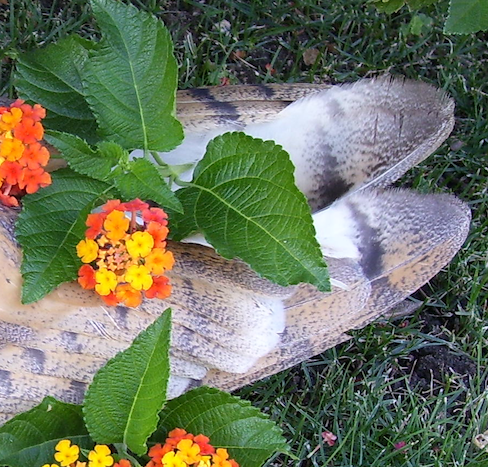
When I see who it is, it takes my breath. It’s a barn owl. It must have been hit by a car. I don’t check his underside, only pick him up as gently as I can, carry him to a grassy spot beneath a flowering bush. I pick a few of the bright orange lantana, tuck them by his curved beak, his ruffled wing feathers, his feet. I touch his talons once with my forefinger–they are too amazing to resist. They speak of his wildness, his fierce strength. I can’t help but wonder. Is he the owl I saw flying in the night by the grove of fan palms? Is he my first owl, dead now? We are only a block away from where I saw him.
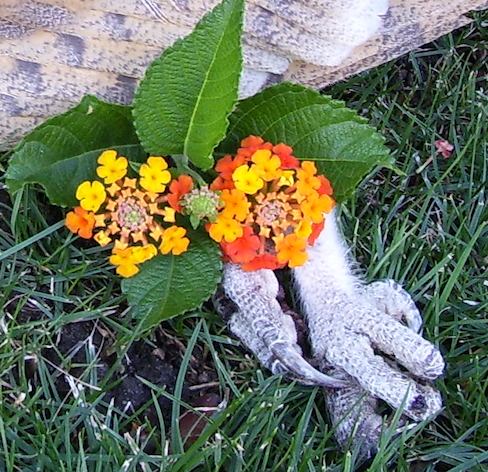
I get my camera from the bike, take pictures of this dead one. I wonder if a bird will come to eat him. I pray for his soul, even though I know it is being well tended. I cry a little. He is so otherworldly to me, the screech in the night, the hallowed, silent white-winged soaring, his feathered shape so still now, ghostly, extraordinary even in death. I stroke him once and straighten. There is a smudge across the day. We’ve lost a piece of light.
 No Holds Barred