I Am the Invader (43)

Once I walked from Ajijic to Chapala and back. I don’t remember how many hours I spent doing it, but I remember being present for big chunks of time, taking it all in with new and thirsty eyes. I avoided the highway for all but a two or three block stretch in a couple of spots where it was the only choice. I walked through cobblestone streets in the villages, past horses and cows and goats on the dirt roads on the outskirts. More than once I sensed I was walking where gringos didn’t show up very often, and probably not on foot, a woman alone. I didn’t feel afraid, only conspicuous from time to time.
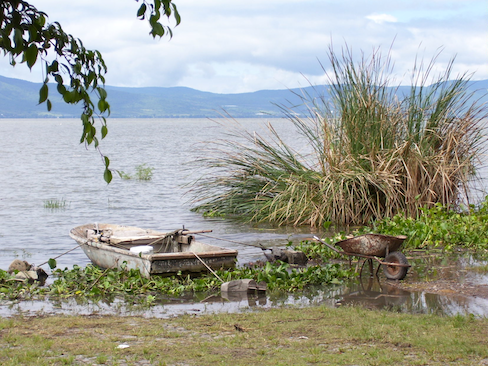
Shore of lake, old rowboat and wheelbarrow

I hugged the lakeside when I could. I passed old brick buildings, glassless windows, the courtyards swept clean, women doing laundry outside by hand, the cluck of chickens behind low brick walls with bougainvillea spilling over them. Once I stopped for a long time watching a heron standing still in the shallows near the shore, and I felt the richness of the life there, the birds, the water, the place where fertile earth and decay overlap, reminiscent of my visit to the deep south here, maybe Biloxi. I marveled at the idea of owning land beside this lake, how much that would mean to me, but wondering if it could feel like that same opulence to the locals in their poverty. East of San Antonio Tlayacapan there was a stretch where the road became more of a walking path than a road, dotted with shacks, more plywood lean-tos than dwellings. I passed a man and two children. They were sitting at the edge of the road, a piece of plywood for a table, a bag of bread between them, the makings of sandwiches. I remember the surprise on their faces when I appeared. I felt like I’d just walked uninvited through their living room. I can still see the man’s face. He is chewing, and he nods to me in response to my greeting. But his eyes are wary, resentful. I am the invader.
The Waxing Light (41)

I am lying on my back on my yoga mat. I’ve come late to my practice today, so I’m on the living room floor, chased inside by the cold air. I move my head, and I can see the last light in the sky through the window, still visible in contrast against the darkness of the bougainvillea leaves in the late dusk. The white of the sky is a soft glow, like muted neon or dimmed florescence. I turn my head back, and my eyes sweep the little row of snow globes on the windowsill. There is something peculiar about them this evening, something caught in their curved glass. I check the sky again. Are there clouds up there, still lit by the sun long lost to our edge of the valley here beside the mountains? Sometimes the clouds are lit golden. But there are no clouds, and it’s too late really for them to still catch and hold the sun’s light from their heights. And then I realize what I’m seeing. It’s the Christmas lights I have woven around the bougainvillea trunk and branches. The green and blue and red and amber lights are showing up in my snow globes, five strands glowing there in miniature. I’ve always loved them, I think, in part because they’re little worlds, and they’ve never felt more like that than this moment with these tiny strings of lights alive in them.

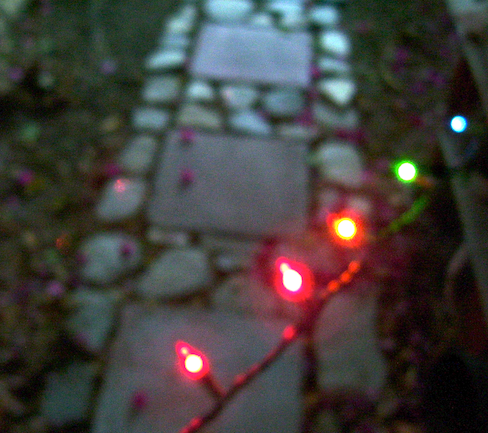
Five colored lights against the stepping stones

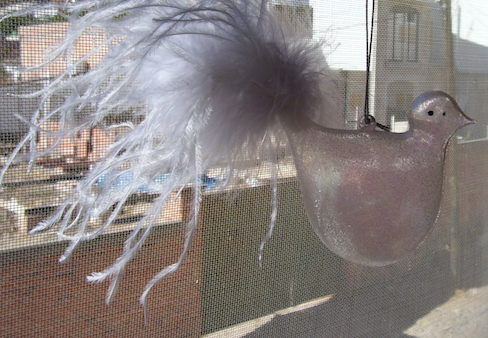
Glass bird in window with white feathers

I think of the lights I laced along the curtain rod in my Ajijic apartment, looping down into the windows so people would see them from the street below. I remember the white glass bird hanging there, a photograph somewhere, the white tail feathers floating against the window screen. I think of the rounded yellow bird so like that white one, that hung on my shower rod with three glass hummingbirds in Santa Rosa, and the shock of the crash when the rod gave way that afternoon, nothing but glorious shards left in the bathtub. I think of the new glass rooster on my patio table, sunlight through the red glass of his comb, his tail, his wattles. It is my love of color and light that leaves me always reluctant to take down my Christmas lights. I left them up late in Ajijic, too, though I felt self-conscious about it there. Would this be another mark of my crazy estadounidense self? Here I don’t seem to care what my neighbors think of me, the solar lights still sharp and vivid in the hedge beside the gate at night.

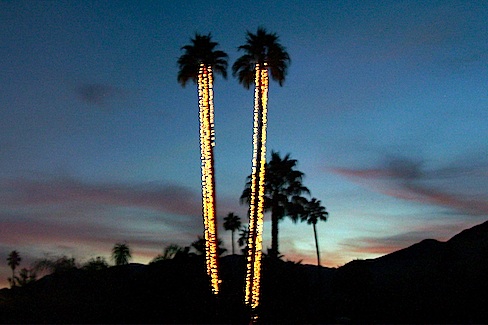
two tall palm streets strung with white lights

But I was glad all out of proportion to see two people in my neighborhood who still have their lights turned on, too. I asked Ana about it once, if people in Ajijic ever left their Christmas lights up despues del año nuevo, after the new year. She told me some people wait until after Candlemas to take them down. Candlemas is the Christianized name for one of the main pagan holidays on February 2nd. The Catholics call it the Feast of the Purification of the Blessed Virgin Mary. But as I understand it, we celebrate the waxing of the light. I told Ana I liked that idea, a kind of sanctioned extension of my pleasure in the lights. What better way to honor the growing light than with these bright colors in the dark? When I finish my yoga, I move on hands and knees to the windowsill, stare deep into the small glass globes. It is a wonder, I think, these tiny strands of light that stretch within them, sharp and clear and luminous. I bow to the light in each and every one of us. Namaste, indeed.

Incarnations of Yerba Maté (35)

This morning I let myself drink two cups of yerba maté. I bought two tea bags from the health food store here on Saturday, my latest approach to letting myself indulge in this addiction now and again. Each sip is delicious, the unique, bitter aroma, the coconut milk and agave a divine alchemy with the sharp flavor. I think of the even more wonderful maté I can buy in bulk from Mountain Rose Herbs. But I don’t let myself buy it because I’ve learned I’ll drink it until it’s gone. And then, I remember the first time I drank that same quality of yerba maté, and it carries me to Ajijic.

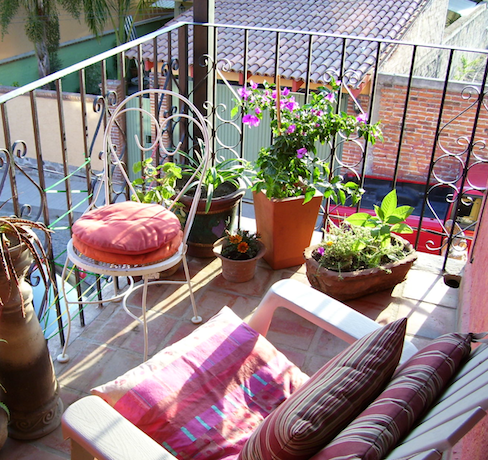
my Ajijic balcony with the chair and pots of flowers, including the terra cotta I mention with the bougainvillea

I am on the sidewalk near the little health food store two blocks from my apartment on Aldama, the one on the frontage road north of the highway, beside the nursery where I bought my bougainvillea for my balcony and that lovely oblong rectangular terra cotta pot. The health food store is run by a woman and her husband who live in Guadalajara. I like them both very much. I pause before the nursery next door, run my eyes over the plants spilling out onto the sidewalk, inhale the scent of gardenias, then move past and enter the open store front. Yerba maté is not a thing in Mexico–it’s more a South American drink–so I don’t really expect them to carry it, but I ask anyway. I’ve forgotten in the moment the owners are from South America themselves. The woman is there today. She nods then smiles at my surprise, walks toward one of the shelves in the small space, hands me a large bag of loose yerba maté. I am shocked they have it, dismayed it’s not in teabags. I buy it anyway, then buy a small sieve from the Soriana in Chapala. I brew it in a glass pitcher in my rental kitchen, strain it with my new sieve.

In Palm Springs now, I use the sieve every day, to strain my alfalfa, oatstraw, horsetail, to catch my seeds when I make a glass of lemon water. But this morning I use the two precious Guayaki teabags I have allowed myself. I sit in my courtyard and savor every sip, relish the clarity of the mountains before me, the peace of the late autumn morning. And then I am back in my rental kitchen in Ajijic, the ridge of the hill outside my window, running that deep green Argentinian maté through my Mexican sieve. I mix in the half and half and local honey I bought from the tiangis. I walk out to the balcony, and I sit in my big chair. I sip the creamy hot sweetness while I look out across the lake below, and the crimson flycatcher makes acrobatic swoops from the neighbor’s chimney across the narrow cobblestone street.

My Respect for Pigeons (34)

I’ve never been fond of pigeons. Even now, I admit I still tend to dismiss them, am less pleased to see a group of them on a telephone wire than a gathering of mourning doves, some strange bird snobbery at work in me. But now I remind myself of what I came to know of them in Mexico. When I lived in La Casa Azul, in the blue house in Todos Santos, I came to respect pigeons. They lived next door to me, in the eves of the artist’s studio, the man I rented my house from there. I always wondered if he initiated their residency, started the colony there on some whim, some fancy about the romance and quirkiness the studio should reflect, not realizing how it might grow. I never asked.

But I would sit perched on my tall wrought iron chair in my semi-third-floor roost and watch the pigeons fly together. I’d always loved the sounds they made nestled in the eves, the muted rounded coos, bird pillow talk. But I never really watched them fly before. I remember the first time I saw them take off for their morning flight, making big loops across the sky, flapping and gliding in tandem. I was struck by the vigor of their bird bodies, by their prowess in formation despite the quickness of their flight. They would launch into the air together every morning for the first looping flight, a burst of celebration for the day to come. In the late afternoon, they took flight again before dusk, a happy sky dance, a few last circles of gratitude and play before bed. And I would sit in my own roost, feet propped on the rebar railing before me, and marvel at the ease of their antics. Each time they took to the sky, I fluttered with awe.

Traveling (33)

Traveling is an odd thing. I bring myself with me wherever I go, but I don’t always feel like myself. I am still tethered to my home, feel its tug. I am tied to who I’ve left behind there. My cats occupy my space, glaring in their absence, a small prickle or a larger ache. Even when I go where I am known, even loved, I carry their absence, feel the tug of my tether. I am missing bits of my self, the one I have grown comfortable with over time, quiet mornings on the patio, the solar Christmas lights a happy glow on the hedge when I walk home in the new dark after dusk.

The birds here are not my birds. But when I reach in, find my way to fullness on the deck of this other home, their unfamiliar calls comfort me, companions in the quiet autumn morning. They tie me to my world, tingle my self, charm me silly. I feel the sun on my forehead, my ankles, my cheek wet from dog kisses. The house is waking up around me, and my eyes fill with warm tears, my breath deep and grateful in my lungs.

I Carry My Longing (32)

I carry Mexico inside me in a way I’ve never known before. It’s half longing, half comfort, I think, as though the country is part of my bedrock now from my short stay–unexpected, surprising, constant. Other places reside in me, too. The open fields of Sonoma County, Sebastopol’s apple orchards alive in the white of full bloom. But they live quietly, rich moist earth breathing peace. I loved it there. For the first time I thought, I could spend the rest of my life here. But I don’t dream of going back, not like with Mexico, though I don’t rule it out. I dream again and again of going back to Mexico. I imagine really moving there this time, not just going like I did before, for a year or two, maybe forever, not returning in a rush to the United States. I can see myself there, sitting in my walled garden, sparrows and white-winged doves in the bougainvillea, daily walks along the malecón, the boardwalk, watching my volcano across the lake. I can picture myself older, taking extra care moving across the cobblestone streets.

Day to day, I hold the longing to return, to make Mexico my own. It lives in the crook of my elbows, hides behind my knees. And yet I wonder if I will ever make that choice. Questions rise in me, yeast in the dough. Can I live again with spiders the size of my hand? What about feeling like “the other” there? Would I grow used to it, morph into new skin, my roots sinking deep in foreign soil? Would my life in the United States fade like a dream? I think it might. I can imagine missing people here, urging them to visit me there. I can imagine missing the conveniences, Trader Joe’s, the rules of a bureaucracy where I can know what to expect. But I can’t picture me living in Mexico and carrying this same longing for life in the United States. When I think of living in Mexico again, I only picture being home.

Crossing (30)

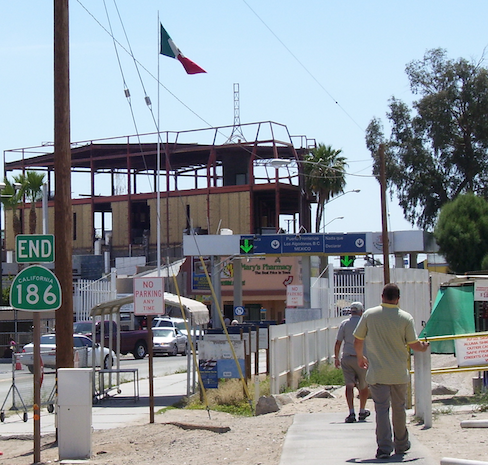
I am fascinated by the boundaries between us. Borders between countries, lines drawn on rock, boundaries between people, between cultures–arbitrary or innate, they separate us, define us. But boundaries aren’t just barriers. They provide the arena for moving back and forth between the two. They offer the possibility of exchange. I can ride the charter bus from the Coachella Valley to Algodónes. I can walk across the border and be in Mexico. One line, drawn no doubt by nations after war, shouldn’t be able to make so much difference. I’ve studied the border from the bus, the way the fence runs through the desert, a jagged monster, the sprawling remains of extraterrestrials. I can find no clues, no evidence that one side of the fence should be so different from the other.

shot of the border looking toward Mexico from the U.S.

But walk a few yards toward el otro lado, the other side, and you can feel the change. It is of the body, I believe, and not the mind, yet I return to it again and again and again, wanting to make sense of it, trying to figure it out. When I walk across, my body knows I’m in a foreign country. Because I lived there once, it feels like coming home, but this is a comfort of the heart, I think, the soul, and not the body. The body knows this is not the land where it was raised. It’s not geography. My scrutiny of the fence line across the desert between us revealed nothing, only made me marvel, knowing just across it lives another world, a stone’s throw only, two crows flying. The land doesn’t change at the border, but we breathe different air. Spanish diphthongs and mariachi and sidewalks all sing Mexico. Grackles call out in their native tongue. Our bodies know.