When I lived in Todos Santos, I would ride the bus to Cabo San Lucas to pick up the mail sent to me from my box in northern California. I would go to the Burger King there, indulge in a Whopper that tasted remarkably like the ones here in the States. (When I was an adolescent, I remember my disappointment when my girlfriend and I found a McDonald’s in Germany but the hamburger there still tasted like a foreign country.) In Cabo San Lucas, hamburger in hand, I’d walk along the harbor, or sit perched on the steps overlooking it, and savor the familiar taste as I chewed. After, I’d go to the Häagen-Dazs store and eat ice cream. Before Cabo San Lucas, I never even knew they had Häagen-Dazs stores. I haven’t seen once since. But the best fast food I had in Mexico was the morning after the cats and I had crossed over to the mainland on the ferry from La Paz. We were stopped in line before a toll booth, and a man came up to my window. He had a small blue and white cooler with him. I don’t remember what he called his wares, but I bought one. The plastic bag was warm, and that surprised me. He was using the cooler to hold in the heat. I paid him, then caught up with the toll booth line, and headed south along the toll road. I remember there were big black birds in the trees lining the highway, their calls an exotic din. I unwrapped the plastic bag, warm skinny rolled tortillas, like taquitos only not fried. They were filled with potatoes and a glimmer of meat, and I remember how tasty they were, how good the freshness and the warmth felt in my mouth. I remember marveling to think that kind of homemade breakfast would find me on the highway like that. I can still see the diffident way the man walked toward my car, the blue and white cooler in his hand. And I can still feel the soft warmth of the tortillas against my fingers while I ate and drove, the air alive in grackles.
Category Archives: Food
Anti Arizona (45)
We were having breakfast together at my favorite place, Palm Greens Cafe, where once when they brought my food I commented about what a glutton I was being, and the kitchen staff serving me smiled an impish smile and said, “Yes, but a gluten-free glutton!” If I hadn’t already been charmed by the place, that alone would have won me over, stolen my word-loving heart. But when Corina told me she was considering Arizona for the next stage of her young wandering life, I think I went into some weird autopilot. I don’t remember half of what I said, only my gluten-free vegan pancakes with blueberries sitting untouched before me during my diatribe and the surprised looks on her parents’ faces across the table. I know I told them I didn’t want to spend one cent in Arizona because of their racist legislation and their lies. (I read one of the reasons they claimed to have crafted the anti-Mexican, anti-immigrant laws was because of increased violence along their southern border. But in truth, violent crime has gone down there in recent years.) I know I told them if I needed to go to New Mexico or Colorado from some reason, I would fill up the gas tank in Blythe and drive straight through their pretty desert state. I know my voice and my words were harsh, maybe shockingly so. I called Corina later to apologize for my vehemence. “I know it’s beautiful,” I said. “I can understand you wanting to go there.” But I’m still praying she’ll pick another spot.
New Year’s, Too (40)
I don’t remember the noise of New Year’s Eve in Ajijic. But after October with the steady rotation of the statue of Guadalupe from church to church, rockets marking the progression every morning at 5am, and the two weeks of our saint’s festival, culminating in whole days of almost ceaseless explosions–not to mention having lived through the rainy season with the cascading thunder (!)–I am betting New Year’s Eve seemed quiet there in comparison.
I do remember walking through the village on New Year’s Day, spying the evidence of street fires in every neighborhood. Everything was rather impressively cleaned up, no trash or half-burned logs or even big ashes left in the road from the last embers. But you could see the charcoal remains dusting the cobblestones every block or two, and you could feel the quiet, everyone asleep after the big night. Later I learned from Ana they would make tamales and have a fire in front of their own house on Zapata. They would stay up all night, eating and drinking and enjoying each other, the family, the neighbors, nearby friends. Staying up all night seemed to be part of the tradition, though I didn’t ask why. One truly greets the new year that way, I am thinking, more than only marking midnight.
Now every year I picture them together in the street on New Year’s Eve, the firelight dancing on brown faces, dark shining hair. I imagine Rodolfo has made his pipián, and there is a big metal pot filled with homemade tamales, and the corn husk wrappers pile up beside it as the night moves toward the dawn. I can almost taste the masa, can almost hear them singing. Happy new year, everyone.
Incarnations of Yerba Maté (35)
This morning I let myself drink two cups of yerba maté. I bought two tea bags from the health food store here on Saturday, my latest approach to letting myself indulge in this addiction now and again. Each sip is delicious, the unique, bitter aroma, the coconut milk and agave a divine alchemy with the sharp flavor. I think of the even more wonderful maté I can buy in bulk from Mountain Rose Herbs. But I don’t let myself buy it because I’ve learned I’ll drink it until it’s gone. And then, I remember the first time I drank that same quality of yerba maté, and it carries me to Ajijic.
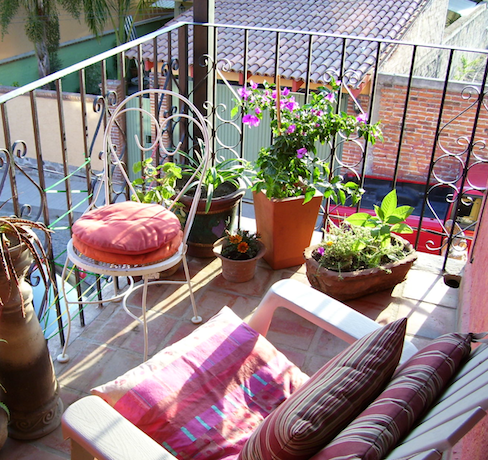
I am on the sidewalk near the little health food store two blocks from my apartment on Aldama, the one on the frontage road north of the highway, beside the nursery where I bought my bougainvillea for my balcony and that lovely oblong rectangular terra cotta pot. The health food store is run by a woman and her husband who live in Guadalajara. I like them both very much. I pause before the nursery next door, run my eyes over the plants spilling out onto the sidewalk, inhale the scent of gardenias, then move past and enter the open store front. Yerba maté is not a thing in Mexico–it’s more a South American drink–so I don’t really expect them to carry it, but I ask anyway. I’ve forgotten in the moment the owners are from South America themselves. The woman is there today. She nods then smiles at my surprise, walks toward one of the shelves in the small space, hands me a large bag of loose yerba maté. I am shocked they have it, dismayed it’s not in teabags. I buy it anyway, then buy a small sieve from the Soriana in Chapala. I brew it in a glass pitcher in my rental kitchen, strain it with my new sieve.
In Palm Springs now, I use the sieve every day, to strain my alfalfa, oatstraw, horsetail, to catch my seeds when I make a glass of lemon water. But this morning I use the two precious Guayaki teabags I have allowed myself. I sit in my courtyard and savor every sip, relish the clarity of the mountains before me, the peace of the late autumn morning. And then I am back in my rental kitchen in Ajijic, the ridge of the hill outside my window, running that deep green Argentinian maté through my Mexican sieve. I mix in the half and half and local honey I bought from the tiangis. I walk out to the balcony, and I sit in my big chair. I sip the creamy hot sweetness while I look out across the lake below, and the crimson flycatcher makes acrobatic swoops from the neighbor’s chimney across the narrow cobblestone street.
If Looks Could Kill (29)
When I first moved to Todos Santos I bought my produce from a place on the main drag, the road the two-lane highway became as it zagged through town. The woman there was never kind to me, a rarity in Mexico. I annoyed her with my questions and my faltering Spanish. She answered me in a sharp, curt voice. She looked at her friends, rolled her eyes, said things I couldn’t understand and laughed. I don’t know how long it took me to stop going there. I found a new place in the north of town, a kind of glitzy store for the expatriates, but the staff were sweet and helpful. I bought produce from a local organic farmer, an estadounidense who camped out on the sidewalk downtown two mornings a week. Once I bought a bag of arugula from him–huge dark green leaves like I’ve never seen before or since. I brought it to my friend Iris at Il Giardino, and someone at the restaurant sauteed it with a little oil and garlic. It’s still a favorite meal of mine, especially with the brown rice pasta I’m in love with now.
One day when I walked past the produce place where I used to shop, the woman made a point of glaring at me. I remember the way she held my passing glance, her head moving, slow and deliberate, to keep me in her gaze as I walked past the open air stall. For a moment, I wondered if she was angry with me because I stopped buying from her. But that was only my logic, only me trying to make sense of what was happening. But logic wouldn’t help me here. Because as I watched her, she bared her lips in a snarl and her cheeks pinched up. It was more fierce than a wild animal might have been, cornered and terrified, lashing out. The look in her eyes was pure hatred, her face made grotesque by it. I scuffed my toe on the pavement, stumbled, her venom like a blow. I turned my back and kept walking. My arms trembled, my cloth shopping bags suddenly too much to keep upright. I let them dangle as I climbed the hill toward home. I wondered how she could hate me that much. She didn’t even know me. But to her I was the ugly American. To her, I was the reason her once-tiny fishing village teetered on an unknown brink, invaded by foreigners building palatial homes north of town, the growing middle class of Mexicans only beginning to get their footing, the huge disparities creating terrible tension just beneath the surface of her world. To her, I was to blame for everything that was wrong with her life. I’ll never forget the look on her face or the shock of that poison spewing out at me.
Mango (25)
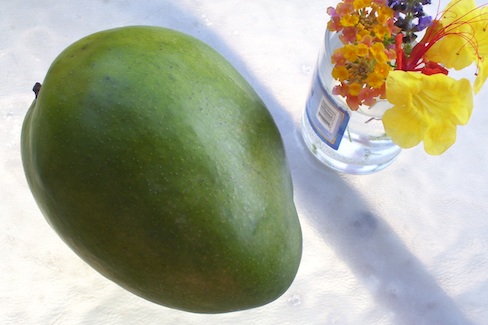
I pick the big green mango up from the counter, cradle it in my cupped hands. I probe the sides with gentle fingers. I am surprised by how quickly it has softened, even in our late summer heat, becoming almost ripe while I was away overnight celebrating Mami’s birthday. Yesterday in the late afternoon I placed it on the patio table beside a tiny vase of blossoms from my garden to honor the equinox.
Now without knowing, I have brought the mango to my face. The sweet, spicy, astringent smell drifts across me. Tears fill my eyes like a yawn, that quick stretching yearning. For one long moment, the scent takes me to Todos Santos. I am sitting at my tall round wrought iron table in the courtyard at Las Flores, marveling over the ripe red mango that has appeared there as if conjured. Later, Alfredo mimes peeling and eating one, not even trying to name it for me, not knowing the word is the same in English except for our terrible American “a” that butchers its beauty. There are three little trees behind the main house. I pass them when I go to use the washing machine. Alfredo brings me more as the weeks go by, sharing the largesse as the season swells and ends. Always they appear on my little courtyard table like sweet offerings to the gods. Sometimes, when he has borrowed my binoculars to look for whales from the steps at the other side of the inn, he will return them to my table with a mango beside them. Back in my desert kitchen, a world away, I roll the big green mango in my palms, my thumbs brushing across it. I press my nose to the firm skin, inhaling, my lips touching, too, my pose a prayer.
La Milpa (18)
One time when I did say yes to Mexico, I got to visit Rodolfo’s milpa, the one south of the carretera, the highway, just west of Ajijic. We rode the bus together, Ana and Rodolfo and their daughters Isabel and Mariane and I. Milpa translate’s literally as cornfield, but Rodolfo grew other vegetables, too. They were all nourished by the nightly summer rains. Every year at harvest they had a gathering at his other milpa, north of the highway somewhere. They roasted elote over a big open fire, the corn in their husks, drank tequila, danced. I don’t know how I missed it, but it breaks my heart now to think I may have passed it up. I hadn’t been there long yet, so I maybe I was too shy, but I know I would have done anything to get there in that second summer. But I left that year when the corn was still growing.
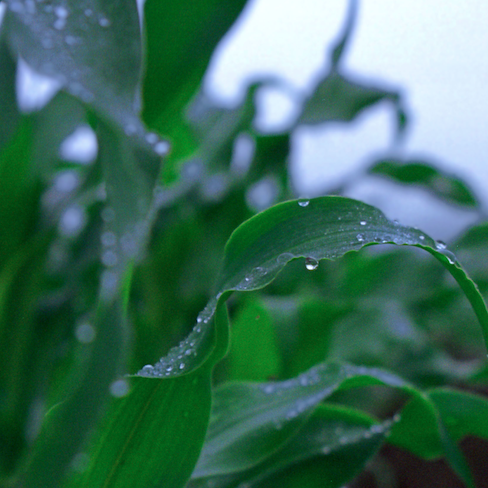
The milpa was a few blocks more to the south, between the carretera and the lake. We walked together on the country road in the late summer afternoon. I remember being transported when I followed Rodolfo through the rows of corn. They must have been twelve feet tall. It was another world inside them, all pale green light, moist earth and growing things. He brought us to a makeshift table in the distant heart of the field. Rodolfo picked a handful of pepinos, cucumbers, and washed them with a gallon of water he’d carried with him on the bus. He had a knife to slice them, and Ana produced limes and salt and chile. We ate pepinos picados in our little spot carved out from the forest of corn, and I remember being charmed and oh so grateful they had wanted me to come.
It began to rain, and I licked lime and salt from my fingers. We grabbed everything and ran down the road, laughing, the rain coming down in fat drops, pelting us as we ran. Rodolfo led us to a half-built home a block away. We stood in an unfinished room while the rain beat down on the metal roof, nibbling on brownies I had bought from a cafe in town and crunching crisp red apples. I have always loved the sound of rain on a metal roof, the smell of the first drops hitting dusty earth. I was glad for the water going to the milpa.
Rodolfo talked about the half-built home, abandoned now. It belonged to a friend of his, and when he looked around, I could see in his eyes the way he imagined it in his mind, picturing it fixed up, livable. But Ana only rolled her eyes. She was not eager to live in the country. Over my dead body, she might have said. But I could see it, too, the place restored, the dream of it. Rodolfo and I looked at each other and smiled. Who knew?
[Cornfield photograph cropped from the full version, © Tomo Yun at www.yunphoto.net/en/. Used with permission.]