The Woman in the Waiting Room (50)

I am not so naive or so bigoted to believe all doctors are assholes or all nurses are saints. I know both groups have their fair share of both. But when my stepfather was in the hospital, it was the doctors who were the challenge and the nurses who helped to get us through. It was the nurses and the other family members of patients on the floor. There is something that happens between strangers sitting together in a room when each of you faces losing a loved one. I remember sitting in the little alcove on the eastern side of the oncology floor in the Newport Beach hospital. And I remember a short blonde-haired woman whose husband was dying. I remember seeing recognition when our eyes would meet across the small space. I think we came to love each other a little bit sitting in that room together.

I was sitting there one afternoon, slouched against the blue fabric chairs, when I heard her voice and looked up. She was standing in the hallway, head tilted up toward the oncologist. “You want to understand?” his voice now, loud against the white tiles. “Then you go back ten years,” he growled at her, “and go to medical school.” I don’t remember what came next, only the way the bottom fell out of me for her in that terrible moment. I knew it had already been almost impossible to remain upright, to keep limbs and torso stitched together, and here she was bludgeoned now by his mean, defensive arrogance. I wanted to scream at him on her behalf. I may very well have gone after him, spoken my mind. I was 24 and had a habit of doing so. But I hope I went to her instead. I hope I offered comfort when she needed it. And I hope my eyes spoke those same volumes to hers whenever we met in the alcove or passed each other in the hallway. Brave, kind stranger—que le vaya bien.

I Want To Write About . . . (28)

Begin with the phrase, “I want to write about. . . .” Go.

I want to write about frogs and waffles, the way frogs come overnight in the ditches beside country highways after a summer rain, and you can hear them, thousands of frog voices all at once, when you drive along with the windows rolled down, and waffles crisp on the outside, pockets filled with melted butter, and you pour real maple syrup over it all and eat fast so they don’t get soggy. I want to write about trampolines. I remember how Del’s family had one flush with the ground in their front yard in La Crescenta. I loved that, not having that extra height of it being off the ground. I want to try one again after I’ve done more yoga and become less and less tight, less constricted in my movements. And oh! The trapeze! I’d forgotten about the low-flying trapeze and how somehow I was light enough and strong enough to move from one to the other in a large circle around Terri’s Berkeley studio all those years ago, like flying, like music, like being in synch, “aligned with something larger” as my blog reader wrote. I want to be that person again who can move around the room on the trapeze. I want to write about fossils. Fossils?!!? I would still like to go on a dig someday. And there is something to be said for holding a piece of life in your hands, rubbing your fingers against its roughness, along its ridges. I want to write about rain spouts in Ajijic.

Time’s up.

Write About Home? (27)

Write about home. That was the writing prompt on April 17th, 2012. Ten minutes. Go.

I think home for me may be anywhere I feel safe and centered and at rest. If I can feel all of these things, I can feel at home in a motel beside of a busy highway. If I’m on edge, off kilter, then I can’t rest in myself, am itchy in my skin, can’t settle. I seem to go for long stretches now where I’m at rest with myself, and then the patio cement wobbles, the windowpanes rattle, and I am on my knees, angry at myself for falling down, for trying to stand up and not being able to. I eat too much, resist the work waiting for me. Essays go ungraded, dishes make a small city in the kitchen sink. When I was much younger, I had a rule about eating for comfort. I would assemble the food beside the television. And then I’d lie on the couch and had to feel whatever it was I was needing to feel. After a good cry, the Cheetos became my reward. I miss Cheetos. Last night I ate savory rice crackers out of the bag and then a small bowl of peanut butter and brown rice syrup and lost myself in a book about Mexico. This morning I lingered in bed and the tears came. They brought me home again.

Where I Live (24)

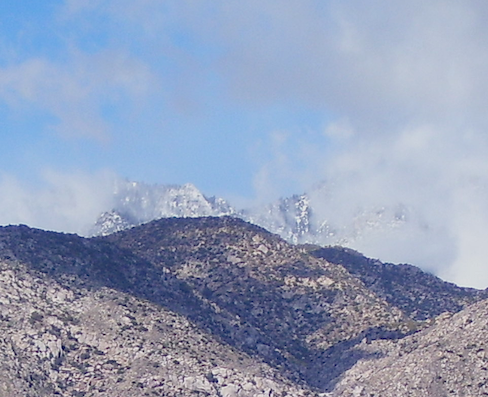
mountains, clouds, sky

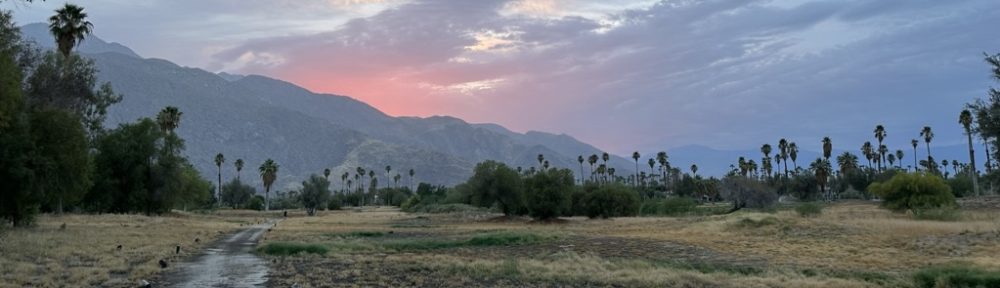
I ride along the bike path on my way home from the farmers market, the San Jacinto mountains ranged before me. “Look where I live,” I whisper. I remember driving home from Santa Rosa on Guerneville Road, fields spread out beside me, the green rolling hills ahead. “Look where I live,” I’d say. I’d wiggle my butt on the seat, both hands on the wheel, dancing a little jig inside. I can go all the way back to Oakland, to that freeway junction I loved, from 580 to 24, I think. It ran in a wide climbing arc, the glory of the East Bay spread out below me. In Hopland I would sit on our wide stone porch and watch the rock outcropping change colors with the day, and I’d feel like I was living in a vacation rental. Then walking on the beach in Todos Santos, alone amidst scoops of brown pelicans, no one else in sight. Or riding the bus to San Juan Cosolá, ranchera music pouring out the open windows, my cheeks wet with grateful tears. I have been so lucky. But there is something about the San Jacintos that stirs me. And they are such a contrast to the lush farmland and oak woodland green of Sonoma County that evoked that first deep sense of wonder over where I lived. Now it is this stark, enormous nearby presence that makes my heart beat, breathes my lungs, these craggy rock mountains so alive I wonder if I can ever choose to live without them.

Buried Alive (23)

I’ve always been a little claustrophobic. I want a window cracked when I drive. I remember fighting with Kay when I drove her to work. She wanted the window closed. I never had a good enough reason for insisting it stay open, only the vague sense of not being able to breathe. During the mountain fire last summer, I was driven inside for a week, windows closed against the choking smoke. My claustrophobia mounted as the week progressed, ash like thick gray snow coating the trailer, the courtyard, my sense of not being able to breathe pulsing through my days and nights. Then it came to me, the source of my claustrophobia. When I began sitting zazen in the early 1990s, I dreamed a past life. It’s the only time it was ever more than snatches, this one whole cloth. I was a priestess, or maybe royalty. I was expected to sacrifice myself for the good of my people. They were preparing to bury me alive. I had long brown hair, maybe seven feet of it or more. I lay down in the open grave, the dark, moist earth warm breath beside me. There were helpers who handled my hair. They gathered and folded it with care, laid it with gentle hands in a long narrow box above my head. Then they began to cover me with dirt. I remember being afraid, not of dying but of shaming myself by resisting, of struggling against them at the last moment. The earth got heavier and heavier, and somehow I was able to hold still. I remember my relief when I realized I was going to just lose consciousness from my lack of air, just drift off, not humiliate myself or my family. In my stifling hot tin can this summer when I felt like I was suffocating, I remembered my dream. “Of course I’m claustrophobic,” I mutter. No wonder. I laugh at myself for not putting it together earlier. “Duh,” I say. I roll my eyes. Being buried alive just might do that to you.

Saturday (6)

Saturday I cry washing dishes because I never got to say goodbye to Ken all those years ago when he was dying in an Oakland hospital. Standing at the sink I remember decades before standing beside him in the driveway in Newport Beach, the two of us watching them drive away with my stepfather’s body. I don’t remember if we spoke, only our silent bond, witnesses to that final leave-taking. When we walked back into the kitchen, Judy and Mary Ann were sweeping things off the counters, quick manic movements, black framed glasses and Bic cigarette lighters and all the little bits of him landing in cardboard boxes. I made myself a tomato and red onion sandwich and sat in the midst of the chaos chewing and swallowing. It could have been different, I think now, my hands full of soap and a slippery blue bowl. It could have been different if we’d all sat down. Maybe Ken and I would have talked about what Jarv meant to us. Maybe Mary Ann and Judy would have joined in, stopped hiding the evidence. It could have been a long slow day of shared grief, even a deep peace at the end of it. Instead, I sat on the barstool licking mayonnaise from my thumb and feeling like an alien.

The Next Rock (3)

For long weeks, I was still living in my old place and spending time in my new place. I could feel the way things were shifting. I remember thinking one day how my old place was still “home,” but I knew I was beginning to move toward the new one. One day I brought over a saucepan to make tea, a can of Bon Ami, bright washcloth rags for cleaning. I wondered if the awkwardness I felt was a funny feeling of being disloyal, forming new attachments, wanting to still cherish our home for as long as I could. I was poised between two worlds, the lizard perched on the side of a rock, ready to launch himself. Soft landing, we always hope, the next rock as lovely as the rock we’re leaving, warm or cool at all the right times. And almost always, if we are lucky, the new view becomes familiar and beloved, the neighbors dear, a wrenching to leave it, cactus and palm, canine and human, hibiscus and pine. “Almost always,” I whisper to myself in the hot summer afternoon, both talisman and promise. If we are lucky.