Psychic Ties and Parallel Worlds (1)

The previous owners of our new old trailer home went back to Canada ten days ago. Since then I’ve felt my psychic responsibility for both dwellings. I agonize over my decisions for the trailer, line up fence contractors, research air conditioners online with Consumer Reports. I cry watering the bougainvillea here, ache when I hear the house sparrows chittering. I sit in our courtyard garden and savor sight and sound. I have dreams of future lushness in our new home, but for the beginning our life outdoors there will be stark in comparison, no trees, no hedge alive with birds. I’ll miss our big fan palm and our valiant pine tree. I’ll miss color and texture, bark and stone and hibiscus. I so hope the new tenant will take care of the lives we leave behind us here.

I lay in bed this morning while fierce winds had their way with our world and worried the teetering fence with the rotted post at the trailer may end up across the road, prayed if it fell it would fall inward instead. When I saw the fence between my landlord’s yard and ours had given way, my first thoughts were go now, move now, don’t wait. My next thought was how odd that this fence would fall over when I was worried about the one at the trailer. Was this some weird kind of mirroring, some parallel universe thing?
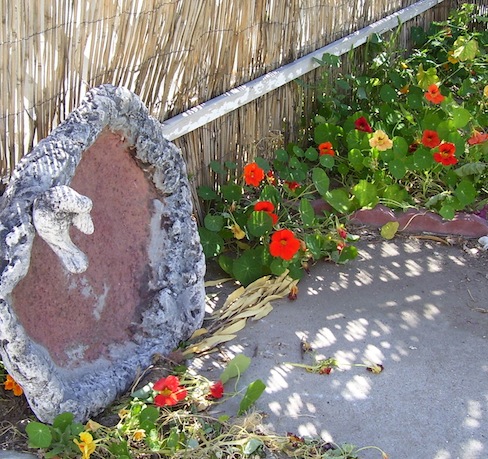
Birdbath props up the fence

When I walked over to check on the trailer, the fence there was listing but not down. I stacked more bricks against one side, wedged the bird bath against the other. Now it’s late at night, the wind still noisy behind our closed doors, but I don’t feel anxious. And there is another sweetness that came to me today. This afternoon, when I went to lock the trailer door, I turned back, compelled by a wash of feeling. “I’m looking forward to coming to live here,” I said to the empty rooms. I think it was the first time I felt it in my bones. I had a lopsided grin on my face when I turned to leave. There is life outside here, too. I passed the orange nasturtiums beside the propped up fence on my way out. I was still grinning when I headed home.
I Have a Dream (53)

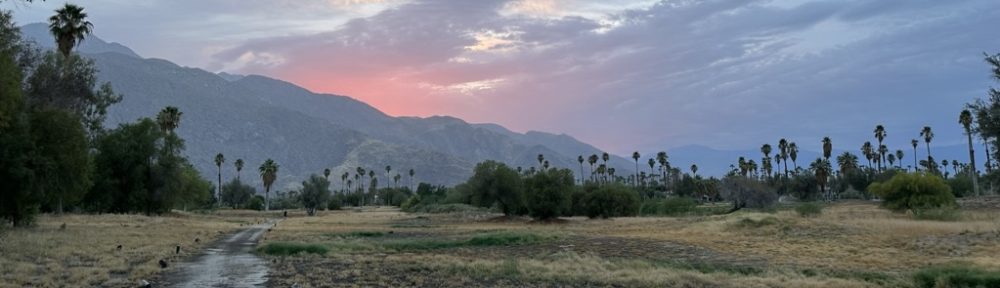
I spent Wednesday at a local resort, “day use” there my treat for spring break. I drank coffee and did my qi gong and my yoga on the cement beside the hot tub. It was warm from the sun, and I lay on my back and watched the fan palm leaves bend and bristle in the wind. I stood beside the wall of cloudy glass bricks, alone in my corner of that public world, and I kicked my legs forward and backward, punched the air before me, stood still at the end of the series, the dragon stands between the heavens and the earth. In between I floated in the hot water and let the tension leak out of my body and felt a dream emerge in me. The “Travel” section of the Sunday Times was about Mexico, and I read it greedily. It was focused on Mérida, a city in the Yucatán. Just like that, the desire to visit was alive in me. And somewhere in the midst of doing my qi gong in that hidden section of the resort, of floating in the hot water watching the San Jacinto mountains peeking out between the palm trees, of feeling the sun-warmed cement beneath my back, against my thighs while I twisted my spine and stretched my hips, a vision grew in me of a neighborhood in Mérida and a part I might play there one day. I dreamed a fountain and good food, a plaza garden, a co-op, a milpa, peace.

Lake Chapala Nibbles on Its Edges (48)

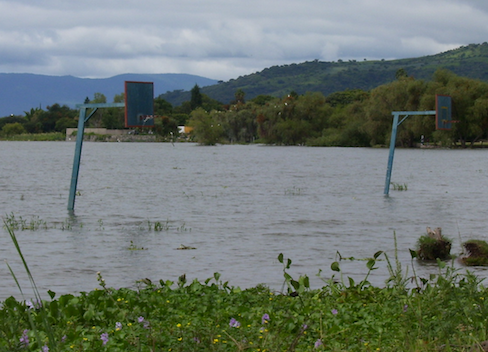
When I lived in Ajijic, the lake flooded. It wasn’t the worst the village had lived through. People told me years before Lake Chapala came two blocks into town. The year I was there, she only swallowed the shoreline. But I remember the eery feeling I had seeing everything submerged. I used to be able to walk straight down Aldama from my hillside home, then walk along a dirt path that hugged the southern edge of the village beside the lake. All of that was submerged, even the cobblestones of my street disappearing into the water. I stood there for a long time listening to the lapping of the small waves, felt my mind twisting with the reality before it. I walked across town, approached the lake from the west.

basketball court submerged in the lake

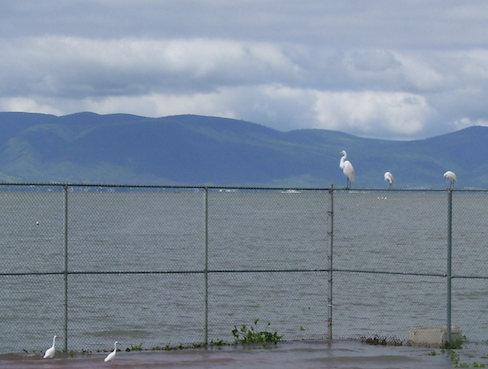
egrets on the tennis court fence

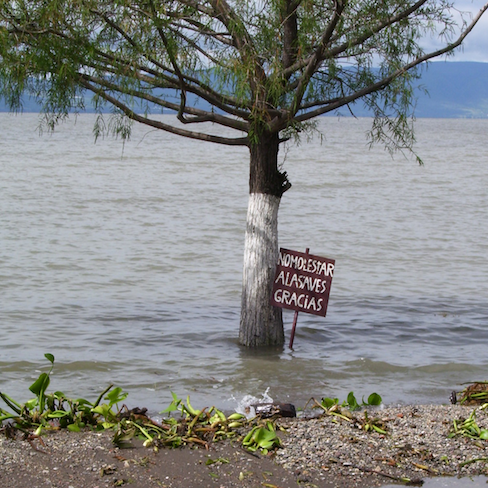
flooding_don't bother the birds sign

I marveled at the way the basketball courts had vanished, the hoops sitting out in the water. The lake edged the tennis courts at the fence line as if by design. I watched the egrets sitting on the chain link, their unexpected furniture. The little sign asking people not to bother the birds was still visible, the tree it was posted beside surrounded by lake. Two people passed me on horseback, the horses legs churning up the mud. I cringed at what their hooves might find, hoped they wouldn’t be injured. It all made me glad I lived on the hillside, as often as I might have looked at homes nearer the lake with a certain longing. On the hillside, the thunder gods sat on our red tile roofs and laughed. But when the rains came, the rivers of our streets ran away from us. I stood watching the horses heading east where I couldn’t follow. I choose thunder, I thought.

Closer to the Earth (44)

I’d pulled out the travel section of my L.A. Times a few weeks ago and set it aside unread. The cover story was about Mexico, about the northern village made famous for its pottery. Now the next generation are doing marvelous contemporary things with clay, and I’ve saved the photographs of big beautiful pots for my mother to see. There is one in particular I think she’ll enjoy that reminds me of some of her own large slab bowls. Nestled between the images of the pottery is a shot of one side of a village street, and I am transported. It could be any rural village in Mexico–the narrow, uneven sidewalk, the crumbling edges of things, the dirt road, the fading paint on the walls of the buildings. But what makes this so different from a dilapidated block in some U.S. town? Why does it awake a longing in me, a fondness, even, none of the aversion I might feel for the equivalent in this country? Is it the colors, the texture, the light? Is it the lack of despair in that Mexican air that weighs more lightly on the world? And why do I crave it?

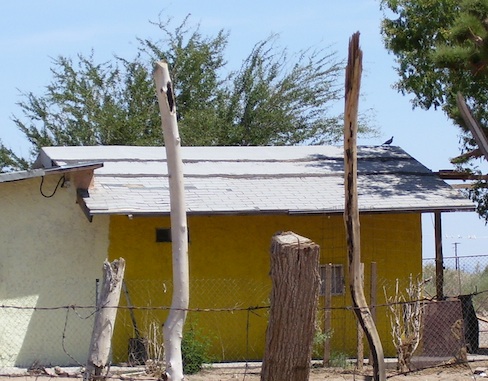
yellow house

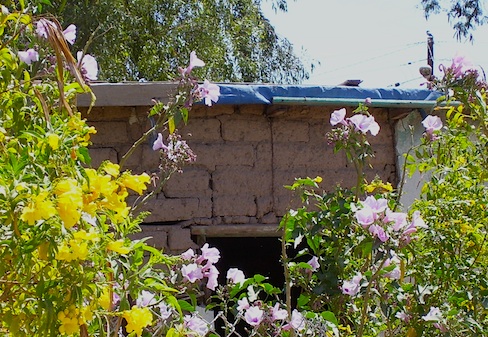
window and flowers

When I moved back to the States, I remember my shock at the clean, wide streets, the lavish landscaping. Now I teeter between pleasure in the places where this wealth allows for a clean beauty, the brick and the desert plants and vivid blooms a masterpiece, often echoing our Spanish roots here in the Coachella Valley, and my dismay and disconnection from the places where the clean wealth falls short of this art and only looks garish and sterile, even obscene. But when I see this photograph of the village street in the newspaper, I ache to be there, walking along the banqueta, the sidewalk, my sandals dusty, my skin drinking in that other sunlight, the colors and the textures akin to the earth, to life, to participating in the world in a different way. I can’t quite grasp the words to explain it even to myself. It is a knowledge and a memory of the body, I think, and the spirit, not the mind.

I can feel myself nodding to two women I pass on the street. “Buenas tardes,” I say.

They take me in with their eyes, nod, smile. “Tardes,” they say.

I Am the Invader (43)

Once I walked from Ajijic to Chapala and back. I don’t remember how many hours I spent doing it, but I remember being present for big chunks of time, taking it all in with new and thirsty eyes. I avoided the highway for all but a two or three block stretch in a couple of spots where it was the only choice. I walked through cobblestone streets in the villages, past horses and cows and goats on the dirt roads on the outskirts. More than once I sensed I was walking where gringos didn’t show up very often, and probably not on foot, a woman alone. I didn’t feel afraid, only conspicuous from time to time.

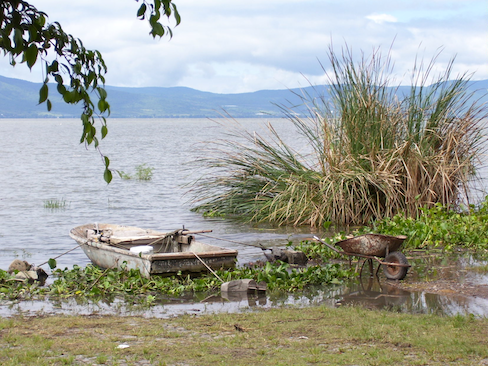
Shore of lake, old rowboat and wheelbarrow

I hugged the lakeside when I could. I passed old brick buildings, glassless windows, the courtyards swept clean, women doing laundry outside by hand, the cluck of chickens behind low brick walls with bougainvillea spilling over them. Once I stopped for a long time watching a heron standing still in the shallows near the shore, and I felt the richness of the life there, the birds, the water, the place where fertile earth and decay overlap, reminiscent of my visit to the deep south here, maybe Biloxi. I marveled at the idea of owning land beside this lake, how much that would mean to me, but wondering if it could feel like that same opulence to the locals in their poverty. East of San Antonio Tlayacapan there was a stretch where the road became more of a walking path than a road, dotted with shacks, more plywood lean-tos than dwellings. I passed a man and two children. They were sitting at the edge of the road, a piece of plywood for a table, a bag of bread between them, the makings of sandwiches. I remember the surprise on their faces when I appeared. I felt like I’d just walked uninvited through their living room. I can still see the man’s face. He is chewing, and he nods to me in response to my greeting. But his eyes are wary, resentful. I am the invader.

My Respect for Pigeons (34)

I’ve never been fond of pigeons. Even now, I admit I still tend to dismiss them, am less pleased to see a group of them on a telephone wire than a gathering of mourning doves, some strange bird snobbery at work in me. But now I remind myself of what I came to know of them in Mexico. When I lived in La Casa Azul, in the blue house in Todos Santos, I came to respect pigeons. They lived next door to me, in the eves of the artist’s studio, the man I rented my house from there. I always wondered if he initiated their residency, started the colony there on some whim, some fancy about the romance and quirkiness the studio should reflect, not realizing how it might grow. I never asked.

But I would sit perched on my tall wrought iron chair in my semi-third-floor roost and watch the pigeons fly together. I’d always loved the sounds they made nestled in the eves, the muted rounded coos, bird pillow talk. But I never really watched them fly before. I remember the first time I saw them take off for their morning flight, making big loops across the sky, flapping and gliding in tandem. I was struck by the vigor of their bird bodies, by their prowess in formation despite the quickness of their flight. They would launch into the air together every morning for the first looping flight, a burst of celebration for the day to come. In the late afternoon, they took flight again before dusk, a happy sky dance, a few last circles of gratitude and play before bed. And I would sit in my own roost, feet propped on the rebar railing before me, and marvel at the ease of their antics. Each time they took to the sky, I fluttered with awe.

Traveling (33)

Traveling is an odd thing. I bring myself with me wherever I go, but I don’t always feel like myself. I am still tethered to my home, feel its tug. I am tied to who I’ve left behind there. My cats occupy my space, glaring in their absence, a small prickle or a larger ache. Even when I go where I am known, even loved, I carry their absence, feel the tug of my tether. I am missing bits of my self, the one I have grown comfortable with over time, quiet mornings on the patio, the solar Christmas lights a happy glow on the hedge when I walk home in the new dark after dusk.

The birds here are not my birds. But when I reach in, find my way to fullness on the deck of this other home, their unfamiliar calls comfort me, companions in the quiet autumn morning. They tie me to my world, tingle my self, charm me silly. I feel the sun on my forehead, my ankles, my cheek wet from dog kisses. The house is waking up around me, and my eyes fill with warm tears, my breath deep and grateful in my lungs.