Things (8)

I don’t have many physical objects to stand for the time I lived in Mexico. I think if my departure had been less quick, maybe I’d have made a point to come back with more things, mementos of my time there. But I had a “knowing” I needed to return to the States, and I left four days later. So I never bought one of those bright-colored baskets the man I liked would carry around Ajijic. I’d had my eye on the big clothes hamper. And I came back with only the one small skeleton, not the collection of dia de los muertos figures I’d imagined. I wanted to buy blankets and rugs, the texture and color that calls me to that country. But I came back without them.

So instead it was the incidental things that returned with us, Lolita Roja packed to her gills with our ordinary possessions. I used the rest of the cinnamon I’d bought in Ajijic in the first few months of our return to the States, and when it was empty, I kept the narrow plastic spice jar for a long time, reluctant to recycle it, its bright orange lid and its Mexican label a strange keepsake. My fondness for the little canela container went beyond the norm. It had lived with us there. And I stretched my aspirin for years, doling out each aspirina tablet like treasure. I loved the Mexican aspirin. I meant to buy more the day I spent in Algodones, but I forgot. They come in small rectangular sheets. You poke them out of their little plastic resting places through the foil backing. You only had to take one. (I did the milligram math when I first moved to Baja California Sur.) They were so handy for slipping into a small zipper pocket. And you could just buy one sheet if you wanted to: eight aspirin. It’s one of the things I love about Mexico–you aren’t penalized if you only have enough money to buy a small amount. The culture isn’t like ours. It’s not all about the more you can afford to buy the less you have to pay for it.
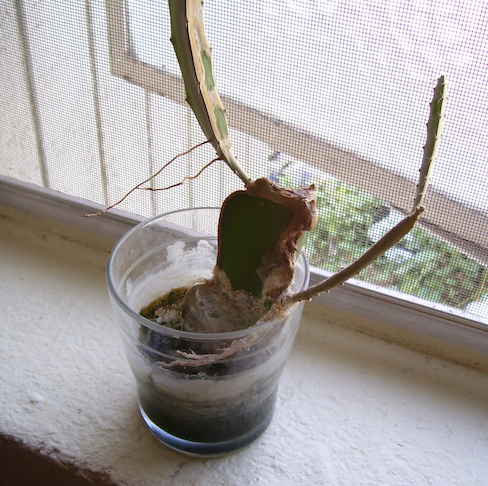
cactus start in waterglass on windowsill

I brought back dried marigold blossoms from the Aldama planters. They have thrived here in my desert garden, my “Mexican marigolds” I wrote about in last year’s blog. They are one of the dearest things I have to remember Mexico by. And on my bathroom windowsill I have another, this little cactus I found in Ajijic. It’s still in the small calcified water glass I placed it in when I first got back to the Aldama apartment with it. When I crossed the border, it was hiding in the trunk. I didn’t know what the rules were, and I wasn’t willing to risk losing this small living evidence of the world I’d left behind. I’ve thought I should plant it in my garden, that it would be happy here. But I haven’t been able to bring myself to do it, our time here uncertain, and I’m still not willing to risk parting with it.

I remember how excited I was the first time it sent out a tiny new shoot. And I remember when I found it, lying in the dirt below its parent plant on the side of the road just west of Ajijic. I’d headed past the cemetery, walked until the road ran to dirt, kept going, all unplanned. I came to big fields with running horses, half-finished dwellings made of red brick. The sounds of the cars on the carretera were faint as I walked, and now and then I caught a glimpse of the lake two blocks south of me. In time I came upon the giant parent cactus, ten feet tall, sprawled behind a brick wall. I stopped on the road to study it. There was a tree in bloom beside it, big puffy cotton-like blossoms. I wanted to come back with my camera. I stood in the road for a long time taking it all in. I felt something ease in me. I hadn’t known how much I needed to get away, how much I’d craved open space, earth beneath my feet, solitude. I soaked up rural Mexico, released breath I didn’t know I was holding, gave thanks. And when I was ready to walk on, I found this little piece of cactus lying in the dirt beside the wall, and I carried it home with care.
Grackles Bring Me Home (4)

My cats and I and Lolita Roja, trusty red Jetta, loyal companion, were heading south on the highway that runs along the western coast of mainland Mexico, sporadic snatches of blue off to our right, the Sea of Cortez. We’d arrived the night before on the ferry from La Paz in Baja California Sur. As the light grew, I remember feeling like I had returned to civilization after nine months in uncharted desert wilderness. I drove through the first highway toll booth and stopped just on the other side to buy ice from the small tienda there. I remember it as though we’d moved from black and white to technicolor, my first sensory experience of the mainland, Dorothy and Toto in that first glimpse of Munchkinland. I remember colors, painted concrete, a kind of careful tendedness, and a sea of bird sounds. Rows of trees–cypresses, I think–lined both sides of the road, filled with big black birds greeting the day. It was madness. They were all talking at once, wild, animated, exotic. I didn’t know then they were grackles, but I was awed by them, and I remember a deep sense of having stepped into another world, not in Kansas anymore. I loved those noisy birds, trees that talked, alive with loud, squawking black fruit.

I left those sheer numbers behind a few days later in San Blas, for the most part, though we had our share of grackles along Lake Chapala, too. I’ve met them three times here since I’ve been back in the States–once when I was trespassing on a golf course in south Palm Springs, once in 29 Palms and once at dusk in the big trees in the parking lot of my neighborhood Ralph’s. But always only a handful, and mostly they’ve been absent. I’ve missed them. They were comforting, somehow, a familiar thread of sound embedded in my life in Jalisco. Last week I walked through Algodones in the state of Baja California. I wanted to find the Colorado River there. I walked alone on dirt roads, wary at first, the U.S.-trained fear of Mexico having seeped into me in recent years without my knowing. I shrugged it off, began to relish my return to this foreign land I’ve come to love. I passed homes part ruins and part unfinished construction, fresh laundry flapping in las brisas, dogs and children watching me from the fronts of houses, bougainvillea and cactus tended along the fence lines. The colors and textures, the richness that is Mexico saturated my starved estadounidense self. Just before the river, I came to a grove of trees alive in grackles. I stopped in the middle of the road and listened to their wild vocalizations, a mad delight rising in my belly, my chest. I felt like I was coming home.

Agradecimiento (2)

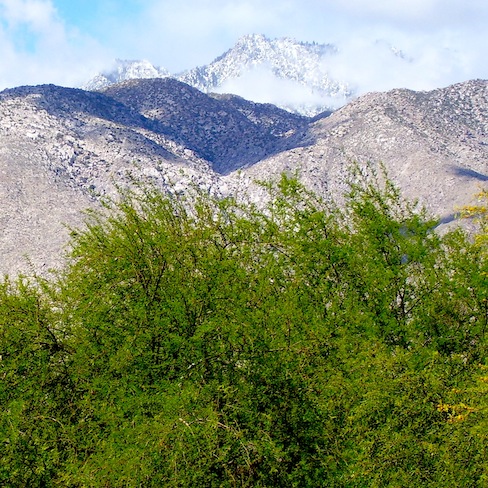
“I always like to end our practice by embracing our gratitude,” Janet says. We are seated on our yoga mats, hands pressed together before our hearts, elbows out. We are in the park on a Saturday morning in April, ringed by a circle of desert acacia. Big tufts of yellow lie spent in the grass around us, and the San Jacintos tower in the west, close enough to touch.

desert acacia with San Jacinto mountains behind them

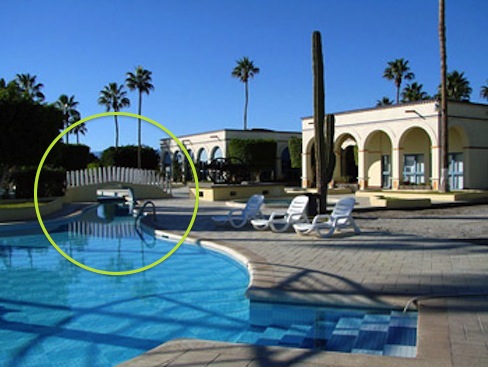
Gratitude, I think. Agradecimiento. I am crouched in shallow water in the motel pool, just below a tiny bridge seeking shade. I am grateful I am not driving, my two miserable cats unwilling passengers, my heart in my throat every time we pass an oncoming semi, no shoulders on the mountain highway, a mere six inches of margin, no room for error. I breathe for the first time in three days. The July air in Loreto is muggy and hot, the water warm but wet, life-giving. I am crouched beside a Mexican woman in her early forties. I talk to her in my excruciating Spanish, and she is patient, kind. “Mi corazon es muy lleno,” I say. My heart is very full. I feel connected to her, fellow travelers escaping the sun in Baja California Sur, scrunched together in the same small patch of shade. Her son is playing nearby. “Tengo muchas gracias para todos,” I say. I have much thank you in order for everything. She smiles, nods, doesn’t laugh at me.

picture of the Loreto motel pool, the little bridge circled

“Agradecimiento,” she says, teaching me the word for gratitude, from the verb agradecer, to thank or to be grateful for. She tells me more, examples of how to use various forms of the word in sentences, but this is what I walk away with. I try it out, happy to have been fed a word that holds so much meaning for me, happy to be having my first Mexican conversation that has depth, speaking in Spanish.

“Tengo mucho agradecimiento,” I say. I have much gratitude. I grin at her, a big, proud, childlike grin, and she grins back.

“Take a moment to be thankful for the people around you,” Janet says, “for sharing this practice today.” The sound of the woman’s son splashing in the warm water under that little bridge recedes. I hear a plane flying south, a car driving past on Miraleste. A raven caws from the north, and a mockingbird begins to sing from his perch in one of the acacias. My heart is full, lleno, quiet. We all bow forward, hands to our hearts. “Namaste.”

[Editor’s note: This second photo that shows the little bridge we were under is not mine. It is a promotional photo from the motel, La Pinta Desert Inn Hotel in Loreto, Baja California Sur, Mexico.]

I Begin (1)

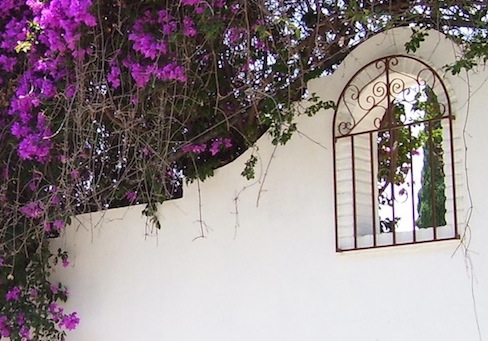
Dusk nears on the second day of my spring holiday, my first in ten years of teaching. I sit on the patio and move my pen across the page of my notebook to begin my first post for this new year of mine, 54 at 54–All Things Mexico. The task I have set for myself terrifies me, but I push the pen across the page anyway. My mind has been wandering paths as steep and twisting as the narrow callejones of Guanajuato, playing out possible topics for my blog, trying them out in my head. Why didn’t I document my time there, take vivid notes, photograph everything I loved? My fear about the course I have set for myself here makes the question come out harsh, anguished. Why didn’t I take pictures of the horses on the cobblestone streets in Ajijic? I would run to the balcony when I heard one passing by below. Why didn’t I record the sound their hooves made dancing on stone? I don’t have any pictures of the Wednesday market or the cemetery or the grackles roosting in the trees at twilight in the plaza. Why, I wonder, didn’t I photograph every doorway, every windowsill, every wall spilling bougainvillea on the street? Why didn’t I photograph every face I came to love, and all the textures and colors that layered themselves inside me, that have me missing Mexico like a river running through my California days?

white wall with window and bougainvillea

Why didn’t I take more photographs, learn more words, record the stories and the history and the rumors that came my way? Is it because I was not yet a writer in the same way I am today? In part, I know that’s true. And I didn’t know one day I’d want to write a blog about this big love of mine. I was busy taking it all in, absorbing the way it felt inside me, this foreign country where I found such sweetness, such welcome, yet where I was still so much “the other,” my white americana self a sore thumb, standing out amidst the dark hair, the dark skin of the other people in the villages. I think in my usual way I paid more attention to emotions and interactions, to the nuances of finding my way in a culture so different from the one I grew up in. I didn’t document the details, not outer or inner, only let them pile up inside me. Now I am afraid I have set myself an impossible task, but it’s one I want very much to meet. And so, as the light wanes on my California evening, I take a deep breath and reach for trust. I will find ways to write about what I love. I have already begun. A bird I don’t know in the pine tree repeats one long sliding note. I take another breath, the pen loose now between my fingers, and I know dusk settles in Mexico in just this way.