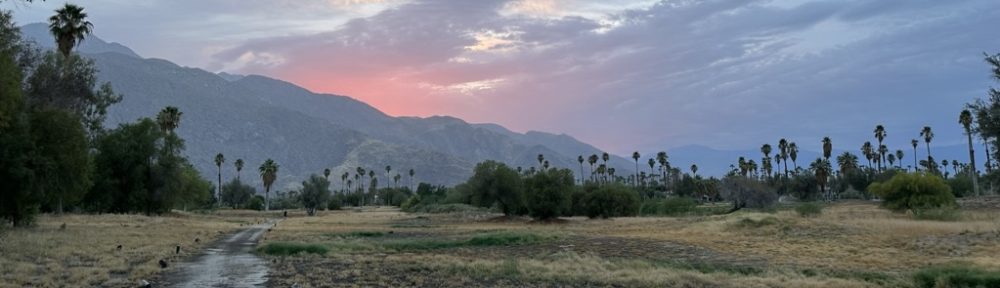
I spent Wednesday at a local resort, “day use” there my treat for spring break. I drank coffee and did my qi gong and my yoga on the cement beside the hot tub. It was warm from the sun, and I lay on my back and watched the fan palm leaves bend and bristle in the wind. I stood beside the wall of cloudy glass bricks, alone in my corner of that public world, and I kicked my legs forward and backward, punched the air before me, stood still at the end of the series, the dragon stands between the heavens and the earth. In between I floated in the hot water and let the tension leak out of my body and felt a dream emerge in me. The “Travel” section of the Sunday Times was about Mexico, and I read it greedily. It was focused on Mérida, a city in the Yucatán. Just like that, the desire to visit was alive in me. And somewhere in the midst of doing my qi gong in that hidden section of the resort, of floating in the hot water watching the San Jacinto mountains peeking out between the palm trees, of feeling the sun-warmed cement beneath my back, against my thighs while I twisted my spine and stretched my hips, a vision grew in me of a neighborhood in Mérida and a part I might play there one day. I dreamed a fountain and good food, a plaza garden, a co-op, a milpa, peace.
Category Archives: Reflections
Fast Food (51)
When I lived in Todos Santos, I would ride the bus to Cabo San Lucas to pick up the mail sent to me from my box in northern California. I would go to the Burger King there, indulge in a Whopper that tasted remarkably like the ones here in the States. (When I was an adolescent, I remember my disappointment when my girlfriend and I found a McDonald’s in Germany but the hamburger there still tasted like a foreign country.) In Cabo San Lucas, hamburger in hand, I’d walk along the harbor, or sit perched on the steps overlooking it, and savor the familiar taste as I chewed. After, I’d go to the Häagen-Dazs store and eat ice cream. Before Cabo San Lucas, I never even knew they had Häagen-Dazs stores. I haven’t seen once since. But the best fast food I had in Mexico was the morning after the cats and I had crossed over to the mainland on the ferry from La Paz. We were stopped in line before a toll booth, and a man came up to my window. He had a small blue and white cooler with him. I don’t remember what he called his wares, but I bought one. The plastic bag was warm, and that surprised me. He was using the cooler to hold in the heat. I paid him, then caught up with the toll booth line, and headed south along the toll road. I remember there were big black birds in the trees lining the highway, their calls an exotic din. I unwrapped the plastic bag, warm skinny rolled tortillas, like taquitos only not fried. They were filled with potatoes and a glimmer of meat, and I remember how tasty they were, how good the freshness and the warmth felt in my mouth. I remember marveling to think that kind of homemade breakfast would find me on the highway like that. I can still see the diffident way the man walked toward my car, the blue and white cooler in his hand. And I can still feel the soft warmth of the tortillas against my fingers while I ate and drove, the air alive in grackles.
Taking It to the Street (50)
Last Saturday I spent the day selling books and bowls and all sorts of other things at my sidewalk sale. I called it that in the craigslist post because I liked the sound of it. We don’t have a sidewalk along this property, but I spread blankets and sheets over the gravel where the sidewalk would be if we had one, and I lined up my boxes of books, my Tupperware, my clothes. I swept the street the night before, and after my 11-hour stint that Saturday, I swept it again, feeling small chills as I moved the broom across the asphalt, the precursors of heat stroke, I imagined. So yesterday when the neighbor’s gardener blew a bunch of debris into the gutter in front of my home, I was already in that mode. I headed out with my broom again. I swept the blacktop and remembered how in Todos Santos, people would rake the dirt road in front of their property. They carved neat tracks in the sandy dirt, and in the dry seasons they would hose it down, the water poking holes in the tidy grooves the rake had made. Downtown, where the roads are paved, shopkeepers would wash the sidewalks in front of their stores with soapy water. I remember being surprised, at first, and yet it seemed so natural, so right. Of course, I thought. Claro que sí. Of course we should each tend our own little section of the street.
Lake Chapala Nibbles on Its Edges (48)
When I lived in Ajijic, the lake flooded. It wasn’t the worst the village had lived through. People told me years before Lake Chapala came two blocks into town. The year I was there, she only swallowed the shoreline. But I remember the eery feeling I had seeing everything submerged. I used to be able to walk straight down Aldama from my hillside home, then walk along a dirt path that hugged the southern edge of the village beside the lake. All of that was submerged, even the cobblestones of my street disappearing into the water. I stood there for a long time listening to the lapping of the small waves, felt my mind twisting with the reality before it. I walked across town, approached the lake from the west.
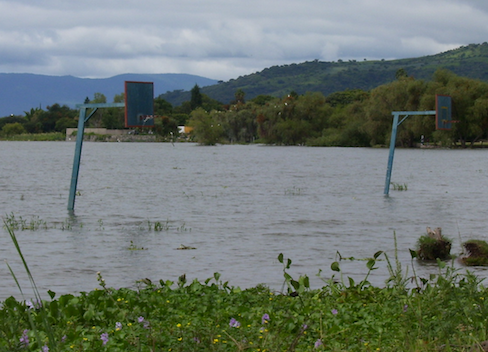
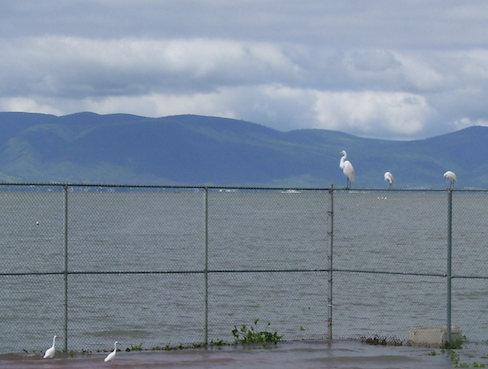
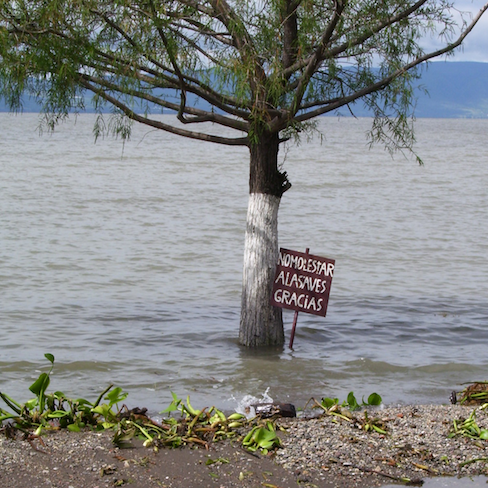
I marveled at the way the basketball courts had vanished, the hoops sitting out in the water. The lake edged the tennis courts at the fence line as if by design. I watched the egrets sitting on the chain link, their unexpected furniture. The little sign asking people not to bother the birds was still visible, the tree it was posted beside surrounded by lake. Two people passed me on horseback, the horses legs churning up the mud. I cringed at what their hooves might find, hoped they wouldn’t be injured. It all made me glad I lived on the hillside, as often as I might have looked at homes nearer the lake with a certain longing. On the hillside, the thunder gods sat on our red tile roofs and laughed. But when the rains came, the rivers of our streets ran away from us. I stood watching the horses heading east where I couldn’t follow. I choose thunder, I thought.
Hope (47)
I was encouraged to read two recent arrests stirred protests over Arizona’s immigration law, glad to know there are civil rights organizations like Corazón de Tucson to rally outside the police department, activists like Alcaraz Ochoa willing to crawl under a Border Patrol vehicle to block them from driving away when the answers they gave him about why they were arresting Rene Meza didn’t satisfy him. It makes me remember I can’t blame all Arizonans for their racist legislation. It reminds me there are people there who didn’t want these laws in place, people who must be as appalled and embarrassed now as I was when our country elected Bush. It makes me remember to have hope.
Anti Arizona (45)
We were having breakfast together at my favorite place, Palm Greens Cafe, where once when they brought my food I commented about what a glutton I was being, and the kitchen staff serving me smiled an impish smile and said, “Yes, but a gluten-free glutton!” If I hadn’t already been charmed by the place, that alone would have won me over, stolen my word-loving heart. But when Corina told me she was considering Arizona for the next stage of her young wandering life, I think I went into some weird autopilot. I don’t remember half of what I said, only my gluten-free vegan pancakes with blueberries sitting untouched before me during my diatribe and the surprised looks on her parents’ faces across the table. I know I told them I didn’t want to spend one cent in Arizona because of their racist legislation and their lies. (I read one of the reasons they claimed to have crafted the anti-Mexican, anti-immigrant laws was because of increased violence along their southern border. But in truth, violent crime has gone down there in recent years.) I know I told them if I needed to go to New Mexico or Colorado from some reason, I would fill up the gas tank in Blythe and drive straight through their pretty desert state. I know my voice and my words were harsh, maybe shockingly so. I called Corina later to apologize for my vehemence. “I know it’s beautiful,” I said. “I can understand you wanting to go there.” But I’m still praying she’ll pick another spot.
Closer to the Earth (44)
I’d pulled out the travel section of my L.A. Times a few weeks ago and set it aside unread. The cover story was about Mexico, about the northern village made famous for its pottery. Now the next generation are doing marvelous contemporary things with clay, and I’ve saved the photographs of big beautiful pots for my mother to see. There is one in particular I think she’ll enjoy that reminds me of some of her own large slab bowls. Nestled between the images of the pottery is a shot of one side of a village street, and I am transported. It could be any rural village in Mexico–the narrow, uneven sidewalk, the crumbling edges of things, the dirt road, the fading paint on the walls of the buildings. But what makes this so different from a dilapidated block in some U.S. town? Why does it awake a longing in me, a fondness, even, none of the aversion I might feel for the equivalent in this country? Is it the colors, the texture, the light? Is it the lack of despair in that Mexican air that weighs more lightly on the world? And why do I crave it?
When I moved back to the States, I remember my shock at the clean, wide streets, the lavish landscaping. Now I teeter between pleasure in the places where this wealth allows for a clean beauty, the brick and the desert plants and vivid blooms a masterpiece, often echoing our Spanish roots here in the Coachella Valley, and my dismay and disconnection from the places where the clean wealth falls short of this art and only looks garish and sterile, even obscene. But when I see this photograph of the village street in the newspaper, I ache to be there, walking along the banqueta, the sidewalk, my sandals dusty, my skin drinking in that other sunlight, the colors and the textures akin to the earth, to life, to participating in the world in a different way. I can’t quite grasp the words to explain it even to myself. It is a knowledge and a memory of the body, I think, and the spirit, not the mind.
I can feel myself nodding to two women I pass on the street. “Buenas tardes,” I say.
They take me in with their eyes, nod, smile. “Tardes,” they say.