The Lone Egret (34)

My shoulders jump, and I bring my bike to a stop. I’d surprised an egret when I came around the bend on the path, his big wings ready to launch himself at the whoosh of my sudden presence. His flurry of flapping startled me in return. Now he is standing off a bit on the golf course looking back at me. “I’m so sorry,” I say. “You scared me, too.” I laugh. “I had no idea you were there.” He stretches his neck, listening, watching me. “I’m coming back in a few minutes,” I warn him. “I’ll be more careful,” I say, and I push myself off again. I have decided to be “smart” on a busy day, taking my bike on the path instead of walking so I can go to Ralph’s on the way home, buy bird seed and cat litter. But maybe in my rush of doing I wasn’t paying enough attention. It feels good to be out, my wild wispy orange scarf keeping my neck warm as I ride. I pass a man with a grumpy face walking his dog. When I turn around and ride past him again I smile, and he almost smiles back. I slow down when I get back to Egret Bend, and I am surprised and glad to see him standing there, his tall, slim form still brilliant in the late dusk. I stop again, and we watch each other a bit more. I don’t know what I say, small endearments, high praise. He stretches his neck and moves his head as though he is following the arc of my words. “Safe night,” I wish him as I begin to ride away. “Sweet dreams.” I look for him and see him again each evening for a week, his stark, graceful form pure white and meandering in the distance. He is always alone.

An Earthling Beholds (21)

Tuesday before the little wooden bridge I glanced back over my shoulder as I walked and saw a big bird flying in my direction from the southwest. I stopped to gawk, and the dark, animated silhouette became an egret. She was flying too high for me to hear the sound of her passing, but I stood and watched the long, silent strokes of her wings until she disappeared. She was still in my head moments later when I rounded a curve and came upon the moon, almost full, peering through the lacy winter branches of the old palo verde beside the path. And so, in the way of things, the two images were linked inside me: the slender, graceful bird, the large, round moon near the horizon, their white shapes both luminous in the late dusk. Words can’t do them justice, I know. But maybe that doesn’t matter. Because the overlapping moments live in me now, their wonder, my awe, clay feet planted on the earth, all of a piece in our fragile, fleeting world. If I might be so blessed, may they live in me all the rest of my days.

Wedded by the Rain (16)

The first time it rained last summer made our trailer home in some subtle, indescribable way. I lay in bed in the early morning listening to the rain falling on the metal roof. I reveled in the sound and the smell of it, fresh dirt and wet pavement coming through the open louvered windows. It’s been one of my secret hopes that global warming will mean Palm Springs gets to have monsoon season like Arizona and parts of Mexico. Lying there in bed, listening and breathing, something loosened in me. The rain outside our metal shell made us one, somehow, the rain falling on us together. Later I went for a walk with my lime green umbrella. I stood for a long time beneath a big tree at the school listening to raindrops falling on the leaves. The rain woke me up, had me walking through the rock labyrinth on the way home, each step on the wet dirt slow and deliberate, my lungs outside my body, the wet air breathing me.

The Woman and the Dog (52)

I remember walking from La Casa Azul to downtown Todos Santos. It was late afternoon. I don’t remember where I was going, maybe to meet my Spanish teacher Guillermo at the cafe. I was taking the side streets north of the highway. I passed a woman washing clothes in her yard, another taking stark white dress shirts down off a clothesline. A man in a hat was hosing down the dirt road in front of his house when I passed. He smiled and nodded. “Buenas tardes,” I said. I passed a house with a garden in the front, vines climbing the wire fence, purple blooms. A woman was scraping food from a pot into a white enamel bowl on the ground, her brown dog dancing at her feet. “Oh,” I said. I was grinning. “She’s so excited about it.” Ella está muy emocionada sobre su comida. I remember the woman’s laugh, how it opened up her face. I remember the sweetness inside that moment together, of being part of her love for her dog.

Closer to the Earth (44)

I’d pulled out the travel section of my L.A. Times a few weeks ago and set it aside unread. The cover story was about Mexico, about the northern village made famous for its pottery. Now the next generation are doing marvelous contemporary things with clay, and I’ve saved the photographs of big beautiful pots for my mother to see. There is one in particular I think she’ll enjoy that reminds me of some of her own large slab bowls. Nestled between the images of the pottery is a shot of one side of a village street, and I am transported. It could be any rural village in Mexico–the narrow, uneven sidewalk, the crumbling edges of things, the dirt road, the fading paint on the walls of the buildings. But what makes this so different from a dilapidated block in some U.S. town? Why does it awake a longing in me, a fondness, even, none of the aversion I might feel for the equivalent in this country? Is it the colors, the texture, the light? Is it the lack of despair in that Mexican air that weighs more lightly on the world? And why do I crave it?

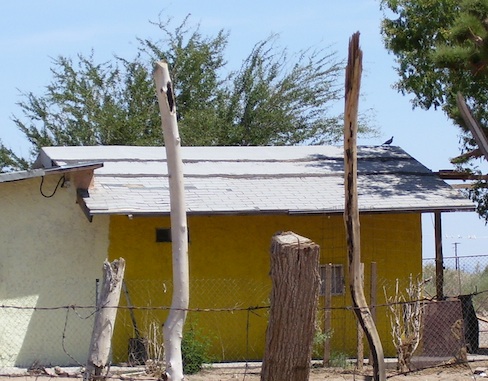
yellow house

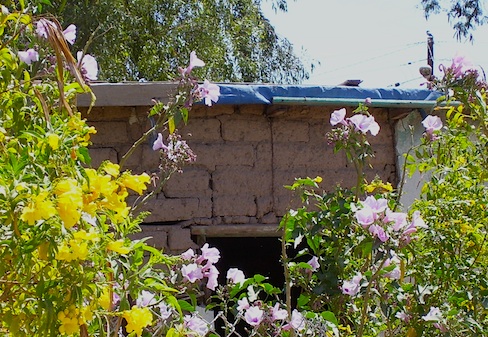
window and flowers

When I moved back to the States, I remember my shock at the clean, wide streets, the lavish landscaping. Now I teeter between pleasure in the places where this wealth allows for a clean beauty, the brick and the desert plants and vivid blooms a masterpiece, often echoing our Spanish roots here in the Coachella Valley, and my dismay and disconnection from the places where the clean wealth falls short of this art and only looks garish and sterile, even obscene. But when I see this photograph of the village street in the newspaper, I ache to be there, walking along the banqueta, the sidewalk, my sandals dusty, my skin drinking in that other sunlight, the colors and the textures akin to the earth, to life, to participating in the world in a different way. I can’t quite grasp the words to explain it even to myself. It is a knowledge and a memory of the body, I think, and the spirit, not the mind.

I can feel myself nodding to two women I pass on the street. “Buenas tardes,” I say.

They take me in with their eyes, nod, smile. “Tardes,” they say.

I Am the Invader (43)

Once I walked from Ajijic to Chapala and back. I don’t remember how many hours I spent doing it, but I remember being present for big chunks of time, taking it all in with new and thirsty eyes. I avoided the highway for all but a two or three block stretch in a couple of spots where it was the only choice. I walked through cobblestone streets in the villages, past horses and cows and goats on the dirt roads on the outskirts. More than once I sensed I was walking where gringos didn’t show up very often, and probably not on foot, a woman alone. I didn’t feel afraid, only conspicuous from time to time.

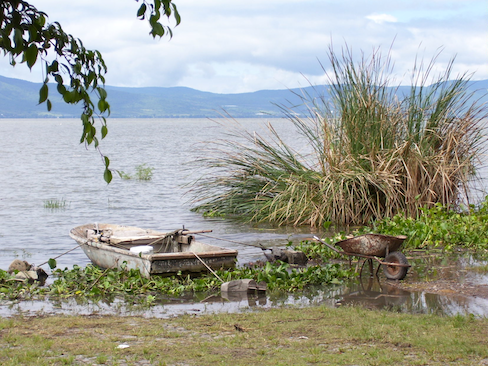
Shore of lake, old rowboat and wheelbarrow

I hugged the lakeside when I could. I passed old brick buildings, glassless windows, the courtyards swept clean, women doing laundry outside by hand, the cluck of chickens behind low brick walls with bougainvillea spilling over them. Once I stopped for a long time watching a heron standing still in the shallows near the shore, and I felt the richness of the life there, the birds, the water, the place where fertile earth and decay overlap, reminiscent of my visit to the deep south here, maybe Biloxi. I marveled at the idea of owning land beside this lake, how much that would mean to me, but wondering if it could feel like that same opulence to the locals in their poverty. East of San Antonio Tlayacapan there was a stretch where the road became more of a walking path than a road, dotted with shacks, more plywood lean-tos than dwellings. I passed a man and two children. They were sitting at the edge of the road, a piece of plywood for a table, a bag of bread between them, the makings of sandwiches. I remember the surprise on their faces when I appeared. I felt like I’d just walked uninvited through their living room. I can still see the man’s face. He is chewing, and he nods to me in response to my greeting. But his eyes are wary, resentful. I am the invader.

Crossing (30)

I am fascinated by the boundaries between us. Borders between countries, lines drawn on rock, boundaries between people, between cultures–arbitrary or innate, they separate us, define us. But boundaries aren’t just barriers. They provide the arena for moving back and forth between the two. They offer the possibility of exchange. I can ride the charter bus from the Coachella Valley to Algodónes. I can walk across the border and be in Mexico. One line, drawn no doubt by nations after war, shouldn’t be able to make so much difference. I’ve studied the border from the bus, the way the fence runs through the desert, a jagged monster, the sprawling remains of extraterrestrials. I can find no clues, no evidence that one side of the fence should be so different from the other.

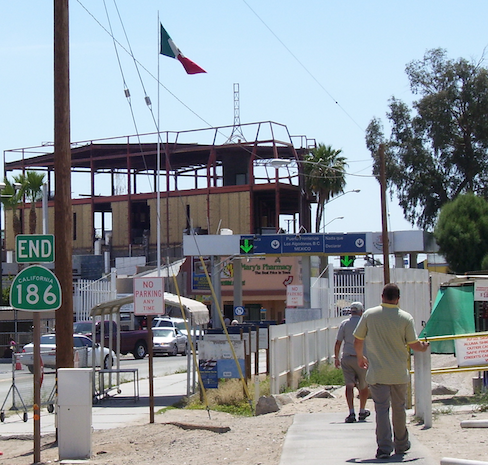
shot of the border looking toward Mexico from the U.S.

But walk a few yards toward el otro lado, the other side, and you can feel the change. It is of the body, I believe, and not the mind, yet I return to it again and again and again, wanting to make sense of it, trying to figure it out. When I walk across, my body knows I’m in a foreign country. Because I lived there once, it feels like coming home, but this is a comfort of the heart, I think, the soul, and not the body. The body knows this is not the land where it was raised. It’s not geography. My scrutiny of the fence line across the desert between us revealed nothing, only made me marvel, knowing just across it lives another world, a stone’s throw only, two crows flying. The land doesn’t change at the border, but we breathe different air. Spanish diphthongs and mariachi and sidewalks all sing Mexico. Grackles call out in their native tongue. Our bodies know.