Conversations (30)

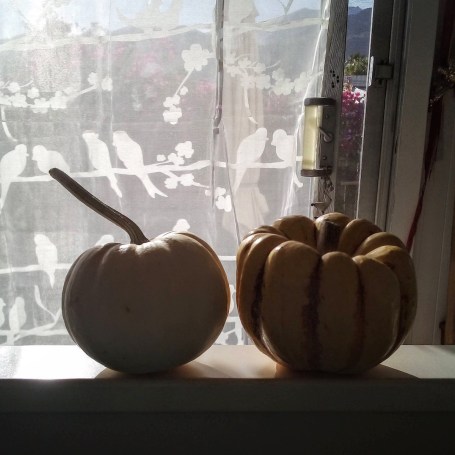
two squash in sunlight

I wake up weird. A deep sadness I can’t touch with my finger, my fist. Did I dream? I remember Iola. I didn’t know she was dying, but I was sad all morning the day she died, this same inexplicable sadness. I ride my bike to get my hair cut. There’s another woman there waiting. We talk about el día de los muertos. I describe a piece I read once, this endearing dialog. Two spirits, excited, visiting the day of the dead altar their family created. Oh, look, she remembered the pozole. And, I wonder where Isabel is? She always makes the best calaveras. We marvel over the sense of affection, how dear it is to celebrate our loved ones who’ve died, this connection between the worlds. I wave at the woman on my way out, wild hands, happy like a kid. I am buoyed, so sure we’ve both liked each other so much. I ride home, work, do laundry, cook broccoli. I am still sad, tender, wobbly. While I eat, a hummingbird flies in. He whirs back and forth across the length of the room four times. For a moment I worry he’s lost track of how to leave, but then he flies straight out the opened louvers, and I know he must only have wanted to make sure I was paying attention. I wake up in the act of loving him, and I decide he’s telling me to care about others. So I put my bowl down to go check on my neighbor, find out what the doctor said about his one eye that isn’t doing well after cataract surgery. Later, my heart savors the two small, pale squash sitting in sunlight on the arm of the couch. I take a picture with my phone. The sun sinks behind the mountains. I read Lab Girl, do more work. The vulnerability is still with me. I watch a house finch crack open sunflower seeds on the wooden fence. I breathe in the scent of tecoma blossoms. Sadness is still here, but so is stillness. So is peace.

Changed (29)

I wake to cat screams in the courtyard. I clap and yell, still half asleep, kneejerk. The cat fight stops, low growls outside my sliding glass door. I go outside to break them up, a huge gray cat I don’t know, long hair all fluffed from the fight, his backside disappearing over the wooden gate. My neighbor’s cat, who I love, escapes behind the shed. I talk to her through the gaps between the wooden fence. She sits cleaning herself on the hood of her fathers’ car, all twitchy from the fight. I go back to bed, take her shock with me, sadness welling. I ache for both cats. I hurt for the gray, hope he isn’t feral, isn’t lonely. And then I cry for my own two little ones, four years dead. Later I sweep the courtyard. I hear a kestral calling, looping about a nearby palm. I can’t tell if something has disturbed her, or if she’s just having fun. She widens her arc and flies over the edge of my yard. I stand still, holding the broom before me, watching. And then I see the waning moon is watching, too, big half moon still bright in the morning sky. It’s one of those moments when everything feels all of a piece. I stand there until the kestrel flies away, and it is just the moon and me, and some subliminal sense of all of us right now. The sparrows across the road and the hedges they roost in. The fan palms jutting into the blue in all directions. The mountains and their close, steady, silent presence. After, I cut a dozen branches from my laden tecoma. I apologize to the bush, to the bees. I sweep my part of the little road, a big pile of loose tecoma and bougainvillea blooms, some dried and crinkly and some still soft and fresh, all those shades of yellow and magenta, from pale to vivid. I scoop them up, and it feels wrong to throw them away, this rich and layered art. When I go back inside, I leave the gray trashcan tucked near the tecoma on the street, the cut branches of still-fresh blooms sticking up and out, a big bouquet for the bees.

Mingled (28)

I walk back down my gravel driveway after taking out the trash. I see a lone guayaba on the ground, bend to pick it up, turn it over. It’s beautiful, ripe and unmarred, untouched by bird or desert rat. The very last one, I suspect. I’d thought the two I ate three days ago would be the end of them. I stand cradling the small perfect fruit in my palm, this sweet surprise. I thank my guayaba tree, kiss a patch of smooth dark trunk between the lovely peeling bark skin. I feel lucky and grateful. Then I move, gentle, through the big palm fronds that brush my trailer, and I feel my sadness. Is it because of my family? Maybe. Maybe it is that. And maybe it is touched by autumn, too, the changing light, the ending in this, the movement toward the new. I love the changing of the seasons, the anticipation in that coming to be. But it’s a time of letting go, too. When I was young I always felt a kind of longing in the fall. I called it “autumn aches.” Maybe what I feel today is that. And maybe I feel the earth’s sorrow, as well. I open my wooden gate, careful of the guayaba I am holding. The Mexican petunias are a wild splash of purple in the center of the courtyard, a volunteer sunflower, big new bloom, beside them. I stop inside the gate, press the guayaba to my lips, breathe the scent of it. The sparrows lift back into the bougainvillea, soft movement, brushstroke on paper. The sadness, I tuck away. I’ll carry it with me, let it live, quiet, just beneath this joy.

Today (26)

Sweep. Sweep the courtyard. Yell at the big red ants. They are everywhere, traveling again and again into the path of my broom. The mess from the birds, black oil sunflower seed shells, kernel-less now. Bird shit, too, accumulates until the next good rain. Love the birds, I tell myself, accept the mess. But sometimes I yell. “Too many,” I call to the sky after them, when 40 mourning doves take wing, startled. Their wingbeats fan more mess onto the cement, and the ants roam, searching for treasure. I yell at them, too, some days. But other days I just move from spot to spot with the broom, avoiding their pathways. When I’m able to do this, to move again and again in order to sweep an ant-free space, letting go of wanting an unencumbered trajectory and my desire to finish, I can circle back again, and it just works, easy. Today, the ants are fewer, slower, maybe because last night was cooler, our first real touch of desert autumn. Today, I feel tender toward each one. I circle, calm. I even wait more than once toward the end for one ant and then another to move away, patient. When I finish, I’m struck by the beauty of this messy pile. Today, a handful of bright yellow tecoma blossoms amid the shell casings, the feathers, the papery dried bougainvillea blooms, the mound of fine, dark desert dust. And one lone purple Mexican petunia blossom still stuck to the bristles of the broom.

What We Carry (24)

I walk south toward my old neighborhood with my lime green umbrella, carrying my shade. I got it in my head I might want to change the location of my writing retreat in November. So today I walk south to find David, who I knew from convivial impromptu gatherings of neighbors in the street at dusk, who has a beautiful inn there in a bend of the road where cicadas meet to sing, to see if this might be a spot for us. Two young people stare at me when I open the door to the lobby. They are cool toward me, stiff. David doesn’t own the hotel anymore. I leave and walk north, past David’s old house. It looks the same, bougainvillea spilling over the brick wall. I didn’t know how much I was looking forward to our brief reunion, that welcome and warm mutual regard. I feel tears pushing, but I know the sadness in me is bigger than this grief. What comes next is the way the young man and woman in the lobby seemed to freeze, how they believed I didn’t belong there, and now I do cry because I am weary of people making me feel like I am less than. (I think of people of color, then, about having moments like this all the time.) So, I carry my shade, and I carry my sadness, softer now, held low against my belly with kindness, and I walk north. I cross the creek bed and let the wildness of the ravine seep into me. When I am on the other side, the church bells begin. I stand in the shade of a big desert willow and listen to the bells ring the noon hour, umbrella dangling, eyes closed. In the quiet after, I hear a small bird calling in the willow. A cicada starts it’s song, and a breeze comes. I stand there for a long time, taking it in, the big gift of it all washing through me. Then I walk north again, toward home, carrying my shade.

Letting Go Is Hard to Do (23)

Chris Erskine, one of my favorite columnists at the L.A. Times, was kind enough to reply to my email years ago. I remember he talked about how writing a column or a blog can be hard because we’re dependent on what happens in our lives. It was the first time I understood the contrast for me, how it moves between plethora and dearth. Because today I want to come back to those two hummingbirds in my living room whose visit I completely missed when I was having a difficult conversation on the phone the other day. And the last time I was on my bird walk, how I was focused on a woodpecker in a nearby oak, when the man beside me said, “Oh, look, a deer.” I glanced up only long enough to see him, to note his short antlers, and went back to looking at the woodpecker. After, I felt terrible. I went looking for the young buck but couldn’t find him. “I’m sorry,” I told the man later when I’d caught back up to the group. “I shouldn’t have let bird trump buck.” But two weeks later, I still feel sad about it, lying on my back in the courtyard after my yoga. I feel sad I was unable to transfer my attention in that moment. I adore deer. If I’d made a real choice, I would have stopped, breath caught in my chest, and watched the deer in wonder. It is still a grief in me, no ease in forgiving myself, in letting even small things like this go. It comes to me I may need to allow the sadness in more when it first arises. Maybe even one brief full moment would do the trick. Maybe an apology to the buck? I coax myself in letting go. I am only human. I’ll miss moments. I’ll mess up others. I’ll get good at forgiving myself. May I rejoice in the times I remember to stop.

Believing in Me (22)

I don’t know how to stop. When I’m alone, I’m better. When I bump my head on the kitchen cabinet or the third time I try to send an email and it still doesn’t work, often I stop long enough to recognize the universe is trying to tell me something. Sometimes I can really stop and redirect myself. But with people it can feel impossible. It is a hot, humid afternoon. I am siting on the couch in the living room talking on the phone. I’m frustrated, impatient, and it’s coming through the sound of my voice. I’m trying to resolve something, unwilling to step back and let it go for now. Two hummingbirds fly in through the open louvers, but I am so wrapped up in my own disturbance, I don’t even look at them. Only a small, distant part of me even knows they have come inside. They spiral together, one glimpse from the corner of my eye. I moderate the tone of my voice on the phone, drop back to a kinder delivery, but I do not drop all the way back down to myself. Later, it makes me sad. The universe sent these amazing creatures on my behalf, tiny luminescent messengers meant to help me, and I missed the whole thing. I did recalibrate, and I’m glad for that. But I was so closed up in my limited experience I missed the magnificence of the moment. I didn’t drop down to bedrock, didn’t welcome those two little beings, didn’t touch awe or gratitude. But tonight I don’t berate myself. I touch the sadness, yes, the disappointment. But I remind myself we live in a generous universe. We get lots of chances. I’m just going to keep trying to pay better attention. I’m going to believe I can learn to stop even in the heart of my disturbance. I’m going to keep aiming myself for the next time, or the next. Or maybe the time after that.