Become Big, or When I Write (13)

Natalie Goldberg says in Writing Down the Bones, “Become big and write with the whole world in your arms.” I love that. I love the way it makes me feel. When I write I am my mother who cleaned the house every Friday when I was little. Daddy brought home Bob’s Big Boy that night for dinner, the combination plates, so she didn’t have to cook. When I write I am my 4th-grade self walking down the hallway in my stepfather’s house in East Granby, Connecticut, when I heard the radio saying Kennedy had been shot. When I write I am big like the San Jacinto mountains that right now are diminished by the smog between us, but I am big like their massive shoulders, big like they are when the air is clean and you think you can reach out and stroke the ridge line like a sleeping bear. When I write I am the African on a crowded raft hoping to reach Italy alive. I am lost treasure at the bottom of the sea beneath him, gold doubloons among the old white bones. When I write I am the breeze that moves across my skin and still cools me in the early summer day. I am the wind that breaks my green umbrella. When I write I hold the field of sunflowers in my arms beside the path to Santiago de Compostela. When I am big I write with Hitler and George Bush (the son) and Glinda from The Wizard of Oz—they are all in my arms. And Toto, too. When I write I am clouds, streetlights, 4711 cologne, Stalin, Ray Bradbury, Natalie Goldberg. I hold rain and starlight, yerba maté with coconut milk and honey, exhaust fumes from the diesel truck my neighbor drives, eggshells in the trash wet with the whites I have syphoned off for the egg yolks I fed the cats. When I write I hold you and Aunt Doris and Huckleberry Finn in my arms. I hold myself in my arms. I learn to be tender with myself. When I write, I hold you, too, and try to be honest and kind.

Morning Kisses (11)

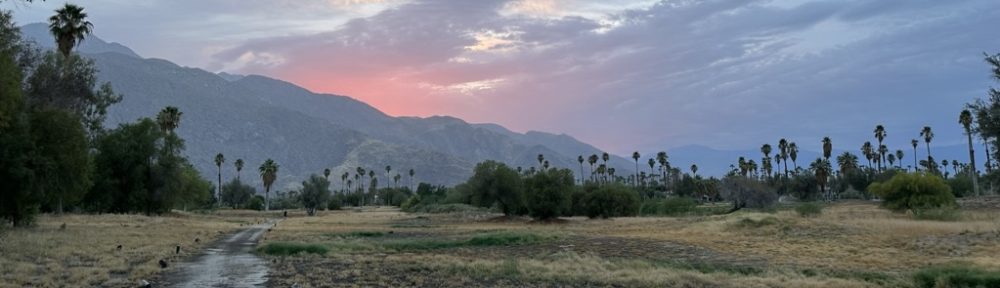
I like to wake up slow. When Sable is beside me, I turn over for morning kisses, pettings and rubbings of his soft furry face against mine. Today he takes off before kisses. Sofia comes instead. She never used to want to be touched, but now the cat she has become will present herself for affection in rare moments. (These times tend to be when I’ve just begun to work on the computer or have just sat down to dinner, and she’s pushy about it. I remind myself I don’t know how long she’ll be here because there is something about the way she invades I don’t find at all endearing.) This morning she is quiet. She gets in my face but then sits down. She lets me kiss the top of her head, stroke her cheeks. She stays for a long time. I talk to her about not hanging on for my sake, remind her to let me know when she’s ready to go. “I’ll help you go night-night,” I say. It makes me cry, good tears. I’m not open to her as often as I’d like to be, so this feels right. Then she decides to run off the bed, quick, jerky movements. She knocks my mini iPad to the floor. I yell at her. I remember I don’t want to yell at her. “Arrrgggghhhhhhhh,” I say, sotto voce, like the whisper of cheering baseball fans on the radio. But then I tell her she’s a creep. If I remembered to stop yelling, couldn’t I not call her names? Still, maybe it’s progress of a sort. I will add name-calling to the list, I think, as I walk to the door. I let the cats outside, step out into the courtyard with them. I say my little morning prayers. I try to forgive myself for yelling at Sofia (yet again). When I “come to,” when my eyes focus, I’m staring at the big waning moon just setting behind the San Jacintos. It is framed, postcard perfect, between the smooth green limbs of our Palo Verde. It makes me stop, this miracle, this affirmation of life, of magic in the world—this big gift. I stand there, grateful, and everything else seeps out of me. I watch, not moving, until she disappears behind the ridge. Goodbye, moon.

Ready to Pounce (10)

I read Natalie Goldberg’s chapter “Be an Animal” (from Writing Down the Bones). Her words surprise me. I’ve read it I don’t know how many times before, and yet it’s all new to me tonight, each image glistening and precise. She talks about how we are writers even when we are not writing. She tells us to be like the cat, all senses focused on our prey, ready to pounce. She urges us out into the world like this. It’s the way we are when we travel, I think, all the more so in a foreign country. But we can do it here, too, on our own block, across our own town. I discovered this on a Thursday when I left my car with my mechanic in Ukiah, half the day until it would be ready. I shouldered my day pack, walked across town. I came upon a small, deserted cafe, sat by the window, drank tea with half-and-half and honey. I explored the residential neighborhoods west of State Street. I stopped for giant zinnias, hummingbirds, a red front door. I stood for a long time listening to a mockingbird singing in a tall tree on a corner. I let myself move from street to street, changing directions on impulse the way I do in a strange city even though I knew Ukiah, even though it wasn’t new to me. I let it feel new. Without trying, I met it with Zen’s “beginner’s mind.” I remember coming upon a row of small businesses. The flower shop had buckets of red dahlias and yellow sunflowers sitting out on the sidewalk in the early morning shade. It woke up in me my old dream of having my own place for flowers, soup, books, the day’s used newspapers and a messy pile of paperbacks on the window seat. I used to picture myself sweeping the sidewalk in the mornings, setting up shop for the day. I loved the quiet satisfaction of the dream. That morning in my wandering I went across the street to a little park, put my pack on a bench, did my qi gong facing southwest under a big redwood. Later, I walked to the county library, went online, checked in with my students, did some grading. Ordinary things, but because I was in a strange chair breathing different air, I stayed more awake. In the heat of the summer afternoon I walked from the library to pick up my old red Jetta, my beloved Lolita Roja. I could still feel it, the mountain lion pace in me, watching, smelling, tasting the air as I walked through the streets of Ukiah.

Hold Still (8)

This morning I read one of the last chapters in the Natalie Goldberg book. It is titled, “Blue Chair.” She comes back again to Gwen, the student and friend who died. The last line ends like this: “it comes home deeper that I don’t get to say any more; what was said, was said, though the knowledge of her death ripples long after the last stone dropped, rich and living on.” At the beginning of the chapter she is painting a big, “fat” blue chair, “the kind of chair you want to nestle in.” Read in. Write books, your legs dangling over the big arms. She describes the layers of gouache she brushes over it, color after vibrant color until the chair has texture and depth, is no one color but alive in its layered-ness. While I write, a dove sits on the neighbor’s carport, his mourning song echoing the sadness and the layers of her chapter still sinking down inside me. I have felt at times in recent years like I am waiting for all my immediate family to die. Then I will go on to the next part of my life, walk el camino de Santiago, see Greece, Africa, find my “real” home, the place I will spend the rest of my own life. I expect my cat Boo to be the last, hope he will see me through the other losses, spend more years beside me. Because he is too thin and won’t eat much, the other day I became afraid it’s all going to happen too soon, too fast. I don’t want to lose any of them. Ever. I’ve told the universe again and again over these last few years: I am in no hurry. I want to be very clear about that. I am happy to wait. A wave of big, big losses rolled through life in my twenties. Now I am poised for another. But even as I write I know I am not really waiting. I just don’t want to leave them to go do other things. I would rather stay, be nearby. Stock up on life together. I can go later in a different time after the wave has washed back out to sea. I know even though I don’t want this wave to come, it will come anyway. And writing now, I know another thing. I know I must not brace myself against it, in spite of what my past, what my instincts beg. Instead, I want to tread water beyond the breakers, keep warm, nimble. I want to stay close, be ready to launch myself into the swell of it. I want to ride it all the way to the shore, the tears on my face indistinguishable from the salty water that holds me, buoys me, carries me whole and unharmed to the warm sand at the sea’s edge, new layers of bright-colored gouache painted on my soul.

Prodigal Feline (2)

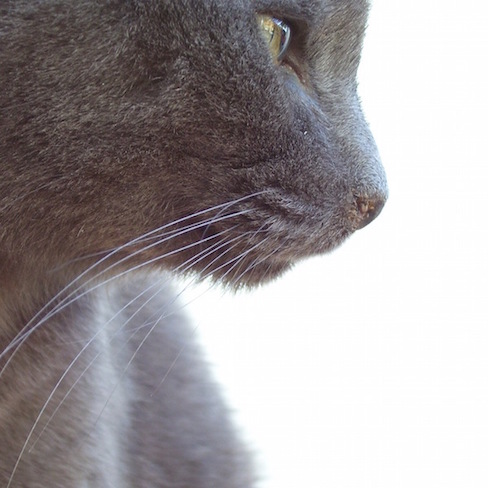
close-up, cropped image of my cat

Sofia’s been gone since yesterday morning. I cried when I woke up in the middle of the night. She’d done this already three days in a row, but the latest she showed up was midnight. I remembered Richard talking about the poems he’s writing for their cat Sunny who died only weeks ago. He’s wishing he’d been as loving, as open to her, as appreciative of her in her coming as he was in her going. I tortured myself in the dark with memories of pushing her off the bed with a pillow when she returned at midnight two days before and wouldn’t settle on the bed with us but kept making determined strikes for the bolster above my head. I wondered if she had found a home where she’s happier, where she is better loved. Even as the thought broke my heart, another followed on its heels. How could I deny her that?

Logic tells me she is only up to independent cat things. But I can’t remember when she had a stretch like this. Sebastopol? Over a decade ago? It’s an upswing in her cyclical illness, I think. She must be feeling better to take off like this. She’s hardly left the courtyard in months, almost always returned in an hour or so on the rare occasion when she did. She would disappear like this when she was young, first a response to her adoption, feral cat that she was. Later because the Hopland countryside was irresistible. I’ve gone through this with her for years.

I am sitting in the courtyard in the late morning, telling my mother about it on the phone. She’s been gone for over 24 hours now. “I tell myself she’ll be okay,” I say. “But every time I wonder if this will be the time she doesn’t come back.”

And then there is movement beside me. Sofia appears in the courtyard on her quiet cat feet. She acts as though she never left, or had been gone only for a moment. I tell my mother she was the magic talisman. I cry again, a muddled combination of relief and gratitude and fear. And then I laugh, kneeling, hugging her, shaking teardrops around us on the cement.

Grace (49)

I wake up at 4:30 in the morning because Sofia is having trouble. I get up to give her more for her pain. On my way back to bed I see the almost full March moon hovering above our mountains on its way to the other side of the world. I stand by the sliding glass door and watch it, grateful to be awake to see it. After, I lie in bed awake, wrestling with my ongoing trouble with a colleague. These thoughts morph into worries about my job. What will happen if our nonprofit falters? Then I remember I don’t need to be afraid. I can trust the universe. Everything will be okay. I am curled up on my right side, Sable’s warm weight a comfort against my back. For a moment, I know I am held. Safe. Loved. It is like rolling onto my side on the yoga mat after Shavasana. I always lie there for a while, letting things sift through me, before I sit up and bow. “Namaste,” I whisper. The sky is beginning to lighten when I drift back to sleep.

My “Duh!” Moment (32)

Last week I had an aha moment. It dawned on me the challenges I’ve been having with my work are the universe’s way of helping me. So, my aha, my belated realization, was also a “Duh!” moment. I knew this, right? I’ve known this for years, haven’t I? I pray for help often, but I never ask for trials. I don’t say, “Please send me some really hard thing so I can learn and grow.” I ask for help—in healing, in changing—as though the powers that be might reach down, brush me with a stroke of feathers. Voilà. I am a new person. I forget I am required to do my share. I forget that healing, that changing, can be hard work. I’ve asked for help, for guidance in getting through a troubled time. And I never doubt I am receiving that help. But somehow I missed the whole part about how these challenges at work are the help. I forgot I asked for this. The trouble I am having is the answer to prayer. “Duh,” I say out loud. Sable’s ear twitches at the sound of my voice. His expression remains deadpan. And here I thought you were smarter than that, he thinks at me. “Duh,” I say again just for fun. But I am smiling now.