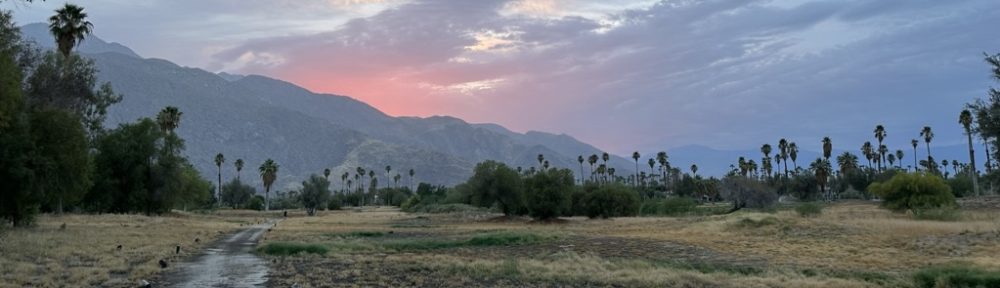
I have a second cup of green tea and toasted rice steeping beside the open kitchen window. After I drank the first cup I found myself nodding off reading. I’m so exhausted I almost can’t function, can’t feel quite like myself, a dull blankness lying over me in layers. How can I let myself become so depleted for work? Can’t I learn to keep better boundaries, check in less often, know when to go to sleep? But when I’m caught up in it, the train holds me rushing down the tracks, the whoosh of air loud in my ears. It doesn’t feel like I have a choice. It feels like all I can do is keep moving through it, swaying car to swaying car. Answer the next question, grade the next submission, remember to cook dinner, feed the cats, field the next three questions waiting after I eat. I call it a night, too tired to wash the dishes waiting in the kitchen sink. While I am in it, the pace sustains me. I wake up early after little sleep, answer more questions from bed. But once the pressure slackens, the train slowing on the tracks, the exhaustion weighs me down, presses me against the earth. Silly mortal. Older mortal now, too. Yesterday afternoon I almost couldn’t stand. Today I think I could fall asleep while I write, but I keep the pen moving across the page. I am in the shade under the umbrella. A house finch calls from the neighbor’s tree. I’d been so eager for this lightening of my load. But I’m too tired to feel it, pressed down as I am by exhaustion, this body heavy like stone. Instead I look forward to being replenished, to feeling lighter, my body not dead weight I wrestle to keep upright, but easy companion, heart lifting again as hearts are meant to do.
Category Archives: Education
Being a Writer (41)
The other night when I was walking it came to me I really am a teacher first. All these years, I’ve kept trying to reverse the sequence. I put “writer, teacher, artist” in my profile. But I put teaching first. How can I not? Right now I’m in the middle of the second week of a two-week intensive online training I am leading with one of my favorite colleagues. Today I am proud of myself because I manage to get my “morning” chores done only two or three hours later than usual. This is the first time in ten days. I lay the walnuts in the glass pan, put them in the toaster oven. I wash the strawberries, have them drying on a kitchen towel by the window. But I don’t make time to eat. When I finish making my third or forth set of rounds, answering questions online, I plummet. I feel sad and discouraged for no reason. I have the sense to eat my breakfast. It is almost 2pm. I realize I feel trapped inside my obsessive online checking in. I get afraid for going forward. How will I ever be able to be a writer if I let my teaching work gobble all my time? I remind myself in the past I was able to carve out more time for my writing. I tell myself I can do this again. I can. I am. I refuse to believe teaching and writing have to be mutually exclusive. But a voice hisses. “Are you sure?” They are such different modes. Writing asks us to surrender. But I won’t give up my dream. Being a writer is who I am. I’m a writer who’s teaching. Maybe one day I’ll be a writer who teaches less.
Kicking into High Gear (17)
For this last week I’ve been struggling with wanting to get more done. Coming off of vacation is never easy for me, and now I have a week to get ready for the next semester. I tell myself, too, after this past summer when I fell so spectacularly apart, it’s been a long time since I worked steadily at my peak. Last semester I did what I needed to do and little else, letting myself retreat to Netflix or a book when those must-dos were done, glad to just be functioning at all, I think, and precarious in it. I tell myself now it isn’t fair to expect to be able to flip a switch, to begin doing not only all sorts of extra things, but to be doing them all quickly. And besides, I point out with a wry grin, it just ain’t happenin’. But I’m not giving up hope. And maybe this is a good experiment. Because I’ve never figured out how to get into high gear without engendering more stress than I want in my life. So, maybe if I keep making this transition like molasses, I’ll get where I want to be without bricks for shoulders. When I begin cataloging what I need to accomplish my body clenches, even though I know I’ll get it all done. Still, my mean voice mutters about all the other things besides schoolwork I’ve been neglecting, nags me about the weeds in the driveway, the dirt from the construction site that’s piled up on the little shelf in the shower where the spray doesn’t reach. My mean voice has a long list, but I don’t want to listen, don’t want to even let the voice live in me. I pause with my pen above the page, take in a deep breath, let it out again. I see the hunter green umbrella poking out above the back fence, a happy reminder my neighbors are back from Canada. I hear a house finch singing in their tree, but I can’t see him. I scratch my head, yawn, grin. I’m going to focus a bit more on my writing today, then move on to some school prep. I’m going to sneak up on this full throttle stuff, I tell myself, and find a way to keep my peace.
The DREAM Act (49)
I thought I’d read the DREAM Act had passed. But I just Googled it to confirm the details, and as far as I can tell it is still not law, even though it was introduced over a decade ago. But there does seem to be some kind of “deferred action” in place now with all the same basic parameters as the DREAM Act itself. If you are an immigrant who was under 16 when you came to this country, if you “have continuously resided in the U.S. for at least five years prior to June 15, 2012 and have been present in the U.S. on June 15, 2012,” if you were under 31 on June 15th of last year, if you are “currently in school, have graduated from high school, have a GED, or [are] an honorably discharged veteran of the U.S. Coast Guard or the U.S. Armed Forces,” and if you have not “been convicted of a felony offense, a ‘significant misdemeanor offense,’ three or more non-significant misdemeanors, or otherwise pose a threat to national security or public safety,” then you can apply for the deferred action. It isn’t clear to me what exactly the deferred action will get you, but the requirements are similar to that of the DREAM Act, so I am guessing the results run along the same lines, too. The DREAM Act allows for a 6-year path to citizenship involving fulfilling certain educational or military requirements. I read about a $495 fee, as well. And while it dismays me that we have fought over this for more than a decade, I’m glad to know we have at least put something in place. I know this will make a big difference for many of my community college students.
But I couldn’t help but feel discouraged by the rules, can’t help wishing we could embrace these young people more completely. I can’t help but wonder if there is any option in place for people to work off their fees during the process. Do we offer payment plans? And I can’t help but think about the brother and sister who are age 30 and 32. My heart sinks at the thought of being so close and not being eligible. I can see that 32-year-old woman, her heart breaking that she missed the age cutoff. But I see her smiling at her brother six years from now, her heart proud, swelling for his big happiness, his big day, becoming a United States citizen. Could we leave her behind more fully, hurt her in any bigger way?
[Editor’s note: The website I quote is available here. And that last rule sounds like it’s open to all kinds of messy interpretation, hmm?]
Not to Mention (37)
I become granite when I hear “English only” bandied about in this country. I don’t even try to be civil. All respect flies away. I am mean and hard, an unreasoning wall. I’ve even heard people complain about Spanish signage in Home Depot. How do they think this can hurt them? “These people should learn to speak the language,” they say. They mean Mexicans. My teeth clench. My skin crawls. I want to spit on them.
“How many languages do you speak?” I want to howl. Do you have any idea how hard it is to learn another language? Not to mention the fact that our corner of the country used to be Mexico. Not to mention the fact that when California became a state it was under the condition that it be bilingual. If we hadn’t broken that pledge, those of us who came up through the public schools here would all speak Spanish fluently. If we hadn’t broken that pledge, maybe I wouldn’t have to listen to the screaming racism underneath their words. Maybe I wouldn’t have to turn to stone.
Mexicans Are (31)
It’s some strange hubris of travel to think we know a country or a people because we came and saw a slice of it, of them. How many different versions of the United States do you imagine foreign visitors carry home? Did they stay with family in the Appalachians? Visit a dude ranch in Arizona? Make a wrong turn into Watts one afternoon when they were looking for the Hollywood hills? My Mexico was made up of poor villagers. They are the bedrock on which I base my sense of who the Mexican people are. They are quick to laugh, treat their burdens with a light touch, pay a man to rake the dirt road in front of their home because he needs the pesos even more than they do.
I met a handful of wealthy Mexicans, came to know two handfuls of people who struck me as part of a burgeoning middle class, enough to understand some of the differences between the socioeconomic strata there, how education and money shape their world. Enough to know better than to base my assumptions about life on Mexico on the lives of poor people in rural villages. But not enough to keep me from doing it anyway. I still remember the look on my Senor Soto’s face when I made this mistake, embarrassed myself. “Es raro, no?” I asked him. That’s unusual, isn’t it? He’d just mentioned he and his wife had two children. I was surprised, though looking back on it now I realize all the middle class families I knew there had only two children. He was driving the taxi, so he couldn’t stop to stare at me, but I remember his piercing look. His voice was kind, but there was steel beneath it.
“You can’t do that,” he told me in Spanish. He’d agreed to let me practice my Spanish even though he was fluent in English. (He even taught me the difference between the words “writer” and “author.”) “You can’t make assumptions about all of us like that.” His gaze moved between me and the highway. I was sitting in the passenger seat. We were on our way to the airport in Guadalajara. “Many people have only one or two children,” he said. “It just depends.” I had known it, seen it already, and yet I blundered in, two feet in my mouth, insulting this well-read man who was fluent in two languages, whose son was attending the university, whose wife and he had practiced family planning. I nodded, blushing.
“Entiendo,” I said. I understand. “Lo siento.” I’m sorry. His kindness never faltered, but he’d put me in my place, and I was glad he did. If I might muster even a faint echo of his grace the next time I need to speak up, I’ll be grateful. I have his business card tucked in my wallet. The day I return, I’ll call to see if he can pick me up from the airport. Or maybe I’ll email him ahead of time, so I can know Senor Soto will be waiting for me there.