Salsa that Sings (17)

Sortera gave me some extra ripe heirloom tomatoes at the farmer’s market Saturday morning. “¿Para mi?” I asked, surprised, pleased. She nodded.

Para salsa.

Ah, muchas gracias,” I said. “¡Que bueno!” I thought for a moment. I big grin came over my face, the child who has figured out something wonderful. “Tengo chips!” I declared, and she smiled back at me. What luck.

I was so glad she offered them to me again. The last time I had hesitated, demurring, suggesting she might want to make salsa from them. (So dumb, this one—of course she could have all the tomatoes she wanted. This was her family’s business.) I know I upset her. I was able to convince her I’d love to have the tomatoes. But in Mexico there should not be any hesitation, only the resounding “Yes.” You accept all that’s offered.

I’m not sure I could ever learn to do that. I know when I lived there I turned things down, begged off because of my work, my lack of time. On New Year’s Eve in Todos Santos, I called Iris to tell her I wouldn’t be coming to their family celebration after all. I felt terrible about it, but I didn’t want to drive past all the bonfires in the streets, through all the fireworks. I was afraid, hid out at home instead. In Ajijic, I turned down more than one invitation to visit my neighbor Ramona, though I don’t think she ever took offense. I think I may have even bowed out once from attending the harvest celebration at the milpa, and I’d undo that in a heartbeat now if I could.

The truth is I was working a lot–too much still then, I think–so much of my time in Mexico spent at home, hunched over my laptop. Though that work allowed me to be living there, so my lament can’t be too strong. Still, I regret not learning more, not leaving with more knowledge, not bringing back more concrete memories. I wish I’d asked Ramona to show me how to make salsa in her molcajete, her basalt mortar. She worked for hours in her dark kitchen, making almost everything from scratch, filling the traditional female role for her big family. She would have been happy to teach me, I think. It would have given us something to do together, too, would have been better than our awkward but heartfelt greetings, our shy but regular exchanges of small gifts, our attempts at chatting when I say with her family in their living room.

And Rodolfo would have permitted me to watch him cook, I’m sure. I know he loved for me to get so much pleasure from what he prepared. I could have learned how to make pipian from a master. And when I made salsa from Sortera’s tomatoes now in my southern California home, even if I made it in the blender, it would sing to me of Mexico. Instead, it makes me miss it more.
Culture Shock (15)

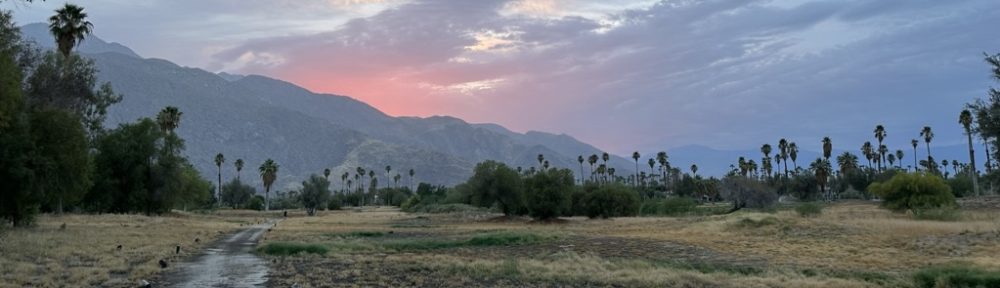
The cats and I crossed the border from Sonoyta, Mexico, three years ago on the second of July. I sang “California Here [We] Come” most of the way through Arizona. Near the California border, we were perched on a ridge on the highway with lightning breaking beside us, my fingers white where they gripped the wheel, the thunder drowning out the beat of my heart. But it cooled the air, welcome relief from the July heat, the desert washed clean around us, alive in scents and color. We bogged down just west of Blythe, an accident on the interstate, and I dipped a washcloth into a bucket of ice water, squeezing it out again and again on the heads of my two cats. I remember running ice cubes over my own forehead, across the back of my neck, along the curve of my collar bone. I decided I was being groomed in some fashion, learning a new kind of endurance on that journey. I would feel that again in the weeks that followed our new lives in the Coachella Valley, coming to terms with the lethal summers, knowing the heat could kill me.

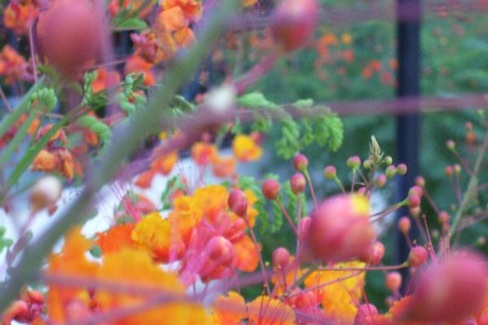
Close-up of Mexican birds of paradise_orange blooms and buds

I took comfort in the bright orange blooms of the Mexican birds of paradise that laced my new home. I thought it was a happy omen. I remember sitting that first evening on the lawn of the motel across the street from the apartment I’d rented over the internet, using their wireless to send emails to Mexico, letting people know we’d arrived, safe, sound, staggered by the feat. I remember walking in the days that followed, feeling like I’d landed on another planet with the wide, clean streets, the expensive landscaping, the manicured everything. After the narrow cobblestone streets of Ajijic that had been my world, being here couldn’t have felt more foreign. I remember feeling like an alien, desperate to connect with the Mexicans who crossed my path, the woman in the mall restroom, the tailor near my new home, the bartender at the Mexican restaurant who told me the owner there was from Guadalajara. I was stripped of the need to speak Spanish, but I didn’t want to stop. It felt wrong. And everywhere I looked, I saw signs of wealth, and you could walk for miles without being able to buy a bottle of water in the brutal heat.

I wanted a tiendita on every block, even in the residential neighborhoods. I wanted brown skin, black hair, warm, laughing bodies greeting each other in the streets, greeting me. I craved the rich, textured, vivid world I’d left behind. I felt small and unveiled, vulnerable, alone. I missed Ana and Rodolfo so much it hurt, an ache that didn’t go away. I didn’t want to be here. I only wanted to be there, in that other world that already seemed like a dream, all those hundreds of miles away, where I’d left all the food that had flavor, all the color that had depth, all the people who met me with an open heart, warm brown eyes meeting mine. I wanted fruta picada on every corner, tortillas delivered every morning, still warm, the sound of the tamale man calling in the early night. I wanted the life that had become mine. I wanted to go home.

Fruta Picada (5)

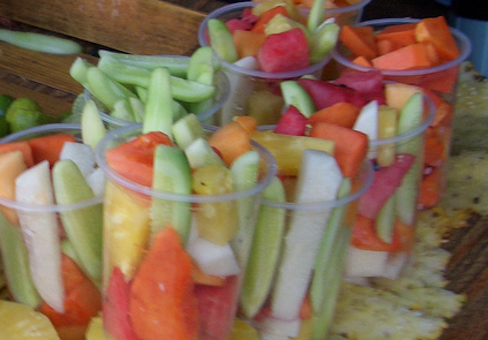
The first time I saw a street vendor selling fresh-cut fruit in Mexico I was wandering through a residential neighborhood in Cabo San Lucas, where a man wielded a small portable set-up, rolling it along the banquetas there, the sidewalks. His work area held whole fruit, cucumbers and pineapple prepped for making slices, his tools, his cutting board, his kitchen towel. It was framed of wood and bordered on three sides by glass. I watched from a small distance, fascinated, while people stopped to make their requests, listening to the rapid-fire Spanish, the different selections. In Ajijic we had a fruit stand every day at the edge of the plaza, and one just east of town on the carretera, the highway. Wednesdays another family always set up shop at the top end of the open-air market, the tianguis. You could find mango and melons, papaya and cucumbers and jicama, sometimes huge bosenberries or bright red strawberries or pineapple, fresh coconut. When there was time, they’d make up clear plastic cupfuls in advance, all cantaloupe or watermelon, or a mixture of berries, the bright colors and succulent fruit a still life on the street. Or you could ask for your own particular combination from the fruit on hand, and they’d prepare it for you. Some vendors use a dry blended chili powder; others offer a chili sauce. Always there is fresh lime and salt. The first time I tasted limon y sal y chile on fruit, it surprised me, all that hot, tangy, salty sweetness. But it grabbed me, too. I loved it. And when I was counting calories, I’d go for the cucumbers.

cut fruit and cucumbers in plastic cups in Mexico

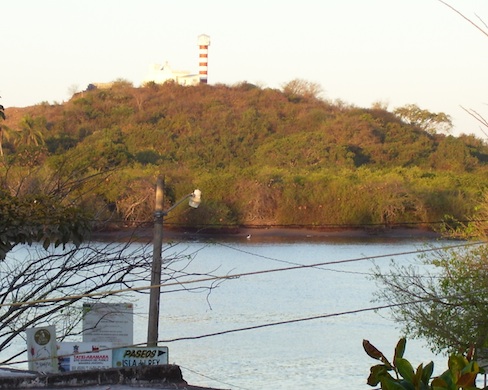
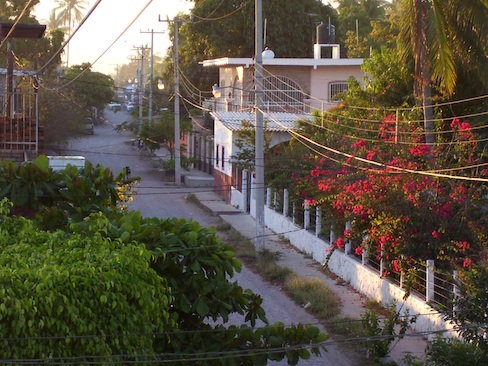
I remember stopping once at the fruit stand on the highway east of town. I was walking home from shopping at the Super Lake grocery store in San Antonio Tlayacapan. I sat on the curb near La Floresta with my large plastic cup of cucumber spears with lime and salt and chili sauce. I savored each long luscious slice, dipping again and again into the spicy red sauce pooling at the bottom of the clear plastic. And our first day on the mainland, the cats and Lolita Roja and I found fruit as if by magic en route to San Blas. The downhill road to the coastal town wound its way through the trees, and at one slow turn three women materialized in front of my car, apparitions with cups of cut fruit in their hands. I got flustered–by the unexpected suddenness, the blind curve, the rapid Spanish, my own ambivalence and groggy brain after a day of driving. I pulled over on the side of the road and chose one container of mixed melons and one of green mango. When I told them I wanted to save the fruit for later, they put the chili powder and the salt in little plastic bags for me, gave me whole limes. We stayed two nights in San Blas, time for the cats to recover from their ferry crossing nightmare. I made three meals of the fruit. It was the perfect thing. I would sit on the veranda outside our room in the warm April breeze eating green mango con limon y sal y chile. I watched the lighthouse revolve, watched our little patch of water move up the estuary, slow and quiet. I listened to the grackles calling from the trees, from the rooftops. I licked lime juice from my fingers and studied the houses down the street and wondered what it might be like to live there.

patch of estuary with lighthouse on the opposite bank

view up San Blas street from veranda

[The photo of the fruit is copyrighted by antefixus21 and can be found here: http://www.flickr.com/photos/21728045@N08/2328071644/.]