The DREAM Act (49)

I thought I’d read the DREAM Act had passed. But I just Googled it to confirm the details, and as far as I can tell it is still not law, even though it was introduced over a decade ago. But there does seem to be some kind of “deferred action” in place now with all the same basic parameters as the DREAM Act itself. If you are an immigrant who was under 16 when you came to this country, if you “have continuously resided in the U.S. for at least five years prior to June 15, 2012 and have been present in the U.S. on June 15, 2012,” if you were under 31 on June 15th of last year, if you are “currently in school, have graduated from high school, have a GED, or [are] an honorably discharged veteran of the U.S. Coast Guard or the U.S. Armed Forces,” and if you have not “been convicted of a felony offense, a ‘significant misdemeanor offense,’ three or more non-significant misdemeanors, or otherwise pose a threat to national security or public safety,” then you can apply for the deferred action. It isn’t clear to me what exactly the deferred action will get you, but the requirements are similar to that of the DREAM Act, so I am guessing the results run along the same lines, too. The DREAM Act allows for a 6-year path to citizenship involving fulfilling certain educational or military requirements. I read about a $495 fee, as well. And while it dismays me that we have fought over this for more than a decade, I’m glad to know we have at least put something in place. I know this will make a big difference for many of my community college students.

But I couldn’t help but feel discouraged by the rules, can’t help wishing we could embrace these young people more completely. I can’t help but wonder if there is any option in place for people to work off their fees during the process. Do we offer payment plans? And I can’t help but think about the brother and sister who are age 30 and 32. My heart sinks at the thought of being so close and not being eligible. I can see that 32-year-old woman, her heart breaking that she missed the age cutoff. But I see her smiling at her brother six years from now, her heart proud, swelling for his big happiness, his big day, becoming a United States citizen. Could we leave her behind more fully, hurt her in any bigger way?

[Editor’s note: The website I quote is available here. And that last rule sounds like it’s open to all kinds of messy interpretation, hmm?]
Lake Chapala Nibbles on Its Edges (48)

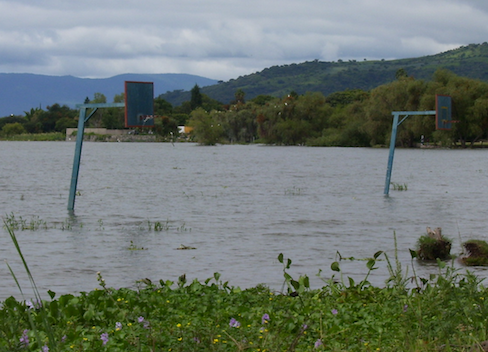
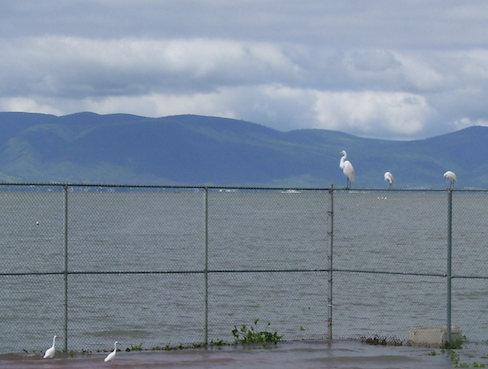
When I lived in Ajijic, the lake flooded. It wasn’t the worst the village had lived through. People told me years before Lake Chapala came two blocks into town. The year I was there, she only swallowed the shoreline. But I remember the eery feeling I had seeing everything submerged. I used to be able to walk straight down Aldama from my hillside home, then walk along a dirt path that hugged the southern edge of the village beside the lake. All of that was submerged, even the cobblestones of my street disappearing into the water. I stood there for a long time listening to the lapping of the small waves, felt my mind twisting with the reality before it. I walked across town, approached the lake from the west.

basketball court submerged in the lake

egrets on the tennis court fence

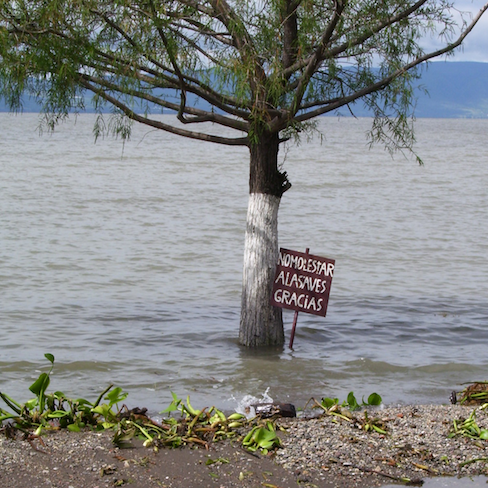
flooding_don't bother the birds sign

I marveled at the way the basketball courts had vanished, the hoops sitting out in the water. The lake edged the tennis courts at the fence line as if by design. I watched the egrets sitting on the chain link, their unexpected furniture. The little sign asking people not to bother the birds was still visible, the tree it was posted beside surrounded by lake. Two people passed me on horseback, the horses legs churning up the mud. I cringed at what their hooves might find, hoped they wouldn’t be injured. It all made me glad I lived on the hillside, as often as I might have looked at homes nearer the lake with a certain longing. On the hillside, the thunder gods sat on our red tile roofs and laughed. But when the rains came, the rivers of our streets ran away from us. I stood watching the horses heading east where I couldn’t follow. I choose thunder, I thought.

Hope (47)

I was encouraged to read two recent arrests stirred protests over Arizona’s immigration law, glad to know there are civil rights organizations like Corazón de Tucson to rally outside the police department, activists like Alcaraz Ochoa willing to crawl under a Border Patrol vehicle to block them from driving away when the answers they gave him about why they were arresting Rene Meza didn’t satisfy him. It makes me remember I can’t blame all Arizonans for their racist legislation. It reminds me there are people there who didn’t want these laws in place, people who must be as appalled and embarrassed now as I was when our country elected Bush. It makes me remember to have hope.

Dreaming Home (46)

I’ve longed for ages for a home where I felt like I could spend the rest of my life. When I moved to Sonoma County, it was the first time I had that feeling about a place. I remember driving home from Santa Rosa on Guerneville Road past green farms, the oak-studded hills before me. Look where I live, I thought. When I moved into La Casa Azul in Todos Santos, it was the first time I had that feeling about an actual dwelling. Things went terribly awry with my landlord there, but I remember that giddy feeling, thinking I’d found the home of my dreams. I remember wondering if I’d be able to negotiate the wrought iron spiral staircase when I grew old.

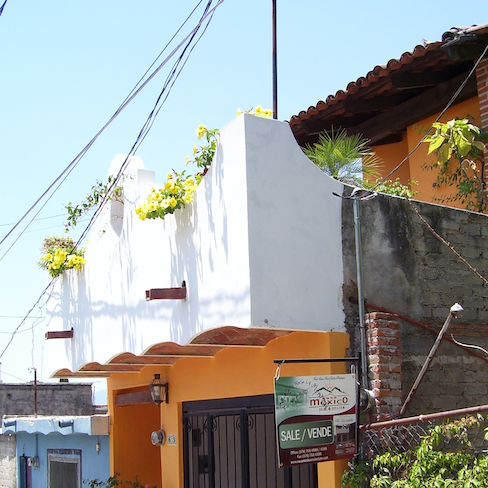
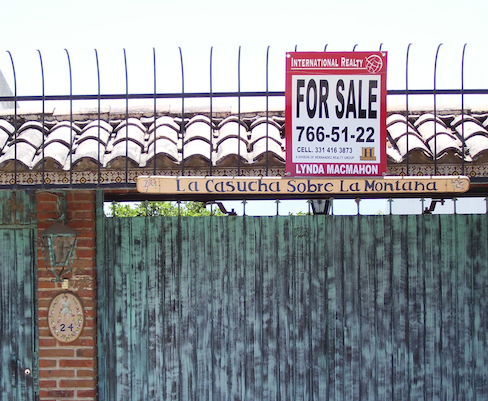
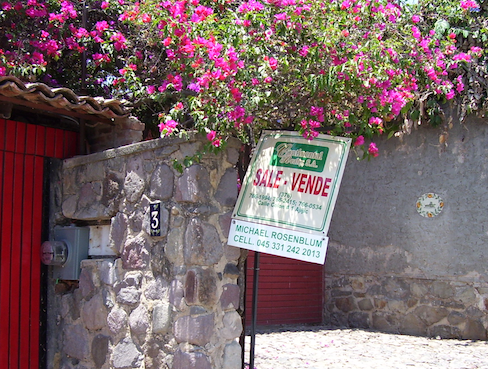
Over the years I’ve built a habit of studying the yards, examining the homes whenever I walk down the street. “Oh, I could live there,” I’d say to myself, caught by the wrap around porch or the climbing wisteria, both pleasure and longing evoked by my ritual, a bittersweet practice. When I lived in Ajijic where buying a home might have been one day more within my reach, I photographed for sale signs. I remember one advertising an empty lot of neatly turned earth, a beautiful brick wall surrounding it, a blue metal gate. I went as far as to look at two homes for sale up in the hills. One was all white and one was green, and they were both two stories tall with miradores that made them seem like three-story homes. I don’t remember any details about the houses themselves, only those marvelous rooftop patios, the views of the village spread out below them, the lake in the distance. I would have lived on those roofs.

for sale sign, white veranda, yellow blossoms

for sale sign, metal gate

for sale sign, bougainvillea and rock wall

Now in my unexpected southern California life, thanks to two dear friends and the workings of a generous universe, I’m on the threshold of having my longing met in the old trailer home I’ve just bought. I don’t get to take possession of it, so to speak, until April, but it has possessed me from day one. It has grabbed me by my viscera, invoking big dreams of a magic home I can grow old in, tending my garden and writing my books, the stark place transformed little by little in the intervening years to lushness and color, where my birds will want to linger chatting together in the bougainvillea or the palos verdes. I can see myself sipping tea on my patio there years from now, watching the sun disappear behind my mountains, the sparrows and the mourning doves scritching among the leftover seeds in the late afternoon quiet. I don’t have words to say how grateful I am, how full this makes me, how much awe it awakens. But I seem determined to try anyway, to fall short but maybe brush the feathers of the thing in my attempt. Thank you, universe. Thank you, dwelling gods. Thank you, especially, my good friends. Thank you.

Closer to the Earth (44)

I’d pulled out the travel section of my L.A. Times a few weeks ago and set it aside unread. The cover story was about Mexico, about the northern village made famous for its pottery. Now the next generation are doing marvelous contemporary things with clay, and I’ve saved the photographs of big beautiful pots for my mother to see. There is one in particular I think she’ll enjoy that reminds me of some of her own large slab bowls. Nestled between the images of the pottery is a shot of one side of a village street, and I am transported. It could be any rural village in Mexico–the narrow, uneven sidewalk, the crumbling edges of things, the dirt road, the fading paint on the walls of the buildings. But what makes this so different from a dilapidated block in some U.S. town? Why does it awake a longing in me, a fondness, even, none of the aversion I might feel for the equivalent in this country? Is it the colors, the texture, the light? Is it the lack of despair in that Mexican air that weighs more lightly on the world? And why do I crave it?

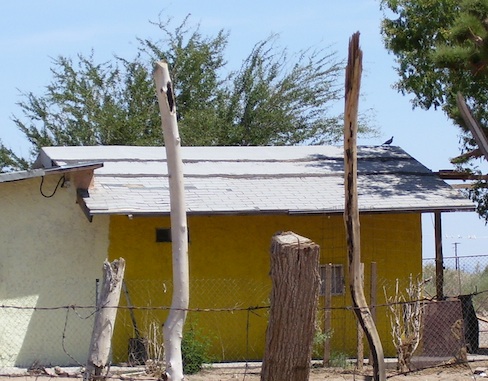
yellow house

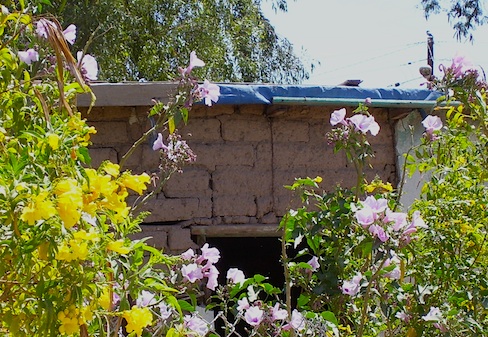
window and flowers

When I moved back to the States, I remember my shock at the clean, wide streets, the lavish landscaping. Now I teeter between pleasure in the places where this wealth allows for a clean beauty, the brick and the desert plants and vivid blooms a masterpiece, often echoing our Spanish roots here in the Coachella Valley, and my dismay and disconnection from the places where the clean wealth falls short of this art and only looks garish and sterile, even obscene. But when I see this photograph of the village street in the newspaper, I ache to be there, walking along the banqueta, the sidewalk, my sandals dusty, my skin drinking in that other sunlight, the colors and the textures akin to the earth, to life, to participating in the world in a different way. I can’t quite grasp the words to explain it even to myself. It is a knowledge and a memory of the body, I think, and the spirit, not the mind.

I can feel myself nodding to two women I pass on the street. “Buenas tardes,” I say.

They take me in with their eyes, nod, smile. “Tardes,” they say.

I Am the Invader (43)

Once I walked from Ajijic to Chapala and back. I don’t remember how many hours I spent doing it, but I remember being present for big chunks of time, taking it all in with new and thirsty eyes. I avoided the highway for all but a two or three block stretch in a couple of spots where it was the only choice. I walked through cobblestone streets in the villages, past horses and cows and goats on the dirt roads on the outskirts. More than once I sensed I was walking where gringos didn’t show up very often, and probably not on foot, a woman alone. I didn’t feel afraid, only conspicuous from time to time.

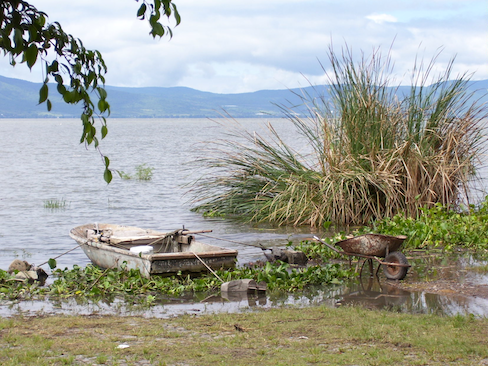
Shore of lake, old rowboat and wheelbarrow

I hugged the lakeside when I could. I passed old brick buildings, glassless windows, the courtyards swept clean, women doing laundry outside by hand, the cluck of chickens behind low brick walls with bougainvillea spilling over them. Once I stopped for a long time watching a heron standing still in the shallows near the shore, and I felt the richness of the life there, the birds, the water, the place where fertile earth and decay overlap, reminiscent of my visit to the deep south here, maybe Biloxi. I marveled at the idea of owning land beside this lake, how much that would mean to me, but wondering if it could feel like that same opulence to the locals in their poverty. East of San Antonio Tlayacapan there was a stretch where the road became more of a walking path than a road, dotted with shacks, more plywood lean-tos than dwellings. I passed a man and two children. They were sitting at the edge of the road, a piece of plywood for a table, a bag of bread between them, the makings of sandwiches. I remember the surprise on their faces when I appeared. I felt like I’d just walked uninvited through their living room. I can still see the man’s face. He is chewing, and he nods to me in response to my greeting. But his eyes are wary, resentful. I am the invader.

The Blind Man (42)

In Ajijic there was a blind man who I came to know a little. I can’t remember his name now. I’ve forgotten it, and the names of other people, names I thought would stay with me always. Was it Luis? The name pops up now, but I can’t be sure. He had a blind person’s cane, red and white, and carried a cup with him. I would see him at the Wednesday tianguis, the outdoor market, or standing in front of one of the supermercados that catered to the expatriates and the tourists. I don’t remember him ever asking for money. There were a few old women there who were pushy and demanding beggars, an odd entitlement I’ve never encountered before. But the blind man was only there with his cup, always cheerful, never pushy. I came to know him a little. We would talk about his family, about the thunder the night before, about what he might be able to do in order to still contribute to his family, about how much he’d like to learn how to play a musical instrument. I remember feeling good when he would recognize me. When I had the money, I would tuck a bill into one of this shirt pockets, tell him in a quiet voice how much I was sticking in there. Because I left so suddenly, I never said goodbye to him. It’s one of my small regrets. But I console myself with pictures of me finding him again one day, of him still remembering me, of being able to explain. “Lo siento mucho que no te dije adios, Luis.” I’m so sorry I didn’t tell you goodbye. “Yo te pensaba muchas veces desde me fui.” I’ve thought of you many times since I went away. I think of him still. I hope one day I find him well.