Here’s to No More Sneers (38)

Learning a language is hard. I’ve studied Spanish off and on for most of my life, and still I am far from what I consider true fluency. When I first moved to Mexico, my words were molasses, poured in fits and starts, agonizing for Mexicans used to their light rail speech. But with very few exceptions, busy retail folks who were fluent in English and wanted me to just get on with it, the people I tried to speak to showed genuine welcome for my efforts, helped me when they could, all smiles and nods and encouragement.

You have to be willing to look like an idiot to learn a new language. You have to do what we are so bad at in this country, feel foolish and stumbling, bumble your way through it, reach for humor if you can in your embarrassment. It’s the only way to move forward. In Mexico, the people in my world there let this be the best it could be. It was still awkward. We don’t like to look stupid. But their reception of my halting, error-ridden Spanish made it okay to keep going, keep practicing. Their welcome of my efforts balanced out the excruciating discomfort.

I wish I could say we returned this favor for immigrants in the United States. And I’m sure in some cases it is returned, kind estadounidenses nodding and smiling and making every effort they can to understand, to appreciate the stumbling English, to welcome the effort. But more times than I can count, instead I see native English speakers here grow rigid when they hear a Mexican accent. Their faces stiffen. Mouths sneer. They seem critical and impatient. In many cases, the immigrant may actually be relatively fluent in English, but the heavy accent alone seems enough to trigger this ugly response.

And if we know how hard it is to learn a second language, how much one needs to practice and practice, feeling like a fool the whole time—is it any wonder many immigrants don’t make themselves this vulnerable as often as they might? If they learn to expect an 80/20 chance, perhaps, that their efforts will be treated with contempt? How many times would you put yourself out on that trembling limb for any occasion where life doesn’t require you to speak a foreign tongue?
Not to Mention (37)

I become granite when I hear “English only” bandied about in this country. I don’t even try to be civil. All respect flies away. I am mean and hard, an unreasoning wall. I’ve even heard people complain about Spanish signage in Home Depot. How do they think this can hurt them? “These people should learn to speak the language,” they say. They mean Mexicans. My teeth clench. My skin crawls. I want to spit on them.

“How many languages do you speak?” I want to howl. Do you have any idea how hard it is to learn another language? Not to mention the fact that our corner of the country used to be Mexico. Not to mention the fact that when California became a state it was under the condition that it be bilingual. If we hadn’t broken that pledge, those of us who came up through the public schools here would all speak Spanish fluently. If we hadn’t broken that pledge, maybe I wouldn’t have to listen to the screaming racism underneath their words. Maybe I wouldn’t have to turn to stone.

On Calling Home (36)

I’m trying to get it together to mail a package to Ana and Rodolfo for Christmas this year, something the whole family can enjoy. I failed to get it there in time before, sent something late two years ago, incomplete. This year I have a puzzle, a night scene that looks like Italy. I went to buy vegetable seeds yesterday for the milpa, but True Value didn’t have their new stock in yet. I want to get some photos made for them, maybe the Mexican marigolds in my garden, pictures of my cats napping on the patio. I worry they’ll think I’ve forgotten them. The last time I spoke to Ana was in January when I called to talk to Isabel on the day of her quinceanero. I never called back to see if her card arrived with the magic Mexican pesos still tucked inside it, worn bills I had carried in my wallet for years like good luck charms.

I’ve thought of calling often, mornings like this when I sit quiet on the patio and let my thoughts wander back to Ajijic, with Ana and Rodolfo always at the heart of it. I especially wanted to call them on el dia de los muertos and for Thanksgiving, too. I wonder if they celebrated it there this year, the expatriate’s customs rubbing off on the locals. They are people I am grateful for, so I wanted to call to let them know. But I didn’t. I haven’t called since that morning in January, the whole family in a happy flurry getting ready for Isabel’s big day. And I ache for not hearing their voices, not learning las noticias, the news. But something keeps stopping me from calling, and I ask myself again and again what it is. I’m pretty sure it’s not the difficulty of speaking Spanish over the phone, the disadvantage of not having their facial expressions and their gestures to help me out. I suspect, instead, it is the way the thought of them squeezes my heart.

Still, for the fullness of the moment, hearing their familiar voices on the phone, reveling in the sound of their laughter, of laughing together though we’re 1600 miles apart–I tell myself to call soon. That richness is worth the small heartbreak sure to follow.

Incarnations of Yerba Maté (35)

This morning I let myself drink two cups of yerba maté. I bought two tea bags from the health food store here on Saturday, my latest approach to letting myself indulge in this addiction now and again. Each sip is delicious, the unique, bitter aroma, the coconut milk and agave a divine alchemy with the sharp flavor. I think of the even more wonderful maté I can buy in bulk from Mountain Rose Herbs. But I don’t let myself buy it because I’ve learned I’ll drink it until it’s gone. And then, I remember the first time I drank that same quality of yerba maté, and it carries me to Ajijic.

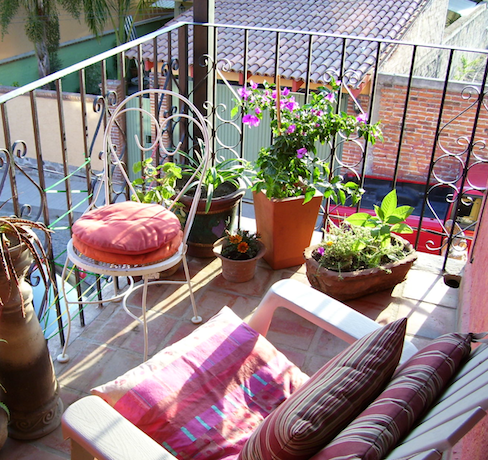
my Ajijic balcony with the chair and pots of flowers, including the terra cotta I mention with the bougainvillea

I am on the sidewalk near the little health food store two blocks from my apartment on Aldama, the one on the frontage road north of the highway, beside the nursery where I bought my bougainvillea for my balcony and that lovely oblong rectangular terra cotta pot. The health food store is run by a woman and her husband who live in Guadalajara. I like them both very much. I pause before the nursery next door, run my eyes over the plants spilling out onto the sidewalk, inhale the scent of gardenias, then move past and enter the open store front. Yerba maté is not a thing in Mexico–it’s more a South American drink–so I don’t really expect them to carry it, but I ask anyway. I’ve forgotten in the moment the owners are from South America themselves. The woman is there today. She nods then smiles at my surprise, walks toward one of the shelves in the small space, hands me a large bag of loose yerba maté. I am shocked they have it, dismayed it’s not in teabags. I buy it anyway, then buy a small sieve from the Soriana in Chapala. I brew it in a glass pitcher in my rental kitchen, strain it with my new sieve.

In Palm Springs now, I use the sieve every day, to strain my alfalfa, oatstraw, horsetail, to catch my seeds when I make a glass of lemon water. But this morning I use the two precious Guayaki teabags I have allowed myself. I sit in my courtyard and savor every sip, relish the clarity of the mountains before me, the peace of the late autumn morning. And then I am back in my rental kitchen in Ajijic, the ridge of the hill outside my window, running that deep green Argentinian maté through my Mexican sieve. I mix in the half and half and local honey I bought from the tiangis. I walk out to the balcony, and I sit in my big chair. I sip the creamy hot sweetness while I look out across the lake below, and the crimson flycatcher makes acrobatic swoops from the neighbor’s chimney across the narrow cobblestone street.

My Respect for Pigeons (34)

I’ve never been fond of pigeons. Even now, I admit I still tend to dismiss them, am less pleased to see a group of them on a telephone wire than a gathering of mourning doves, some strange bird snobbery at work in me. But now I remind myself of what I came to know of them in Mexico. When I lived in La Casa Azul, in the blue house in Todos Santos, I came to respect pigeons. They lived next door to me, in the eves of the artist’s studio, the man I rented my house from there. I always wondered if he initiated their residency, started the colony there on some whim, some fancy about the romance and quirkiness the studio should reflect, not realizing how it might grow. I never asked.

But I would sit perched on my tall wrought iron chair in my semi-third-floor roost and watch the pigeons fly together. I’d always loved the sounds they made nestled in the eves, the muted rounded coos, bird pillow talk. But I never really watched them fly before. I remember the first time I saw them take off for their morning flight, making big loops across the sky, flapping and gliding in tandem. I was struck by the vigor of their bird bodies, by their prowess in formation despite the quickness of their flight. They would launch into the air together every morning for the first looping flight, a burst of celebration for the day to come. In the late afternoon, they took flight again before dusk, a happy sky dance, a few last circles of gratitude and play before bed. And I would sit in my own roost, feet propped on the rebar railing before me, and marvel at the ease of their antics. Each time they took to the sky, I fluttered with awe.

I Carry My Longing (32)

I carry Mexico inside me in a way I’ve never known before. It’s half longing, half comfort, I think, as though the country is part of my bedrock now from my short stay–unexpected, surprising, constant. Other places reside in me, too. The open fields of Sonoma County, Sebastopol’s apple orchards alive in the white of full bloom. But they live quietly, rich moist earth breathing peace. I loved it there. For the first time I thought, I could spend the rest of my life here. But I don’t dream of going back, not like with Mexico, though I don’t rule it out. I dream again and again of going back to Mexico. I imagine really moving there this time, not just going like I did before, for a year or two, maybe forever, not returning in a rush to the United States. I can see myself there, sitting in my walled garden, sparrows and white-winged doves in the bougainvillea, daily walks along the malecón, the boardwalk, watching my volcano across the lake. I can picture myself older, taking extra care moving across the cobblestone streets.

Day to day, I hold the longing to return, to make Mexico my own. It lives in the crook of my elbows, hides behind my knees. And yet I wonder if I will ever make that choice. Questions rise in me, yeast in the dough. Can I live again with spiders the size of my hand? What about feeling like “the other” there? Would I grow used to it, morph into new skin, my roots sinking deep in foreign soil? Would my life in the United States fade like a dream? I think it might. I can imagine missing people here, urging them to visit me there. I can imagine missing the conveniences, Trader Joe’s, the rules of a bureaucracy where I can know what to expect. But I can’t picture me living in Mexico and carrying this same longing for life in the United States. When I think of living in Mexico again, I only picture being home.

Mexicans Are (31)

It’s some strange hubris of travel to think we know a country or a people because we came and saw a slice of it, of them. How many different versions of the United States do you imagine foreign visitors carry home? Did they stay with family in the Appalachians? Visit a dude ranch in Arizona? Make a wrong turn into Watts one afternoon when they were looking for the Hollywood hills? My Mexico was made up of poor villagers. They are the bedrock on which I base my sense of who the Mexican people are. They are quick to laugh, treat their burdens with a light touch, pay a man to rake the dirt road in front of their home because he needs the pesos even more than they do.

I met a handful of wealthy Mexicans, came to know two handfuls of people who struck me as part of a burgeoning middle class, enough to understand some of the differences between the socioeconomic strata there, how education and money shape their world. Enough to know better than to base my assumptions about life on Mexico on the lives of poor people in rural villages. But not enough to keep me from doing it anyway. I still remember the look on my Senor Soto’s face when I made this mistake, embarrassed myself. “Es raro, no?” I asked him. That’s unusual, isn’t it? He’d just mentioned he and his wife had two children. I was surprised, though looking back on it now I realize all the middle class families I knew there had only two children. He was driving the taxi, so he couldn’t stop to stare at me, but I remember his piercing look. His voice was kind, but there was steel beneath it.

“You can’t do that,” he told me in Spanish. He’d agreed to let me practice my Spanish even though he was fluent in English. (He even taught me the difference between the words “writer” and “author.”) “You can’t make assumptions about all of us like that.” His gaze moved between me and the highway. I was sitting in the passenger seat. We were on our way to the airport in Guadalajara. “Many people have only one or two children,” he said. “It just depends.” I had known it, seen it already, and yet I blundered in, two feet in my mouth, insulting this well-read man who was fluent in two languages, whose son was attending the university, whose wife and he had practiced family planning. I nodded, blushing.

“Entiendo,” I said. I understand. “Lo siento.” I’m sorry. His kindness never faltered, but he’d put me in my place, and I was glad he did. If I might muster even a faint echo of his grace the next time I need to speak up, I’ll be grateful. I have his business card tucked in my wallet. The day I return, I’ll call to see if he can pick me up from the airport. Or maybe I’ll email him ahead of time, so I can know Senor Soto will be waiting for me there.