Long Way Back (14)

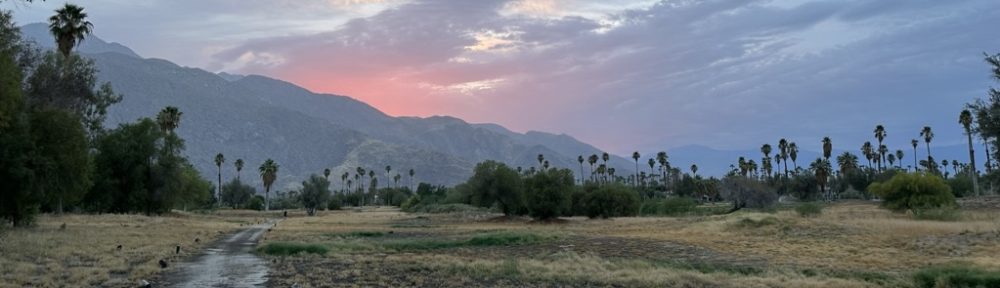
The hot air is thick with unfallen rain. My body feels too heavy to fly, so I walk along the creek. I see three white egrets. One is standing on one leg in the shallow water at the creek’s edge. The other two walk together. One keeps looking at the other. It feels like they are deep in conversation I can’t hear. I stop in the middle of the footbridge and face east. I can’t see the egrets now. But I hear a few frogs, just starting up in the early dusk. The crickets are singing, too, and I hear the buzz of cicadas in the cluster of smoke trees on the south side of the bridge. I run both hands along the sides of my face, my forehead, across my shorn hair, pushing back sweat. I take a deep breath, close my eyes and reach for that spot inside my skull. Nothing happens. I am trying too hard. “No, sweetling. Don’t push.” I can hear Kira’s voice as if it were yesterday and not two decades ago. She smiles, shakes her head. “Hold the thought—touch the place, but do not try to force it,” she says. She forms her words with care. English is not her native tongue. “Let it come,” she says. I blow breath through my lips and let them vibrate, make noise. I sound like a horse, I think. And then, horses can’t fly. I reach again, coaxing, gentle. The spot responds, thick and alive in my head. My feet leave the ground. I lift up, then falter and almost touch the bridge again. But I stroke the space inside me, that dense unseen thing, and I steady.

I lift up to the tops of the trees and hover, still hesitant. I have not been able to stay aloft for the past seven days, and I am afraid. “Easy,” Kira’s voice whispers. I remember to breathe, and I let myself drift east above the creek bed. I see the egrets again—they’d been hidden by a small palo verde. They look up but don’t react. The birds here are used to us by now. I turn over and stretch out my arms like a kid floating on her back. I am over the old golf course now, so I adjust my height to clear the tallest of the palm trees. I hear a grackle near where the pond used to be. It makes me happy. I haven’t heard a grackle here in a long time. Maybe we really are turning things around. Maybe it isn’t too late. I hope I’m right. Desirée doesn’t think so. We argued about it again last night. I can still taste the angry words in my mouth, still see her flying away from me as though she couldn’t leave me fast enough, moonlight on her back. Most people believe her. They think it’s too late. We are stupid and wasting our time. I only know a few who think like I do, who believe what we’re doing matters. Lisa. Shawnee. Verdis. But how could we not try? How could we live with ourselves if we didn’t? I begin to sink. My thoughts are making me too heavy. I’ve flown far. It will be a long walk back.

Become Big, or When I Write (13)

Natalie Goldberg says in Writing Down the Bones, “Become big and write with the whole world in your arms.” I love that. I love the way it makes me feel. When I write I am my mother who cleaned the house every Friday when I was little. Daddy brought home Bob’s Big Boy that night for dinner, the combination plates, so she didn’t have to cook. When I write I am my 4th-grade self walking down the hallway in my stepfather’s house in East Granby, Connecticut, when I heard the radio saying Kennedy had been shot. When I write I am big like the San Jacinto mountains that right now are diminished by the smog between us, but I am big like their massive shoulders, big like they are when the air is clean and you think you can reach out and stroke the ridge line like a sleeping bear. When I write I am the African on a crowded raft hoping to reach Italy alive. I am lost treasure at the bottom of the sea beneath him, gold doubloons among the old white bones. When I write I am the breeze that moves across my skin and still cools me in the early summer day. I am the wind that breaks my green umbrella. When I write I hold the field of sunflowers in my arms beside the path to Santiago de Compostela. When I am big I write with Hitler and George Bush (the son) and Glinda from The Wizard of Oz—they are all in my arms. And Toto, too. When I write I am clouds, streetlights, 4711 cologne, Stalin, Ray Bradbury, Natalie Goldberg. I hold rain and starlight, yerba maté with coconut milk and honey, exhaust fumes from the diesel truck my neighbor drives, eggshells in the trash wet with the whites I have syphoned off for the egg yolks I fed the cats. When I write I hold you and Aunt Doris and Huckleberry Finn in my arms. I hold myself in my arms. I learn to be tender with myself. When I write, I hold you, too, and try to be honest and kind.

Morning Kisses (11)

I like to wake up slow. When Sable is beside me, I turn over for morning kisses, pettings and rubbings of his soft furry face against mine. Today he takes off before kisses. Sofia comes instead. She never used to want to be touched, but now the cat she has become will present herself for affection in rare moments. (These times tend to be when I’ve just begun to work on the computer or have just sat down to dinner, and she’s pushy about it. I remind myself I don’t know how long she’ll be here because there is something about the way she invades I don’t find at all endearing.) This morning she is quiet. She gets in my face but then sits down. She lets me kiss the top of her head, stroke her cheeks. She stays for a long time. I talk to her about not hanging on for my sake, remind her to let me know when she’s ready to go. “I’ll help you go night-night,” I say. It makes me cry, good tears. I’m not open to her as often as I’d like to be, so this feels right. Then she decides to run off the bed, quick, jerky movements. She knocks my mini iPad to the floor. I yell at her. I remember I don’t want to yell at her. “Arrrgggghhhhhhhh,” I say, sotto voce, like the whisper of cheering baseball fans on the radio. But then I tell her she’s a creep. If I remembered to stop yelling, couldn’t I not call her names? Still, maybe it’s progress of a sort. I will add name-calling to the list, I think, as I walk to the door. I let the cats outside, step out into the courtyard with them. I say my little morning prayers. I try to forgive myself for yelling at Sofia (yet again). When I “come to,” when my eyes focus, I’m staring at the big waning moon just setting behind the San Jacintos. It is framed, postcard perfect, between the smooth green limbs of our Palo Verde. It makes me stop, this miracle, this affirmation of life, of magic in the world—this big gift. I stand there, grateful, and everything else seeps out of me. I watch, not moving, until she disappears behind the ridge. Goodbye, moon.

Ready to Pounce (10)

I read Natalie Goldberg’s chapter “Be an Animal” (from Writing Down the Bones). Her words surprise me. I’ve read it I don’t know how many times before, and yet it’s all new to me tonight, each image glistening and precise. She talks about how we are writers even when we are not writing. She tells us to be like the cat, all senses focused on our prey, ready to pounce. She urges us out into the world like this. It’s the way we are when we travel, I think, all the more so in a foreign country. But we can do it here, too, on our own block, across our own town. I discovered this on a Thursday when I left my car with my mechanic in Ukiah, half the day until it would be ready. I shouldered my day pack, walked across town. I came upon a small, deserted cafe, sat by the window, drank tea with half-and-half and honey. I explored the residential neighborhoods west of State Street. I stopped for giant zinnias, hummingbirds, a red front door. I stood for a long time listening to a mockingbird singing in a tall tree on a corner. I let myself move from street to street, changing directions on impulse the way I do in a strange city even though I knew Ukiah, even though it wasn’t new to me. I let it feel new. Without trying, I met it with Zen’s “beginner’s mind.” I remember coming upon a row of small businesses. The flower shop had buckets of red dahlias and yellow sunflowers sitting out on the sidewalk in the early morning shade. It woke up in me my old dream of having my own place for flowers, soup, books, the day’s used newspapers and a messy pile of paperbacks on the window seat. I used to picture myself sweeping the sidewalk in the mornings, setting up shop for the day. I loved the quiet satisfaction of the dream. That morning in my wandering I went across the street to a little park, put my pack on a bench, did my qi gong facing southwest under a big redwood. Later, I walked to the county library, went online, checked in with my students, did some grading. Ordinary things, but because I was in a strange chair breathing different air, I stayed more awake. In the heat of the summer afternoon I walked from the library to pick up my old red Jetta, my beloved Lolita Roja. I could still feel it, the mountain lion pace in me, watching, smelling, tasting the air as I walked through the streets of Ukiah.

Coyote Tears (9)

In spite of good intentions, I am late and run to the bus stop. I am grabbing adventure today, rushing off early on a Sunday morning, unheard of for me. On Sundays I like to laze around daydreaming over the “Travel” section of the L.A. Times, read my horoscope, eat scrambled eggs. Now as I hurry toward the bus stop I see a coyote in the park. She gets spooked, changes course and runs along the edge of the street behind me. When I turn to look at her she shies away. If I thought I could herd her back to safety, I would abandon my bus. But I know I would only scare her. She is running like a lost dog, hesitant, jerky. I am afraid to even look at her, afraid she will veer away from me into the path of a car. So instead I pray, loud, silent, fierce prayer that she be guided home, that she be kept safe. Please oh please. She stops near the corner, and I point down the street like the scarecrow in The Wizard of Oz. “That way would be good,” I say. She goes in the other direction, heading east. My throat hurts as she disappears. She is so lost, so tender, so very alone in this scary place. I look for her when I am on the bus, hoping she will make it, some scent will be familiar, and she will find her way. I don’t see her. The bus turns the corner, heading north, and I am sure I will not see her now. But there she is. She runs across the street in front of the bus, her panic rising. In moments we are past, and I can’t see her anymore. I cry then, big fat tears that come fast, wet my face in seconds. I turn away from people, toward the window. I push my glasses up, wipe my face with the backs of my hands, surprised and a little embarrassed. Please oh please oh please.

A New Moose (50)

Sunday afternoon the sun comes out in the middle of a hard rain. I look for a rainbow. I think of my father. “Oh,” I tell the cats. “A new moose is born.” I am excited. My father taught me this when I was three or four, an old Native American legend. The rain falls even harder. I hear it on my neighbor’s awning, watch the slanting fall of it through the sliding glass door. The sun gets brighter. “Oh,” I say, enchanted. “Maybe it’s more than one moose.” Then I grin. “Or maybe it’s a really big moose.”

Grace (49)

I wake up at 4:30 in the morning because Sofia is having trouble. I get up to give her more for her pain. On my way back to bed I see the almost full March moon hovering above our mountains on its way to the other side of the world. I stand by the sliding glass door and watch it, grateful to be awake to see it. After, I lie in bed awake, wrestling with my ongoing trouble with a colleague. These thoughts morph into worries about my job. What will happen if our nonprofit falters? Then I remember I don’t need to be afraid. I can trust the universe. Everything will be okay. I am curled up on my right side, Sable’s warm weight a comfort against my back. For a moment, I know I am held. Safe. Loved. It is like rolling onto my side on the yoga mat after Shavasana. I always lie there for a while, letting things sift through me, before I sit up and bow. “Namaste,” I whisper. The sky is beginning to lighten when I drift back to sleep.