Hope (47)

I was encouraged to read two recent arrests stirred protests over Arizona’s immigration law, glad to know there are civil rights organizations like Corazón de Tucson to rally outside the police department, activists like Alcaraz Ochoa willing to crawl under a Border Patrol vehicle to block them from driving away when the answers they gave him about why they were arresting Rene Meza didn’t satisfy him. It makes me remember I can’t blame all Arizonans for their racist legislation. It reminds me there are people there who didn’t want these laws in place, people who must be as appalled and embarrassed now as I was when our country elected Bush. It makes me remember to have hope.

Anti Arizona (45)

We were having breakfast together at my favorite place, Palm Greens Cafe, where once when they brought my food I commented about what a glutton I was being, and the kitchen staff serving me smiled an impish smile and said, “Yes, but a gluten-free glutton!” If I hadn’t already been charmed by the place, that alone would have won me over, stolen my word-loving heart. But when Corina told me she was considering Arizona for the next stage of her young wandering life, I think I went into some weird autopilot. I don’t remember half of what I said, only my gluten-free vegan pancakes with blueberries sitting untouched before me during my diatribe and the surprised looks on her parents’ faces across the table. I know I told them I didn’t want to spend one cent in Arizona because of their racist legislation and their lies. (I read one of the reasons they claimed to have crafted the anti-Mexican, anti-immigrant laws was because of increased violence along their southern border. But in truth, violent crime has gone down there in recent years.) I know I told them if I needed to go to New Mexico or Colorado from some reason, I would fill up the gas tank in Blythe and drive straight through their pretty desert state. I know my voice and my words were harsh, maybe shockingly so. I called Corina later to apologize for my vehemence. “I know it’s beautiful,” I said. “I can understand you wanting to go there.” But I’m still praying she’ll pick another spot.

I Am the Invader (43)

Once I walked from Ajijic to Chapala and back. I don’t remember how many hours I spent doing it, but I remember being present for big chunks of time, taking it all in with new and thirsty eyes. I avoided the highway for all but a two or three block stretch in a couple of spots where it was the only choice. I walked through cobblestone streets in the villages, past horses and cows and goats on the dirt roads on the outskirts. More than once I sensed I was walking where gringos didn’t show up very often, and probably not on foot, a woman alone. I didn’t feel afraid, only conspicuous from time to time.

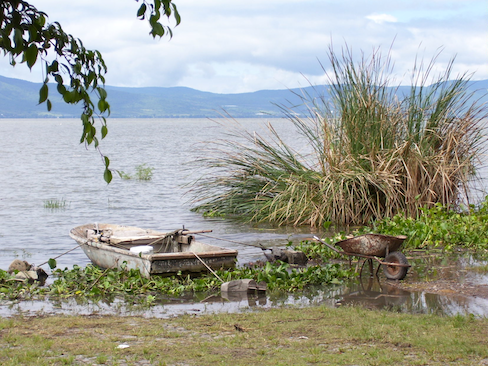
Shore of lake, old rowboat and wheelbarrow

I hugged the lakeside when I could. I passed old brick buildings, glassless windows, the courtyards swept clean, women doing laundry outside by hand, the cluck of chickens behind low brick walls with bougainvillea spilling over them. Once I stopped for a long time watching a heron standing still in the shallows near the shore, and I felt the richness of the life there, the birds, the water, the place where fertile earth and decay overlap, reminiscent of my visit to the deep south here, maybe Biloxi. I marveled at the idea of owning land beside this lake, how much that would mean to me, but wondering if it could feel like that same opulence to the locals in their poverty. East of San Antonio Tlayacapan there was a stretch where the road became more of a walking path than a road, dotted with shacks, more plywood lean-tos than dwellings. I passed a man and two children. They were sitting at the edge of the road, a piece of plywood for a table, a bag of bread between them, the makings of sandwiches. I remember the surprise on their faces when I appeared. I felt like I’d just walked uninvited through their living room. I can still see the man’s face. He is chewing, and he nods to me in response to my greeting. But his eyes are wary, resentful. I am the invader.

The Blind Man (42)

In Ajijic there was a blind man who I came to know a little. I can’t remember his name now. I’ve forgotten it, and the names of other people, names I thought would stay with me always. Was it Luis? The name pops up now, but I can’t be sure. He had a blind person’s cane, red and white, and carried a cup with him. I would see him at the Wednesday tianguis, the outdoor market, or standing in front of one of the supermercados that catered to the expatriates and the tourists. I don’t remember him ever asking for money. There were a few old women there who were pushy and demanding beggars, an odd entitlement I’ve never encountered before. But the blind man was only there with his cup, always cheerful, never pushy. I came to know him a little. We would talk about his family, about the thunder the night before, about what he might be able to do in order to still contribute to his family, about how much he’d like to learn how to play a musical instrument. I remember feeling good when he would recognize me. When I had the money, I would tuck a bill into one of this shirt pockets, tell him in a quiet voice how much I was sticking in there. Because I left so suddenly, I never said goodbye to him. It’s one of my small regrets. But I console myself with pictures of me finding him again one day, of him still remembering me, of being able to explain. “Lo siento mucho que no te dije adios, Luis.” I’m so sorry I didn’t tell you goodbye. “Yo te pensaba muchas veces desde me fui.” I’ve thought of you many times since I went away. I think of him still. I hope one day I find him well.

New Year’s, Too (40)

I don’t remember the noise of New Year’s Eve in Ajijic. But after October with the steady rotation of the statue of Guadalupe from church to church, rockets marking the progression every morning at 5am, and the two weeks of our saint’s festival, culminating in whole days of almost ceaseless explosions–not to mention having lived through the rainy season with the cascading thunder (!)–I am betting New Year’s Eve seemed quiet there in comparison.

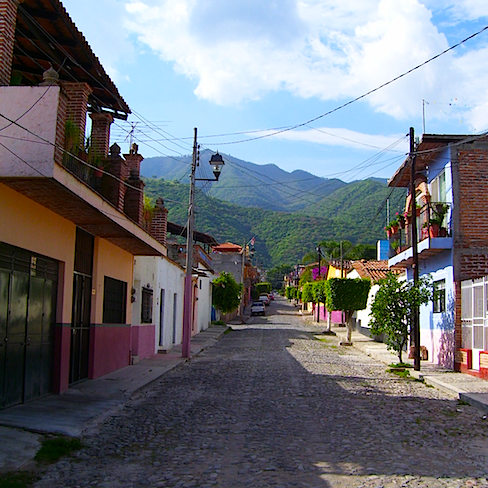
Cobblestone street in Ajijic

I do remember walking through the village on New Year’s Day, spying the evidence of street fires in every neighborhood. Everything was rather impressively cleaned up, no trash or half-burned logs or even big ashes left in the road from the last embers. But you could see the charcoal remains dusting the cobblestones every block or two, and you could feel the quiet, everyone asleep after the big night. Later I learned from Ana they would make tamales and have a fire in front of their own house on Zapata. They would stay up all night, eating and drinking and enjoying each other, the family, the neighbors, nearby friends. Staying up all night seemed to be part of the tradition, though I didn’t ask why. One truly greets the new year that way, I am thinking, more than only marking midnight.

Now every year I picture them together in the street on New Year’s Eve, the firelight dancing on brown faces, dark shining hair. I imagine Rodolfo has made his pipián, and there is a big metal pot filled with homemade tamales, and the corn husk wrappers pile up beside it as the night moves toward the dawn. I can almost taste the masa, can almost hear them singing. Happy new year, everyone.

Felíz Año Nuevo (39)

crossroads with corner market

In Todos Santos, I could see the bonfire in the dirt crossroads beside the corner market two doors down from La Casa Azul. Rockets bombarded the last night of the year, and the flash of firecrackers fell across the ceiling and the tall walls in my second story bedroom.

window and light on the tall walls

I was supposed to go to Iris’s for the evening celebration. I’d imagined driving over before dark, but she called me from a restaurant downtown where they had all ended up to let me know they wouldn’t be home until later. It took what wind was left in me, buffeted as I was from the neighborhood fiesta. I imagined trying to squeeze my red Jetta past all the other fires in the streets between my center of the old village and Iris’s home in el otro lado, fireworks arcing across my car, fingers gripping white on the steering wheel. I chickened out, hunkered down at home with the cats while the wild party crashed around our barrio. Felíz año nuevo.

What a Wonderful World

This is the note I wrote to go out with my Christmas cards this year. They have a colorful tree and the words “What a wonderful world” on the front of the card. I thought I’d like to share it here with all of the rest of you, too. Happy new era. Happy holidays.

image of ornaments on a tree

I first reached for this card because I liked the cool, artsy tree, the newsprint and paint. Texture and color pull me. The words on the cover conjure Louis Armstrong.
“I see friends shaking hands,” he sings in his rich, unmistakeable voice, “saying how do you do. They’re really saying, I love you.” The song was released the year before Martin Luther King, Jr. was killed. But you can hear the love in Armstrong’s voice. He was courageous enough, large enough, to believe in us, in spite of all evidence to the contrary. So when the phrase makes me pause, makes me wonder if it’s okay to choose this card given all the violence, all the hate, all the tragedy in our world, I can’t help but think there’s something wrong with that, something wrong that I should hesitate. These things don’t make the words untrue, do they? It is a world full of wonder—big sky, palo verde trees, grackles, people helping. It’s the world my father saw, the small wonders, a person’s profile in that gnarl of tide-washed wood, the magic bean sprouts he brought for my dog Sanji when she was dying, the label he made on his old manual typewriter still taped to the jar, crisp in memory, a cherished item when he died just weeks after she did. It makes me want to cry for him, for both of them gone now these 27 years. But it’s layered in me, the way they loved me, the way I’ll love them always. They are composted in me, rich, fertile soil, my carpet, my gifts, my wonder. And this is the time to look to those we love today, remember they are our diamonds, our emeralds, to run our fingers through them, these gemstones of ours, to spread them out in the morning sunlight or kiss the fire of their facets in the shining of the moon. Bring warm scarves, bundle them forward in the quiet almost-winter afternoon, count ourselves lucky. What a wonderful world.