The Waxing Light (41)

I am lying on my back on my yoga mat. I’ve come late to my practice today, so I’m on the living room floor, chased inside by the cold air. I move my head, and I can see the last light in the sky through the window, still visible in contrast against the darkness of the bougainvillea leaves in the late dusk. The white of the sky is a soft glow, like muted neon or dimmed florescence. I turn my head back, and my eyes sweep the little row of snow globes on the windowsill. There is something peculiar about them this evening, something caught in their curved glass. I check the sky again. Are there clouds up there, still lit by the sun long lost to our edge of the valley here beside the mountains? Sometimes the clouds are lit golden. But there are no clouds, and it’s too late really for them to still catch and hold the sun’s light from their heights. And then I realize what I’m seeing. It’s the Christmas lights I have woven around the bougainvillea trunk and branches. The green and blue and red and amber lights are showing up in my snow globes, five strands glowing there in miniature. I’ve always loved them, I think, in part because they’re little worlds, and they’ve never felt more like that than this moment with these tiny strings of lights alive in them.
Five colored lights against the stepping stones

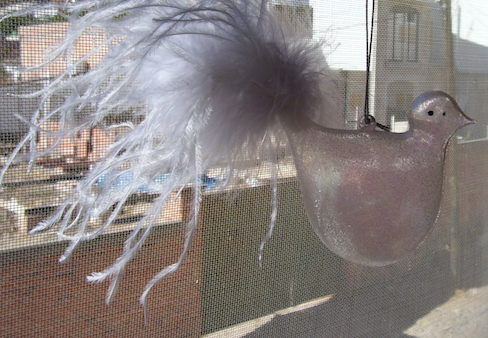
Glass bird in window with white feathers

I think of the lights I laced along the curtain rod in my Ajijic apartment, looping down into the windows so people would see them from the street below. I remember the white glass bird hanging there, a photograph somewhere, the white tail feathers floating against the window screen. I think of the rounded yellow bird so like that white one, that hung on my shower rod with three glass hummingbirds in Santa Rosa, and the shock of the crash when the rod gave way that afternoon, nothing but glorious shards left in the bathtub. I think of the new glass rooster on my patio table, sunlight through the red glass of his comb, his tail, his wattles. It is my love of color and light that leaves me always reluctant to take down my Christmas lights. I left them up late in Ajijic, too, though I felt self-conscious about it there. Would this be another mark of my crazy estadounidense self? Here I don’t seem to care what my neighbors think of me, the solar lights still sharp and vivid in the hedge beside the gate at night.
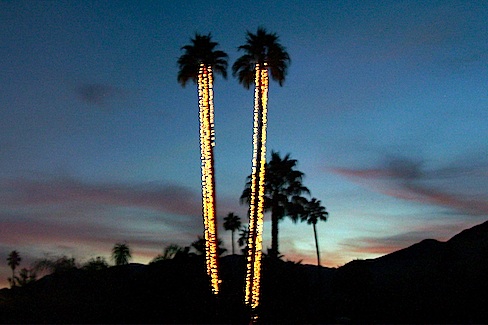
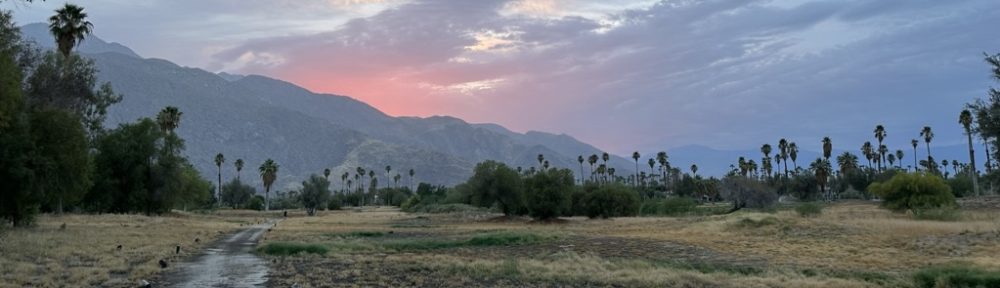
two tall palm streets strung with white lights

But I was glad all out of proportion to see two people in my neighborhood who still have their lights turned on, too. I asked Ana about it once, if people in Ajijic ever left their Christmas lights up despues del año nuevo, after the new year. She told me some people wait until after Candlemas to take them down. Candlemas is the Christianized name for one of the main pagan holidays on February 2nd. The Catholics call it the Feast of the Purification of the Blessed Virgin Mary. But as I understand it, we celebrate the waxing of the light. I told Ana I liked that idea, a kind of sanctioned extension of my pleasure in the lights. What better way to honor the growing light than with these bright colors in the dark? When I finish my yoga, I move on hands and knees to the windowsill, stare deep into the small glass globes. It is a wonder, I think, these tiny strands of light that stretch within them, sharp and clear and luminous. I bow to the light in each and every one of us. Namaste, indeed.
Not to Mention (37)

I become granite when I hear “English only” bandied about in this country. I don’t even try to be civil. All respect flies away. I am mean and hard, an unreasoning wall. I’ve even heard people complain about Spanish signage in Home Depot. How do they think this can hurt them? “These people should learn to speak the language,” they say. They mean Mexicans. My teeth clench. My skin crawls. I want to spit on them.

“How many languages do you speak?” I want to howl. Do you have any idea how hard it is to learn another language? Not to mention the fact that our corner of the country used to be Mexico. Not to mention the fact that when California became a state it was under the condition that it be bilingual. If we hadn’t broken that pledge, those of us who came up through the public schools here would all speak Spanish fluently. If we hadn’t broken that pledge, maybe I wouldn’t have to listen to the screaming racism underneath their words. Maybe I wouldn’t have to turn to stone.

Mexicans Are (31)

It’s some strange hubris of travel to think we know a country or a people because we came and saw a slice of it, of them. How many different versions of the United States do you imagine foreign visitors carry home? Did they stay with family in the Appalachians? Visit a dude ranch in Arizona? Make a wrong turn into Watts one afternoon when they were looking for the Hollywood hills? My Mexico was made up of poor villagers. They are the bedrock on which I base my sense of who the Mexican people are. They are quick to laugh, treat their burdens with a light touch, pay a man to rake the dirt road in front of their home because he needs the pesos even more than they do.

I met a handful of wealthy Mexicans, came to know two handfuls of people who struck me as part of a burgeoning middle class, enough to understand some of the differences between the socioeconomic strata there, how education and money shape their world. Enough to know better than to base my assumptions about life on Mexico on the lives of poor people in rural villages. But not enough to keep me from doing it anyway. I still remember the look on my Senor Soto’s face when I made this mistake, embarrassed myself. “Es raro, no?” I asked him. That’s unusual, isn’t it? He’d just mentioned he and his wife had two children. I was surprised, though looking back on it now I realize all the middle class families I knew there had only two children. He was driving the taxi, so he couldn’t stop to stare at me, but I remember his piercing look. His voice was kind, but there was steel beneath it.

“You can’t do that,” he told me in Spanish. He’d agreed to let me practice my Spanish even though he was fluent in English. (He even taught me the difference between the words “writer” and “author.”) “You can’t make assumptions about all of us like that.” His gaze moved between me and the highway. I was sitting in the passenger seat. We were on our way to the airport in Guadalajara. “Many people have only one or two children,” he said. “It just depends.” I had known it, seen it already, and yet I blundered in, two feet in my mouth, insulting this well-read man who was fluent in two languages, whose son was attending the university, whose wife and he had practiced family planning. I nodded, blushing.

“Entiendo,” I said. I understand. “Lo siento.” I’m sorry. His kindness never faltered, but he’d put me in my place, and I was glad he did. If I might muster even a faint echo of his grace the next time I need to speak up, I’ll be grateful. I have his business card tucked in my wallet. The day I return, I’ll call to see if he can pick me up from the airport. Or maybe I’ll email him ahead of time, so I can know Senor Soto will be waiting for me there.

Crossing (30)

I am fascinated by the boundaries between us. Borders between countries, lines drawn on rock, boundaries between people, between cultures–arbitrary or innate, they separate us, define us. But boundaries aren’t just barriers. They provide the arena for moving back and forth between the two. They offer the possibility of exchange. I can ride the charter bus from the Coachella Valley to Algodónes. I can walk across the border and be in Mexico. One line, drawn no doubt by nations after war, shouldn’t be able to make so much difference. I’ve studied the border from the bus, the way the fence runs through the desert, a jagged monster, the sprawling remains of extraterrestrials. I can find no clues, no evidence that one side of the fence should be so different from the other.

shot of the border looking toward Mexico from the U.S.

But walk a few yards toward el otro lado, the other side, and you can feel the change. It is of the body, I believe, and not the mind, yet I return to it again and again and again, wanting to make sense of it, trying to figure it out. When I walk across, my body knows I’m in a foreign country. Because I lived there once, it feels like coming home, but this is a comfort of the heart, I think, the soul, and not the body. The body knows this is not the land where it was raised. It’s not geography. My scrutiny of the fence line across the desert between us revealed nothing, only made me marvel, knowing just across it lives another world, a stone’s throw only, two crows flying. The land doesn’t change at the border, but we breathe different air. Spanish diphthongs and mariachi and sidewalks all sing Mexico. Grackles call out in their native tongue. Our bodies know.

Seasons (26)

I’ve heard the mockingbird singing from the top of the fan palm three mornings in a row. Today when I was lying on my back in the courtyard on my yoga mat, I listened to the verdin’s sweet three-note call. I pictured him sitting in the pine tree, his bright yellow cap and cheerful eyes hidden among the long green needles. Last week, both the hibiscus and the apricot mallow began to bloom again. The crickets have woken up, too. In spite of still mostly three-digit temperatures, they all recognize the secret signals, a heady mixture of the fewer hours of high heat each day, the angle of the sun making its way south, the nights in the seventies. And they aren’t grumbling like I am–tired of the heat, my tolerance used up–though they have more reason to than I who could escape it. They don’t indulge in weariness–they bounce. They celebrate in song, in bloom.

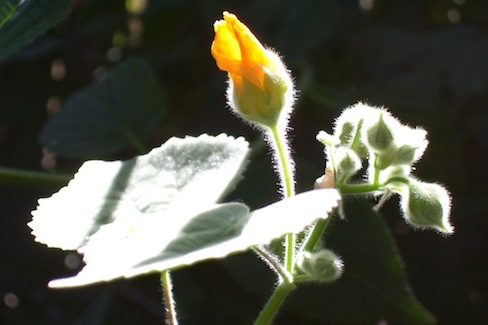
Apricot mallow with the sun shining on fuzzy leaves and one bloom

And their festivities cheer me on. I relish the feel of the cotton sheet over me in the early hours of the morning, the occasional weight of Sofia against leg or hip, missing for months now, a welcome surprise. I look forward to the day when I’ll be seeking the warmth of the sun on the patio when I do my yoga instead of hiding from it. I’ve lived in California most of my life, and still I bristle when someone tells me there are no seasons here. They are subtle but marked. Do not tell me otherwise. Soon the long clusters of green berries on the fan palm will ripen, and the starlings will feast, scattering in shiny black chattering when I walk outside. The days will grow shorter, the blue of the sky deeper. Riding my bike will become sheer bliss. Sometimes I think our desert, where some claim we have only two seasons, may mark the changes in the year more clearly than other parts of the state. Though I realize the changes are less visual than visceral. Here in the fall we begin to reawaken. We return to a state of grace, of ease in the outdoors.

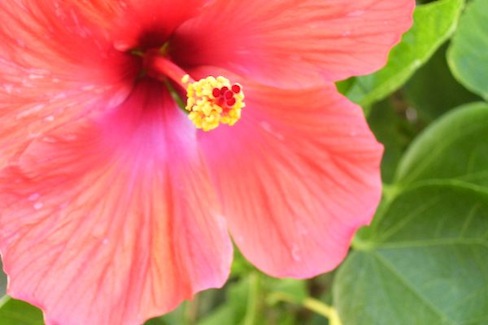
one red hibiscus bloom, cropped

The seasons were subtle in the places I lived in Mexico, too. But they were undeniable unless you just weren’t paying attention. In Todos Santos, the summer rains made for muggy heat, a boon for bugs, biting and otherwise. But it washed the dusty desert clean, changed the color of the world, the lush plant life made new. In winter you could go barefoot in the warm dry days. I remember sitting in my third-floor roost in La Casa Azul, my feet propped up against the rebar railing, marveling at being barefoot in the middle of January. You knew it was winter there by the nights. In Ajijic, jacarandas trumpeted the burgeoning spring, their lilac blossoms littering the cobblestones. The “rainbirds” were the harbingers of the summer rains, not birds at all but insects, a kind of cicada, I think. You could mark the onset of the rains on the calendar from the date you first heard the rainbirds sing. Autumn there meant a world of green, the hills bathed in all their new-growth glory after months of nightly rain. And fresh, sweet corn was everywhere.

A World without Cars (23)

I’m riding my bike home from the laundromat on the path that runs along Highway 111 when two motorcycles fly past on the road. My body startles and cringes, shock to ears and cells and heart. “Why aren’t things like that outlawed?” I shout to the hot air as I push the pedals in the afternoon heat. “There’s no reason we should have to live with that kind of blaring, grating noise,” I say. I am only grumbling now, my heart finding its rhythm again. I want to live in a world without cars, I think for the fourth time this week. But is there such a place, one without sacrificing all connection to the modern world? If I flee to the country, there is still always a highway somewhere nearby, the steady background of engines and heavy masses moving past. Do any of our communities ban vehicles, the way some ban leaf blowers? If I had moved to Todos Santos ten years earlier, it would have still been a slumbering fishing village on the rise, only a thin ribbon of traffic on the highway marring the quiet. But when the burgeoning expatriate community started building their homes, the first thing the locals did with their money was buy big shiny pickup trucks. What would it have been like to make my way across town on the dirt roads there without a car in sight?

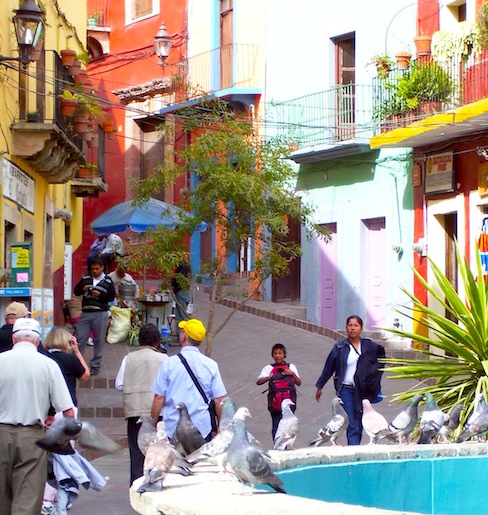
angled entrance of alley in Guanajuato with people walking and pigeons

When I visited Guanajuato, I was thrilled to discover several blocks of their downtown closed to traffic. The streets were for us, for humans walking or climbing the crisscrossing stairways up the steep hillsides, the callejones that branched off all over the small city. I wanted to live there, stood for a long time in the middle of the road studying a house for rent and dreaming. And Ajijic was not a town with motorcycles screaming through it. The narrow cobblestone streets did not lend themselves to speeding. Instead, expats ambled past in golf carts, kids drove ATVs and somber middle-aged caballeros rode their horses, or practiced their parade gaits on a quiet street, the hard hooves ringing against the cobblestones, more music than noise. But here, where many of the surface streets have a 50 or 55 miles-per-hour limit, there are always huge blocks of steel hurtling past you. I shrug off my momentary terror at the motorcycles roaring past and the anger that followed it and keep my bike moving west, glad of the small buffer of palm trees between the highway and the bike path. All those loud chunks of heavy metal rocketing by are disconcerting, a constant looming threat to skin and bones. I wonder, not for the last time, if there is a village or an island in this world without cars I might one day call home. Maybe I need to give Guanajuato another look.

The Trouble with Attachments (14)

Three years ago on the first of July I was driving west across northern Mexico in the late afternoon. I planned to spend my last night in the country near the little border town of Sonoyta. I wanted to cross into Arizona early the next morning. The weather had been kind to us, clouds hugging our toll road for the past three days, but it was still hot. Undeveloped desert stretched in all directions. The night before, we stayed at a wonderful motel, but I can’t remember where it was. I only remember there were big trees and grassy areas, wild ferns, lush growth in contrast to the sparse desert. I walked to see the nearby river from the overpass, and on my way back to my room a big truck drove past me. It was filled with pigs. They were screaming, as though they knew where they were going. I’ll never forget the sound or the feeling of helpless terror it conveyed. I remembered reading (in a romance novel!) that pigs are almost as intelligent as dolphins. Now when I miss bacon I remember their screams.

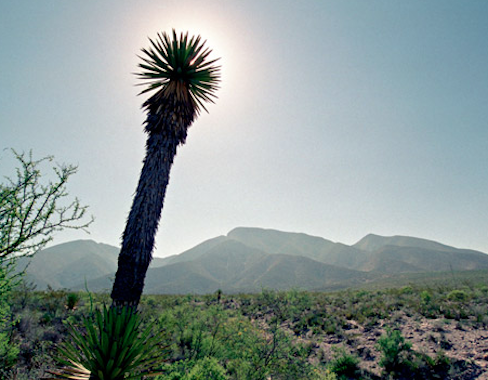
Desert and mountains copyright Tommy Huynh

Later, I ate dinner on the patio. I lingered through the late afternoon and evening by the pool. It was safe and soothing, my oasis in a stressful journey from Jalisco with my two cats. But as is my wont, I decided I would try to repeat this luxury the following night. This is where I went astray. In the afternoon when I was about an hour or so from the border, I saw a motel in the middle of nowhere, sitting alone on the right-hand side of the highway. It was new, and the man in the office was warm and kind. But I had it in my head I wanted a pool. He told me about a motel with a pool in the next town (whose name also escapes me now, and no staring at my worn and folded map evokes an answer), so I thanked him and drove on. I found the motel and checked in. And little by little I discovered this was where the army stayed. There was a pool, all right, but it was crowded with young army men on their off shifts. I was damn well going to swim anyway, and swim I did, weaving in and out of the boisterous young men. I chatted with one, treading water in the deep end, and that’s when I got the skinny on the place. It turned out they came and went all night long.

It wasn’t only the incredible, constant noise that marred my night. It was the energy of the military outside my door and the sight of all those young men carrying machine guns, that even after almost two years in Mexico I never learned to see without a little skip in my heart. To this day I am convinced my last night on the other side of the border would have been filled with big sweetness if I’d only stayed at the place that caught my eye, not had my heart set on a pool at all costs, been content with my previous night’s oasis without being greedy and trying to grab after more. But there was sweetness in the early morning hours there. I couldn’t get Sable out from under the bed when I was ready to leave, and one of the army guys who was out by the pool offered to help me. I couldn’t have done it alone, and I owe him a debt and my big gratitude. Maybe he was the reason I was there.

[Editor’s note: This photo is by Tommy Huynh. He holds the copyright, and you can find it on his website: http://www.lumika.org/mexico/natural_scenes/14.htm. Used here with his permission. And on another note, I got a chuckle out of my title here. I wondered if people would think I was going to talk about problems with attached files! ;-) ]