Africa? (27)

I dream I am in a foreign country. I drive across a sprawling city where there are no tall buildings, and all the roads cross on the diagonal. Later, I am in a big high-ceilinged room with a hundred children. They are all busy talking in a language I don’t recognize. When I leave, I drive on a narrow dirt road barely as wide as my car. The road peters out into a path, wide enough for people or burros, and in the dark I picture people walking there. The sides of the trail are covered with sand, spotted with scrubby vegetation, though I have the sense of trees in the distance, and open, undeveloped land that goes on and on toward the east. I turn the car around, thinking about my afternoon with the children.

My mind is working on the differences between this world and my own. I feel like I did when I first moved to Baja California Sur. I was glad I had driven there even though the driving itself was nightmarish. But it gave me a clear sense of the vast wilderness that lay between me and the border, long open distances like in the dream. I remember in those first weeks in Todos Santos noticing all the differences between the two worlds, my mind on overdrive, always comparing, contrasting, wondering, discerning.
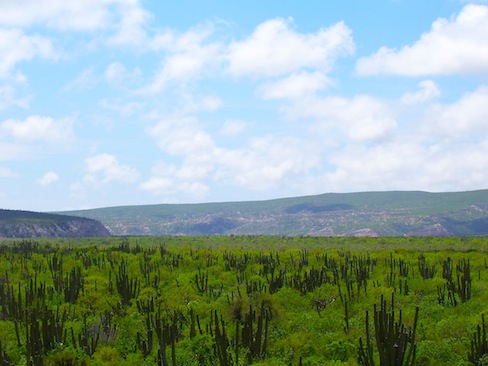
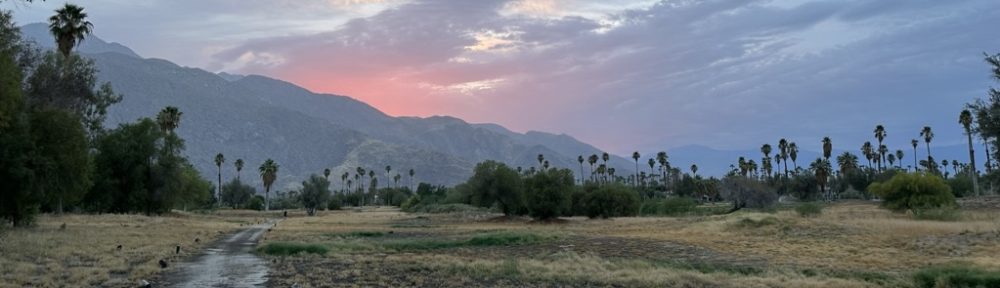
image of sky and lush wild green with mountains in the distance

There were little things and big ones everywhere I looked. In Mexico, the check is never brought to your table at a restaurant until you ask for it. In Mexico, you never approach someone in a store only to blurt our your question or your demand. You say good afternoon, buenas tardes. ¿Como está? How are you? You make contact first, present, courteous. In Mexico, you might sit on the patio reading or working online. You might forget you are in another world. But then you glance over your shoulder and see an iguana as big as your leg from the knee down, as thick around as your muscled calf. He is eating leaves in a nearby tree, his chewing slow and relaxed. He seems benign, but to have him munching yards away from your table is surreal.

In my dream, as I get the car turned around and head back the way I came on the dirt road, I remember how it felt when I couldn’t quiet my brain, couldn’t stop taking the measure of all things. I am doing it, too, in the dream, comparing the culture of this undeveloped country with my own. I watch the sandy banks beside the road in the headlights. I like this foreign land. But it will be much harder, I think, to come to understand the differences between this world and mine without knowing the language here. I’ll have to get to work on that.
Scorpions and Besoconas (24)

I am watering the palm trees and the bougainvillea in the side yard when I think I see a small scorpion curled up against the faded red cement. Even as the possibility takes shape in my mind I have already washed it away. I stand barefoot on the wet stepping stone and point my nearsighted eyes around the edges, hunting for that familiar form. I don’t see the scorpion, but there are dried blossoms everywhere, evidence of my careless gardening. It would be easy to blend in. I bend close to the ground, afraid of spotting it, my wet toes curling at the thought. The scorpions I removed, again and again and again, from our blue house in Todos Santos come back to me now. I can’t remember my exact method, only the stiffness of my arms extended in front of me as I carried the scorpion out to the back patio and with each slow step the stifling of my urge to shriek and fling it violently away.

There were spiders in that home, too. I remember one black body crawling up the orange kitchen wall. It was bigger than my hand, my fingers spread wide. I left it alone, managed not to scream, not go running down the dirt road, gibbering in horror. I shudder even now, make another quick check around the circumference of my feet. All clear. I hose down my knees, my shins, wriggle my toes against the glistening cement. Did I really see a scorpion just now? And if I did, was it dead or alive? I shiver, go back to my watering. There are some things I don’t miss about living in Mexico, I think, as I turn to retrace my steps along the walkway. I wonder if some things, like spiders the size of plates, might even make me hesitate to live there again.

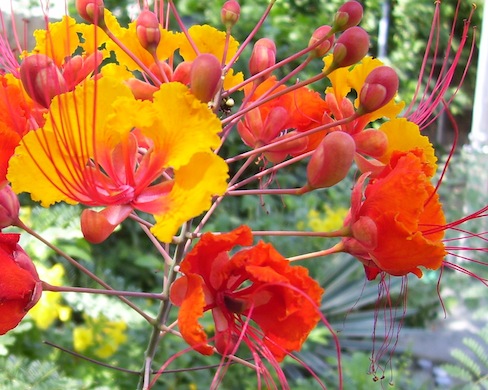
Close-up of Mexican birds of paradise blossoms and buds

I shake my head, as if I could dislodge the thought, and walk through the cool wet to water my tecoma and my Mexican birds of paradise. They are both spilling out of their ceramic pots, encroaching on the path, lush and stunning in their messy late summer opulence. I see the painted gecko peeking out behind them, and I remember the high-pitched kissing sounds of the besoconas who lived in the palapa roof of our first Todos Santos rental. I liked their company, and I miss their cheerful noise. I remember, too, they are great eaters of bugs.

A World without Cars (23)

I’m riding my bike home from the laundromat on the path that runs along Highway 111 when two motorcycles fly past on the road. My body startles and cringes, shock to ears and cells and heart. “Why aren’t things like that outlawed?” I shout to the hot air as I push the pedals in the afternoon heat. “There’s no reason we should have to live with that kind of blaring, grating noise,” I say. I am only grumbling now, my heart finding its rhythm again. I want to live in a world without cars, I think for the fourth time this week. But is there such a place, one without sacrificing all connection to the modern world? If I flee to the country, there is still always a highway somewhere nearby, the steady background of engines and heavy masses moving past. Do any of our communities ban vehicles, the way some ban leaf blowers? If I had moved to Todos Santos ten years earlier, it would have still been a slumbering fishing village on the rise, only a thin ribbon of traffic on the highway marring the quiet. But when the burgeoning expatriate community started building their homes, the first thing the locals did with their money was buy big shiny pickup trucks. What would it have been like to make my way across town on the dirt roads there without a car in sight?

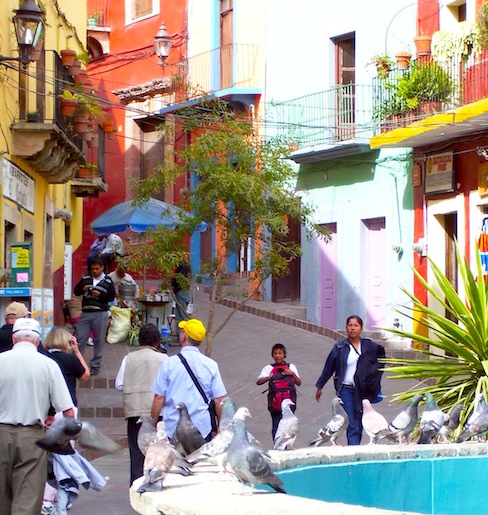
angled entrance of alley in Guanajuato with people walking and pigeons

When I visited Guanajuato, I was thrilled to discover several blocks of their downtown closed to traffic. The streets were for us, for humans walking or climbing the crisscrossing stairways up the steep hillsides, the callejones that branched off all over the small city. I wanted to live there, stood for a long time in the middle of the road studying a house for rent and dreaming. And Ajijic was not a town with motorcycles screaming through it. The narrow cobblestone streets did not lend themselves to speeding. Instead, expats ambled past in golf carts, kids drove ATVs and somber middle-aged caballeros rode their horses, or practiced their parade gaits on a quiet street, the hard hooves ringing against the cobblestones, more music than noise. But here, where many of the surface streets have a 50 or 55 miles-per-hour limit, there are always huge blocks of steel hurtling past you. I shrug off my momentary terror at the motorcycles roaring past and the anger that followed it and keep my bike moving west, glad of the small buffer of palm trees between the highway and the bike path. All those loud chunks of heavy metal rocketing by are disconcerting, a constant looming threat to skin and bones. I wonder, not for the last time, if there is a village or an island in this world without cars I might one day call home. Maybe I need to give Guanajuato another look.

The Music of Mexico (22)

When I flew to Cabo San Lucas for the first time, a kind man took me in his taxi to catch the local bus just outside the airport. I remember a woman smiling at me when I took my seat. The bus driver left the door open as he drove, dirt flying away from the wheels where the side roads reached the paved highway. I was a ringing bell, the loud music and the air and the open desert in the distance resonating through me. I was so filled up I cried. There were times when I lived in Mexico when instead it was all dissonance, when I counted music blasting from six different neighbors in crazed competition, or on the fourteenth day of the town saint’s festival when the rockets exploded nonstop, and after two weeks of it, my endurance was shot. I wanted to scream. But there is a cadence to a country, some etheric weaving of language and land, of custom and spirit, and our bodies grow used to this rhythm. We miss it when it’s gone.

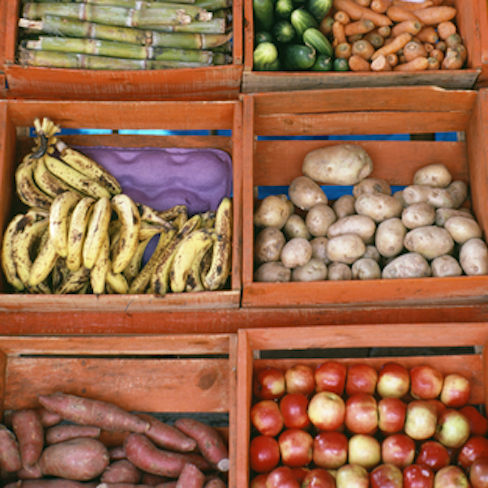
vegetables in wooden bins at Mexican market

When I first came back from Mexico, Sortera’s family produce stand at the farmer’s market here became one of my comforts. I latched onto them as one of the places I could still speak Spanish. I remember when I was still raw, listening to their rapid speech, their lively, happy banter, their laughter, for me the undercurrent to everyday life in Mexico running through it. I would stand there choosing a head of green cabbage, or filling a plastic bag with yellow and red and green bell peppers, and let it all wash over me, both soothed by it and filled with yearning. The ambient sounds were wrong, I know, but if I closed my eyes, I could have been standing at my favorite produce stand in the tianguis in Ajijic, the weight of the cabbage heavy in my hand. The day I spent in Algodones, it was the song of the grackles by the river that swept me back in time. And later in the little town’s zócolo, part park, part plaza, I sat on a white wrought iron bench and let the familiar sounds cradle me, the taco vendors, the music cranked up from someone’s car stereo, the loudspeaker mounted on a passing car announcing some event, the occasional grackle. I closed my eyes and let the music of Mexico wash over me. Now I let the memory carry me back, let it ring my bell.


Refrigerator Blues (21)

When I moved into La Casa Azul, the refrigerator was filled with old food. It was sitting, skewed, on top of two old wooden pallets, and there was mold and rust everywhere. I threw out the food, scrubbed each surface with soap. When I brought its condition up with the man who handled the rental for the famous Mexican artist who owned the blue house, Umberto looked blank and suggested I paint over it. I didn’t let this mar my new dream home. The building was alive with color and light. I felt like I could spend the rest of my life there. I’d never felt that way before. When I moved into my current home, my landlord emphasized the importance of the hedges being watered, of my not interfering with the automatic timer. When I discovered the timer didn’t work, I told my landlord. “Do you have a hose?” he asked. Last year he stopped having the hedges trimmed, though I’ve fought for them to be done again twice now in the past six months. But the pyracanthas have been getting more and more bare, my privacy in my courtyard garden now more illusion than real. And then my refrigerator died, and he wheeled a “new” one for me upright down the road from around the block, rattling and bumping along the asphalt. My jaw dropped. I spent three hours cleaning it out and trying to get the marks out of the floor, only to discover it didn’t work anymore. It shouldn’t have been a surprise.

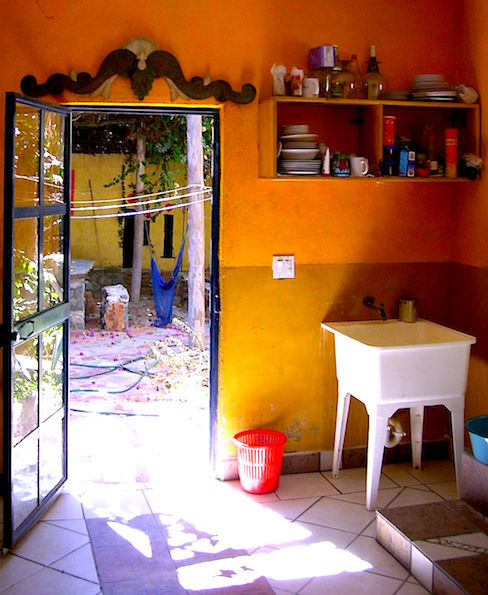
kitchen of La Casa Azul, door open to the patio, orange walls

But it wasn’t just the hassle of the refrigerator. It was cumulative. The hedges might be dying. Could it really be from lack of water? “Do you have a hose?” rang in my mind. “Puedes pintarlo,” Umberto had said. You can paint it. And before I left Todos Santos, the refrigerator stopped working all together. I didn’t even ask them to fix it. Things had deteriorated beyond that. I lived out of my two little ice chests. I felt helpless in Todos Santos, trapped. In the end I fled my beloved Casa Azul. I’ll always be glad I did, and I’ll always regret it couldn’t have worked out differently. When the wealthy Mexican artist refused to give me back the $700 he owed me from my deposits, the bad fridge was one of his reasons. The memory still brings me to wall of anger, the stone cold against my fingers. So when I found myself living out of my ice chests again here, I know the rest of this was at work beneath the surface. I was desperate to get away, out of all proportion to the circumstances. I threw myself once more into looking for a mobile home, contemplating buying a trailer, even looking at other rentals. But then my landlord gave me his refrigerator, and the panic eased. I am now soaking the hedges every other day, hoping they’ll revive. And I’m thankful I’m not fleeing. I know when the day comes, it will be hard to leave my enchanted courtyard garden. I don’t want it to come in haste, unsettled, my need to escape eclipsing everything. I want the peace of mind to cherish what I have through that last day, still obscured in mist, be it in two months or twelve years. If I could do it over again, I would stroll through the kitchen at La Casa Azul with all my gladness and all my gratitude sitting there beside my grief. I would run my hand against the orange wall, take in the sunlight and the colors and relive that last goodbye without the taint of despair, my clear heart cheering in a loud and grateful voice.

La Milpa (18)

One time when I did say yes to Mexico, I got to visit Rodolfo’s milpa, the one south of the carretera, the highway, just west of Ajijic. We rode the bus together, Ana and Rodolfo and their daughters Isabel and Mariane and I. Milpa translate’s literally as cornfield, but Rodolfo grew other vegetables, too. They were all nourished by the nightly summer rains. Every year at harvest they had a gathering at his other milpa, north of the highway somewhere. They roasted elote over a big open fire, the corn in their husks, drank tequila, danced. I don’t know how I missed it, but it breaks my heart now to think I may have passed it up. I hadn’t been there long yet, so I maybe I was too shy, but I know I would have done anything to get there in that second summer. But I left that year when the corn was still growing.

The milpa was a few blocks more to the south, between the carretera and the lake. We walked together on the country road in the late summer afternoon. I remember being transported when I followed Rodolfo through the rows of corn. They must have been twelve feet tall. It was another world inside them, all pale green light, moist earth and growing things. He brought us to a makeshift table in the distant heart of the field. Rodolfo picked a handful of pepinos, cucumbers, and washed them with a gallon of water he’d carried with him on the bus. He had a knife to slice them, and Ana produced limes and salt and chile. We ate pepinos picados in our little spot carved out from the forest of corn, and I remember being charmed and oh so grateful they had wanted me to come.

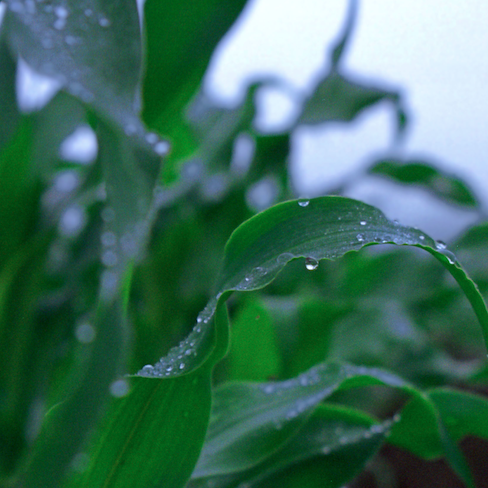
corn plant leaves with raindrops © Tomo Yun

It began to rain, and I licked lime and salt from my fingers. We grabbed everything and ran down the road, laughing, the rain coming down in fat drops, pelting us as we ran. Rodolfo led us to a half-built home a block away. We stood in an unfinished room while the rain beat down on the metal roof, nibbling on brownies I had bought from a cafe in town and crunching crisp red apples. I have always loved the sound of rain on a metal roof, the smell of the first drops hitting dusty earth. I was glad for the water going to the milpa.

Rodolfo talked about the half-built home, abandoned now. It belonged to a friend of his, and when he looked around, I could see in his eyes the way he imagined it in his mind, picturing it fixed up, livable. But Ana only rolled her eyes. She was not eager to live in the country. Over my dead body, she might have said. But I could see it, too, the place restored, the dream of it. Rodolfo and I looked at each other and smiled. Who knew?

[Cornfield photograph cropped from the full version, © Tomo Yun at www.yunphoto.net/en/. Used with permission.]

Salsa that Sings (17)

Sortera gave me some extra ripe heirloom tomatoes at the farmer’s market Saturday morning. “¿Para mi?” I asked, surprised, pleased. She nodded.

Para salsa.

Ah, muchas gracias,” I said. “¡Que bueno!” I thought for a moment. I big grin came over my face, the child who has figured out something wonderful. “Tengo chips!” I declared, and she smiled back at me. What luck.

I was so glad she offered them to me again. The last time I had hesitated, demurring, suggesting she might want to make salsa from them. (So dumb, this one—of course she could have all the tomatoes she wanted. This was her family’s business.) I know I upset her. I was able to convince her I’d love to have the tomatoes. But in Mexico there should not be any hesitation, only the resounding “Yes.” You accept all that’s offered.

I’m not sure I could ever learn to do that. I know when I lived there I turned things down, begged off because of my work, my lack of time. On New Year’s Eve in Todos Santos, I called Iris to tell her I wouldn’t be coming to their family celebration after all. I felt terrible about it, but I didn’t want to drive past all the bonfires in the streets, through all the fireworks. I was afraid, hid out at home instead. In Ajijic, I turned down more than one invitation to visit my neighbor Ramona, though I don’t think she ever took offense. I think I may have even bowed out once from attending the harvest celebration at the milpa, and I’d undo that in a heartbeat now if I could.

The truth is I was working a lot–too much still then, I think–so much of my time in Mexico spent at home, hunched over my laptop. Though that work allowed me to be living there, so my lament can’t be too strong. Still, I regret not learning more, not leaving with more knowledge, not bringing back more concrete memories. I wish I’d asked Ramona to show me how to make salsa in her molcajete, her basalt mortar. She worked for hours in her dark kitchen, making almost everything from scratch, filling the traditional female role for her big family. She would have been happy to teach me, I think. It would have given us something to do together, too, would have been better than our awkward but heartfelt greetings, our shy but regular exchanges of small gifts, our attempts at chatting when I say with her family in their living room.

And Rodolfo would have permitted me to watch him cook, I’m sure. I know he loved for me to get so much pleasure from what he prepared. I could have learned how to make pipian from a master. And when I made salsa from Sortera’s tomatoes now in my southern California home, even if I made it in the blender, it would sing to me of Mexico. Instead, it makes me miss it more.