The Waxing Light (41)

I am lying on my back on my yoga mat. I’ve come late to my practice today, so I’m on the living room floor, chased inside by the cold air. I move my head, and I can see the last light in the sky through the window, still visible in contrast against the darkness of the bougainvillea leaves in the late dusk. The white of the sky is a soft glow, like muted neon or dimmed florescence. I turn my head back, and my eyes sweep the little row of snow globes on the windowsill. There is something peculiar about them this evening, something caught in their curved glass. I check the sky again. Are there clouds up there, still lit by the sun long lost to our edge of the valley here beside the mountains? Sometimes the clouds are lit golden. But there are no clouds, and it’s too late really for them to still catch and hold the sun’s light from their heights. And then I realize what I’m seeing. It’s the Christmas lights I have woven around the bougainvillea trunk and branches. The green and blue and red and amber lights are showing up in my snow globes, five strands glowing there in miniature. I’ve always loved them, I think, in part because they’re little worlds, and they’ve never felt more like that than this moment with these tiny strings of lights alive in them.

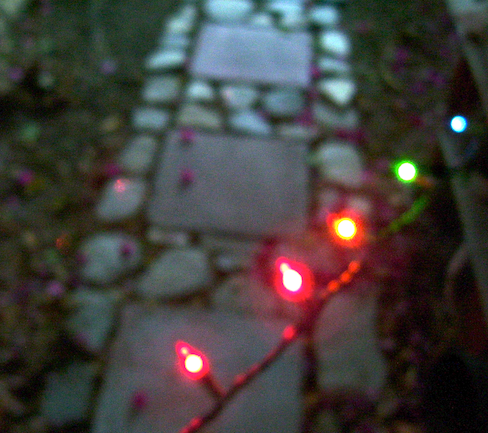
Five colored lights against the stepping stones

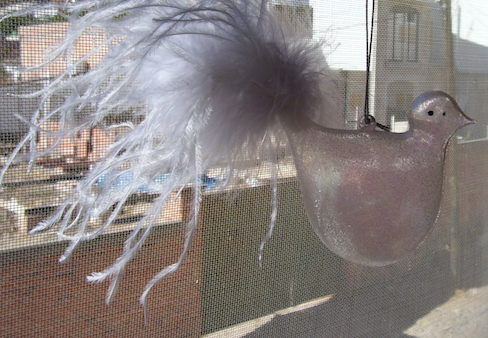
Glass bird in window with white feathers

I think of the lights I laced along the curtain rod in my Ajijic apartment, looping down into the windows so people would see them from the street below. I remember the white glass bird hanging there, a photograph somewhere, the white tail feathers floating against the window screen. I think of the rounded yellow bird so like that white one, that hung on my shower rod with three glass hummingbirds in Santa Rosa, and the shock of the crash when the rod gave way that afternoon, nothing but glorious shards left in the bathtub. I think of the new glass rooster on my patio table, sunlight through the red glass of his comb, his tail, his wattles. It is my love of color and light that leaves me always reluctant to take down my Christmas lights. I left them up late in Ajijic, too, though I felt self-conscious about it there. Would this be another mark of my crazy estadounidense self? Here I don’t seem to care what my neighbors think of me, the solar lights still sharp and vivid in the hedge beside the gate at night.

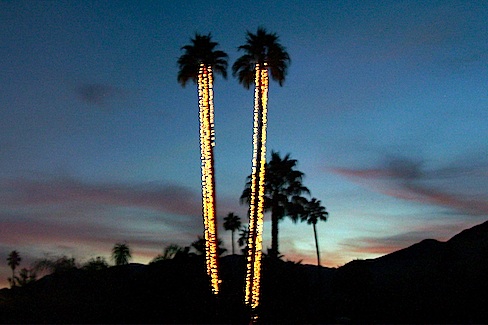
two tall palm streets strung with white lights

But I was glad all out of proportion to see two people in my neighborhood who still have their lights turned on, too. I asked Ana about it once, if people in Ajijic ever left their Christmas lights up despues del año nuevo, after the new year. She told me some people wait until after Candlemas to take them down. Candlemas is the Christianized name for one of the main pagan holidays on February 2nd. The Catholics call it the Feast of the Purification of the Blessed Virgin Mary. But as I understand it, we celebrate the waxing of the light. I told Ana I liked that idea, a kind of sanctioned extension of my pleasure in the lights. What better way to honor the growing light than with these bright colors in the dark? When I finish my yoga, I move on hands and knees to the windowsill, stare deep into the small glass globes. It is a wonder, I think, these tiny strands of light that stretch within them, sharp and clear and luminous. I bow to the light in each and every one of us. Namaste, indeed.

Crossing (30)

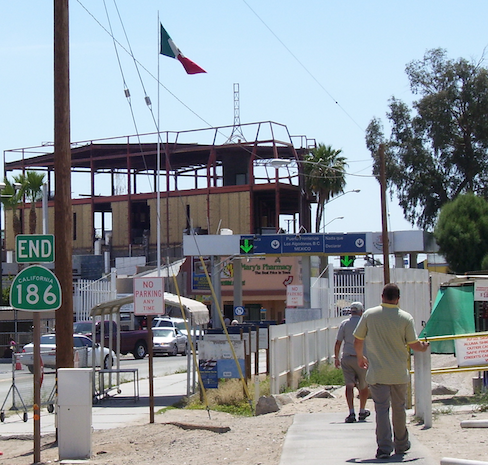
I am fascinated by the boundaries between us. Borders between countries, lines drawn on rock, boundaries between people, between cultures–arbitrary or innate, they separate us, define us. But boundaries aren’t just barriers. They provide the arena for moving back and forth between the two. They offer the possibility of exchange. I can ride the charter bus from the Coachella Valley to Algodónes. I can walk across the border and be in Mexico. One line, drawn no doubt by nations after war, shouldn’t be able to make so much difference. I’ve studied the border from the bus, the way the fence runs through the desert, a jagged monster, the sprawling remains of extraterrestrials. I can find no clues, no evidence that one side of the fence should be so different from the other.

shot of the border looking toward Mexico from the U.S.

But walk a few yards toward el otro lado, the other side, and you can feel the change. It is of the body, I believe, and not the mind, yet I return to it again and again and again, wanting to make sense of it, trying to figure it out. When I walk across, my body knows I’m in a foreign country. Because I lived there once, it feels like coming home, but this is a comfort of the heart, I think, the soul, and not the body. The body knows this is not the land where it was raised. It’s not geography. My scrutiny of the fence line across the desert between us revealed nothing, only made me marvel, knowing just across it lives another world, a stone’s throw only, two crows flying. The land doesn’t change at the border, but we breathe different air. Spanish diphthongs and mariachi and sidewalks all sing Mexico. Grackles call out in their native tongue. Our bodies know.

Cinco de Mayo Martín (6)

A young man is standing at the bus stop when I arrive. “Do you speak Spanish?” he asks me. We end up talking on the bus together, trading off between English and Spanish, and we don’t stop until over an hour later when we reach my bus stop. It is such a joy. His name is Martín. He lives in Mexicali and is doing my planned trip in reverse, Greyhound from Mexicali to Indio, then our local buses. He is twenty-seven, and he is tall. It runs in his family, his town. From the Spaniards? We wonder out loud. His accent when he speaks English sounds more European than Mexican to me, and I wonder where his teacher was from. I think he may have more English than my Spanish, but he has no chance to practice. Would I be the only estadounidense there? The only gringa? He loves Mexicali, wants to spend the rest of his life there. I tell him I felt that way for the first time when I moved to Sonoma County. He lived in L.A. for a few months when he was fifteen. He was lonely, I think. He missed fútbol.

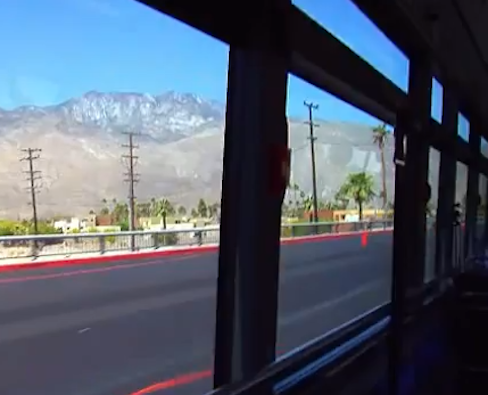
mountains visible through the bus window

I tell him about the near miss I have just had outside the casino after my Kentucky Derby day with Auntie Christel, how the runaway car might have hit me, only seconds to separate me from its path, stopping on the corner to take stock. “Fue muy ‘creepy,'” I tell him. He gives me the Spanish word for it. Espeluznante? I tell him how grateful I am to be here, safe, alive. He tells me his own story, at a party the week before, moved to go home early only to find his mother lying on the floor. How grateful. We understand each other, the bigness of the events. He is young, I tell him, to be going through this with his mother’s illness. I was twenty-four when my stepfather died, Martín’s age when my father died. I think he knows I know. But there are differences. I hope his mother will get well, and when I needed to call 911, I bumbled, my adrenaline blocking my brain. But Martín became clear-headed and superhuman, scooping his heavy mother into his arms, getting her to the hospital. And he remembered all the details in the process, to bring the phone, grab her meds, lock the door. It was a huge victory for him, and so validating, I think, knowing he could do so well in an emergency. But later, like the time I pulled the big dog off my cat Trair and threw him across the yard, Martín was sore for days. We laugh. I feel glad for him, and proud, even as my heart breaks a little that he needs to go through this.

I ask him to tell me about Mexicali. He names a plaza, and somewhere else that is a good place to walk. I scribble them down on the envelope my horseracing money was in. I will hunt for them when I go, think of him. We don’t exchange phone numbers, and as soon as I am home I am sorry. I would have liked to visit him in Mexicali, meet his family. So now I fantasize his sister in Desert Hot Springs will find my blog, read about my Cinco de Mayo Martín, put us in touch. I am talking on the phone, telling my friend Janice about our meeting, about the sweetness of it, how glad we both were, how grateful. I realize in the telling how meeting Martín felt like a reunion. Maybe one day I will walk in the Plaza Calafia at dusk and find Martín and his mother sitting on a bench, and we will sit together and listen to the birds roosting in the trees. Maybe I will come upon his whole family, strolling one late fall afternoon in the Campos UABC, and Martín and I will have our second reunion. Ah, mucho gusto, Martín. Qué te vayas bien.