July 31st (21)

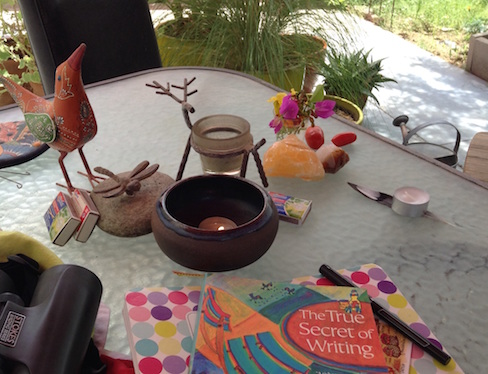
book, notebook, binoculars, candles, altar things on patio table

It’s July 31st. I hear Carole King singing in my head and dream of waking up beside the man I love on the first day of August. Hers is a love song to summer. It’s not yet noon, over 100 degrees, muggy. Clouds piled against the mountains move toward us. One good thing: this weather gives us cleaner air. Second good thing: cicadas loud in the two trees. They change pitch, volume, breath, weave sound in and out, insect orchestra. I have just read the chapter of Natalie’s book where she talks about teachers, about Wendy. She is right. Wendy’s rich prose makes me envious. But right before, she tells us to copy Hemingway, to write a piece in one or two syllable words. I think: I do that. I don’t need to practice that. It’s organic, what comes to me. Today is the eve of the halfway point between midsummer and the fall equinox, the veil between the worlds thin. I make a small altar on the courtyard table: two tomatoes grown in the big terra cotta pot, bougainvillea, tecoma and Mexican birds of paradise from our garden, orange calcite, yellow citrine. I light one candle for this harvest time, for this turning of our world, and a second candle for all the beings I know who’ve died in recent months, feline, human, canine: Sunny, Auntie Christel’s brother in Germany, Bob, Colleen’s father, Annie. I ask for blessings on their spirits, on the ones left behind, still in bodies. May we honor both sides of this thinning veil. I take a deep breath, hear small chirpings in our tree. A verdin, I think. One lone dove sits on the wooden fence, Boo sprawled beneath the apricot mallow. Sofia comes outside, drinks water. Everything goes still. And then the cicadas begin to buzz again, and I draw another breath, keep my pen moving across the page. Sweat rolls down my right temple. My stomach growls. I twitch a fly off my forearm. I am in love with the last day of July.

Mudballs (15)

It’s crazy hot. I’m dripping with sweat but reluctant to go inside. I’ve become attached to reading Natalie Goldberg and doing my “morning writing” on the patio, even on days when morning becomes late afternoon. Today she talks about being lonely, how Katagiri Roshi says we must stand up in it, not let ourselves be “tossed away.” I think of Bernardo. I saw him on the creek path last week. He told me how lonely he is, how women won’t engage with him because he is not wealthy, because he is short. I talked about how we often don’t get things we are too attached to wanting. It’s the way the universe works. I used my writing contests as an example, how I may be too attached to wanting to win. But my heart went out to him. Today my horoscope says that empathy is underrated but much needed, great for actors, parents. Teachers? Writers, too. But it isn’t always an easy gift. Empathy hurts. I know deep loneliness. Maybe without knowing I learned to stand up in it. I made my peace with it. Bernardo hasn’t, I don’t think. He’s hoping someone will come along to make it go away. It’s why I’ve always felt uncomfortable in our exchanges even though I like him and enjoy our talks. I sensed this, a kind of energetic grasping. Of course, there’s a hunger for connection, for physical closeness, too. It’s different from loneliness but a close cousin, all fruit of feeling alone in the world. Feeling connected to the planet helps. I miss walking every day for that, for the big picture connection. But even here in the courtyard I have my mountains, our palo verde, the birds, the moon, the wind that picks up now as I write, wanting to be included on my list. I feel lonely, yes, but not like years ago. Bernardo’s is a deep ache. I ache for him, for all of us, stumbling along being in bodies, saddled with the illusion we are all alone and separate, our odd human condition. We fumble, tumble into each other, mudballs all—stars inside us.

Hold Still (8)

This morning I read one of the last chapters in the Natalie Goldberg book. It is titled, “Blue Chair.” She comes back again to Gwen, the student and friend who died. The last line ends like this: “it comes home deeper that I don’t get to say any more; what was said, was said, though the knowledge of her death ripples long after the last stone dropped, rich and living on.” At the beginning of the chapter she is painting a big, “fat” blue chair, “the kind of chair you want to nestle in.” Read in. Write books, your legs dangling over the big arms. She describes the layers of gouache she brushes over it, color after vibrant color until the chair has texture and depth, is no one color but alive in its layered-ness. While I write, a dove sits on the neighbor’s carport, his mourning song echoing the sadness and the layers of her chapter still sinking down inside me. I have felt at times in recent years like I am waiting for all my immediate family to die. Then I will go on to the next part of my life, walk el camino de Santiago, see Greece, Africa, find my “real” home, the place I will spend the rest of my own life. I expect my cat Boo to be the last, hope he will see me through the other losses, spend more years beside me. Because he is too thin and won’t eat much, the other day I became afraid it’s all going to happen too soon, too fast. I don’t want to lose any of them. Ever. I’ve told the universe again and again over these last few years: I am in no hurry. I want to be very clear about that. I am happy to wait. A wave of big, big losses rolled through life in my twenties. Now I am poised for another. But even as I write I know I am not really waiting. I just don’t want to leave them to go do other things. I would rather stay, be nearby. Stock up on life together. I can go later in a different time after the wave has washed back out to sea. I know even though I don’t want this wave to come, it will come anyway. And writing now, I know another thing. I know I must not brace myself against it, in spite of what my past, what my instincts beg. Instead, I want to tread water beyond the breakers, keep warm, nimble. I want to stay close, be ready to launch myself into the swell of it. I want to ride it all the way to the shore, the tears on my face indistinguishable from the salty water that holds me, buoys me, carries me whole and unharmed to the warm sand at the sea’s edge, new layers of bright-colored gouache painted on my soul.

Entering In (6)

I let myself read a bit of the Natalie Goldberg book every day. At some point I come close to tears. Today is no different. Richard told me years ago my writing tends to make him cry. I wonder if it still does? I think in the Goldberg it is something about the open heartedness but also the bigness of spirit, that maybe we are grouchy and critical but still human and lovable. And this bigness of spirit is in her writing itself, not just in what she says. She makes me want to reach for those open spaces in my own writing. I used to find them more often, I think, but I’m not sure. I remember talking about “entering in” at one of Clive Matson’s workshops. It seemed to happen every time I wrote. It’s hard to know now if this was even true. Was it a kind of beginner’s luck? Or was it only a different understanding of it all when I first started? I was reading Natalie Goldberg then, too, every morning on my stone porch in Hopland before I filled my page a day. I wrote the beginnings of my novel that way, felt like a “real” writer for the first time in my life. But I remember the look on Clive’s face when I was talking about it. “What do you mean by entering in?” he said. He was hesitant, puzzled. I hadn’t meant to be glib. I thought I was talking about something that happened to everyone when we wrote, that dropping down and the opening up, being part of something larger, letting the writing come out. I used to be able to do it at will. Now I’m not sure I do it at all. But maybe my memory of those Hopland mornings is exaggerated, dreamlike. Or maybe over time the experience becomes more familiar, the transition less noticeable. I don’t know. But I do know reading Natalie Goldberg makes me want to break out into something larger. And I dream about one day going to one of her writing retreats. But what if in person she rubs me the wrong way? It’s silly, I know, but I don’t want to “ruin” her books for me, like being afraid to sleep with your best friend, not wanting to take that risk. Still, I think, if I get the chance I’m going. Maybe she’ll do a retreat at a hot springs, maybe Tassajara. Sit. Walk. Write. Soak. (Sigh.) I’m in.

Too Many Lonely Dogs (5)

I read in the newspaper there is now a “movement” to have one day each week free from technology. (It also said most people in the United States check their cell phones 150 times a day. Gasp. Choke.) Because of time spent engaged with technology, the article went on, kids feel their parents aren’t present. I tend to see this in the grocery store, the child trying (and failing) to get their mother’s attention while they wheel the cart down the isle one-handed, talking on the phone. This isn’t anything new. It’s been going on for a long time now. I see dogs suffering when they’re out for a walk. The people on the other end of the leash are on their cell phones, talking or texting. The dog walks beside them. You can feel their sadness, their loneliness, their longing for their human. It’s supposed to be a special time to be together, connected in those quiet moments of mutual pursuit. Instead, I watch the dog walking alone, their human miles away. I’ve watched this for years with my students, too. The moment they step out of the classroom, their cell phones come out. If they have ten minutes to get to their next class, they fill it up. “Hi,” they say. “Where are you?” Too many people are never alone with their thoughts. They are listening to music, talking, texting. It’s rare to see people sitting on the bus just taking things in. Once in a while I see someone reading a real book, and it makes me glad. The act of reading is alive with imagination, and it can be looked up from, left in intermittent moments to become immersed in the environment. It doesn’t separate us in the same way. If there is truly a movement to leave technology behind one day a week, I’m all for it. I’ll even vote for two days. Because this trend has worried me for years. If we can’t be alone with our thoughts, can’t be comfortable in silence, what kind of life does that leave us? And I don’t think it’s only troublesome in terms of its toll on heart and soul. What about the vanishing attention span? I’m afraid we’re creating people who won’t be able to focus on one thing long enough for complex thought. And, well, too many lonely dogs.

Prodigal Feline (2)

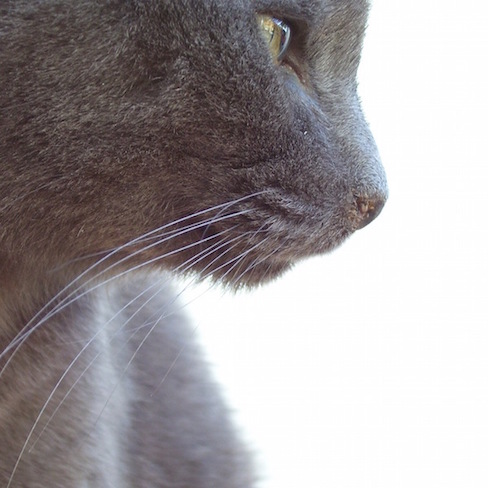
close-up, cropped image of my cat

Sofia’s been gone since yesterday morning. I cried when I woke up in the middle of the night. She’d done this already three days in a row, but the latest she showed up was midnight. I remembered Richard talking about the poems he’s writing for their cat Sunny who died only weeks ago. He’s wishing he’d been as loving, as open to her, as appreciative of her in her coming as he was in her going. I tortured myself in the dark with memories of pushing her off the bed with a pillow when she returned at midnight two days before and wouldn’t settle on the bed with us but kept making determined strikes for the bolster above my head. I wondered if she had found a home where she’s happier, where she is better loved. Even as the thought broke my heart, another followed on its heels. How could I deny her that?

Logic tells me she is only up to independent cat things. But I can’t remember when she had a stretch like this. Sebastopol? Over a decade ago? It’s an upswing in her cyclical illness, I think. She must be feeling better to take off like this. She’s hardly left the courtyard in months, almost always returned in an hour or so on the rare occasion when she did. She would disappear like this when she was young, first a response to her adoption, feral cat that she was. Later because the Hopland countryside was irresistible. I’ve gone through this with her for years.

I am sitting in the courtyard in the late morning, telling my mother about it on the phone. She’s been gone for over 24 hours now. “I tell myself she’ll be okay,” I say. “But every time I wonder if this will be the time she doesn’t come back.”

And then there is movement beside me. Sofia appears in the courtyard on her quiet cat feet. She acts as though she never left, or had been gone only for a moment. I tell my mother she was the magic talisman. I cry again, a muddled combination of relief and gratitude and fear. And then I laugh, kneeling, hugging her, shaking teardrops around us on the cement.

Comfort and Conundrum (1)

I am determined to stay current with my blog this year, so I will post today no matter what. Even if what I post is terrible. Natalie Goldberg does tell us we need to be willing to write the worst crap in the United States, yes? Or in the universe. Though I don’t believe she means we need to be willing to publish the worst crap in the world. Only that we need to not be afraid to write badly. We need to not be afraid of our thoughts, afraid of ourselves. We need to be willing to put everything down on the page—no holds barred. Still, after the act of writing we get to choose. Do I really want Uncle Horace to know this about me? What about the people I work with? Do I really want to publish this even though it seems clunky and unpolished? Am I really willing to be that honest, show that much of myself to the world? It is a choice we face again and again, like deciding not to light that cigarette, not to cheat on our husbands. But unlike failing at quitting smoking, unlike making that decision to light up, choosing to edit out parts of our story doesn’t have to be a bad thing. Right? Each time we send something we’ve written out into the world, we decide how much we want to risk, how vulnerable we want to make ourselves. We get to keep ourselves safe. And I think that’s a good thing. (I can hear the clamor of this controversy even as I write.) Is it without its own dangers? No. We might end up not being willing to take risks in our writing. We might keep ourselves too safe. But knowing it is our choice what to reveal, when to reveal it—that’s a comfort to me (if also a conundrum). Thank you, writing gods. Thank you for that. And here’s to being willing to risk. Here’s to trusting we can still be safe.