Cinco de Mayo Martín (6)

A young man is standing at the bus stop when I arrive. “Do you speak Spanish?” he asks me. We end up talking on the bus together, trading off between English and Spanish, and we don’t stop until over an hour later when we reach my bus stop. It is such a joy. His name is Martín. He lives in Mexicali and is doing my planned trip in reverse, Greyhound from Mexicali to Indio, then our local buses. He is twenty-seven, and he is tall. It runs in his family, his town. From the Spaniards? We wonder out loud. His accent when he speaks English sounds more European than Mexican to me, and I wonder where his teacher was from. I think he may have more English than my Spanish, but he has no chance to practice. Would I be the only estadounidense there? The only gringa? He loves Mexicali, wants to spend the rest of his life there. I tell him I felt that way for the first time when I moved to Sonoma County. He lived in L.A. for a few months when he was fifteen. He was lonely, I think. He missed fútbol.
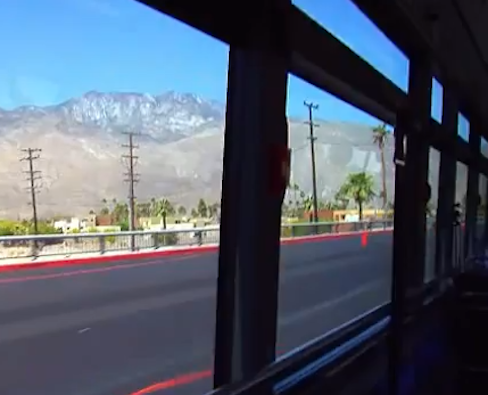
mountains visible through the bus window

I tell him about the near miss I have just had outside the casino after my Kentucky Derby day with Auntie Christel, how the runaway car might have hit me, only seconds to separate me from its path, stopping on the corner to take stock. “Fue muy ‘creepy,'” I tell him. He gives me the Spanish word for it. Espeluznante? I tell him how grateful I am to be here, safe, alive. He tells me his own story, at a party the week before, moved to go home early only to find his mother lying on the floor. How grateful. We understand each other, the bigness of the events. He is young, I tell him, to be going through this with his mother’s illness. I was twenty-four when my stepfather died, Martín’s age when my father died. I think he knows I know. But there are differences. I hope his mother will get well, and when I needed to call 911, I bumbled, my adrenaline blocking my brain. But Martín became clear-headed and superhuman, scooping his heavy mother into his arms, getting her to the hospital. And he remembered all the details in the process, to bring the phone, grab her meds, lock the door. It was a huge victory for him, and so validating, I think, knowing he could do so well in an emergency. But later, like the time I pulled the big dog off my cat Trair and threw him across the yard, Martín was sore for days. We laugh. I feel glad for him, and proud, even as my heart breaks a little that he needs to go through this.

I ask him to tell me about Mexicali. He names a plaza, and somewhere else that is a good place to walk. I scribble them down on the envelope my horseracing money was in. I will hunt for them when I go, think of him. We don’t exchange phone numbers, and as soon as I am home I am sorry. I would have liked to visit him in Mexicali, meet his family. So now I fantasize his sister in Desert Hot Springs will find my blog, read about my Cinco de Mayo Martín, put us in touch. I am talking on the phone, telling my friend Janice about our meeting, about the sweetness of it, how glad we both were, how grateful. I realize in the telling how meeting Martín felt like a reunion. Maybe one day I will walk in the Plaza Calafia at dusk and find Martín and his mother sitting on a bench, and we will sit together and listen to the birds roosting in the trees. Maybe I will come upon his whole family, strolling one late fall afternoon in the Campos UABC, and Martín and I will have our second reunion. Ah, mucho gusto, Martín. Qué te vayas bien.
Fruta Picada (5)

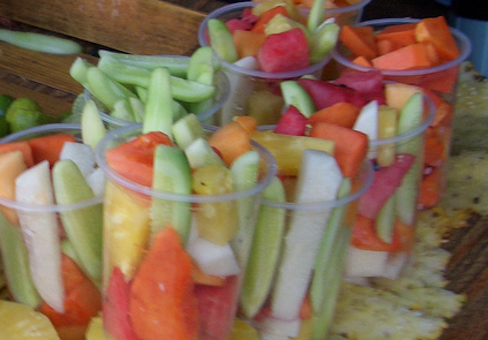
The first time I saw a street vendor selling fresh-cut fruit in Mexico I was wandering through a residential neighborhood in Cabo San Lucas, where a man wielded a small portable set-up, rolling it along the banquetas there, the sidewalks. His work area held whole fruit, cucumbers and pineapple prepped for making slices, his tools, his cutting board, his kitchen towel. It was framed of wood and bordered on three sides by glass. I watched from a small distance, fascinated, while people stopped to make their requests, listening to the rapid-fire Spanish, the different selections. In Ajijic we had a fruit stand every day at the edge of the plaza, and one just east of town on the carretera, the highway. Wednesdays another family always set up shop at the top end of the open-air market, the tianguis. You could find mango and melons, papaya and cucumbers and jicama, sometimes huge bosenberries or bright red strawberries or pineapple, fresh coconut. When there was time, they’d make up clear plastic cupfuls in advance, all cantaloupe or watermelon, or a mixture of berries, the bright colors and succulent fruit a still life on the street. Or you could ask for your own particular combination from the fruit on hand, and they’d prepare it for you. Some vendors use a dry blended chili powder; others offer a chili sauce. Always there is fresh lime and salt. The first time I tasted limon y sal y chile on fruit, it surprised me, all that hot, tangy, salty sweetness. But it grabbed me, too. I loved it. And when I was counting calories, I’d go for the cucumbers.

cut fruit and cucumbers in plastic cups in Mexico

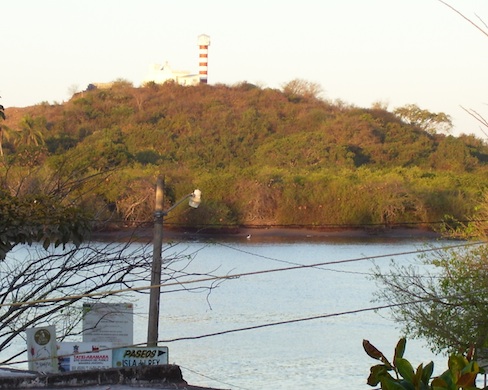
I remember stopping once at the fruit stand on the highway east of town. I was walking home from shopping at the Super Lake grocery store in San Antonio Tlayacapan. I sat on the curb near La Floresta with my large plastic cup of cucumber spears with lime and salt and chili sauce. I savored each long luscious slice, dipping again and again into the spicy red sauce pooling at the bottom of the clear plastic. And our first day on the mainland, the cats and Lolita Roja and I found fruit as if by magic en route to San Blas. The downhill road to the coastal town wound its way through the trees, and at one slow turn three women materialized in front of my car, apparitions with cups of cut fruit in their hands. I got flustered–by the unexpected suddenness, the blind curve, the rapid Spanish, my own ambivalence and groggy brain after a day of driving. I pulled over on the side of the road and chose one container of mixed melons and one of green mango. When I told them I wanted to save the fruit for later, they put the chili powder and the salt in little plastic bags for me, gave me whole limes. We stayed two nights in San Blas, time for the cats to recover from their ferry crossing nightmare. I made three meals of the fruit. It was the perfect thing. I would sit on the veranda outside our room in the warm April breeze eating green mango con limon y sal y chile. I watched the lighthouse revolve, watched our little patch of water move up the estuary, slow and quiet. I listened to the grackles calling from the trees, from the rooftops. I licked lime juice from my fingers and studied the houses down the street and wondered what it might be like to live there.

patch of estuary with lighthouse on the opposite bank

view up San Blas street from veranda

[The photo of the fruit is copyrighted by antefixus21 and can be found here: http://www.flickr.com/photos/21728045@N08/2328071644/.]

Grackles Bring Me Home (4)

My cats and I and Lolita Roja, trusty red Jetta, loyal companion, were heading south on the highway that runs along the western coast of mainland Mexico, sporadic snatches of blue off to our right, the Sea of Cortez. We’d arrived the night before on the ferry from La Paz in Baja California Sur. As the light grew, I remember feeling like I had returned to civilization after nine months in uncharted desert wilderness. I drove through the first highway toll booth and stopped just on the other side to buy ice from the small tienda there. I remember it as though we’d moved from black and white to technicolor, my first sensory experience of the mainland, Dorothy and Toto in that first glimpse of Munchkinland. I remember colors, painted concrete, a kind of careful tendedness, and a sea of bird sounds. Rows of trees–cypresses, I think–lined both sides of the road, filled with big black birds greeting the day. It was madness. They were all talking at once, wild, animated, exotic. I didn’t know then they were grackles, but I was awed by them, and I remember a deep sense of having stepped into another world, not in Kansas anymore. I loved those noisy birds, trees that talked, alive with loud, squawking black fruit.

I left those sheer numbers behind a few days later in San Blas, for the most part, though we had our share of grackles along Lake Chapala, too. I’ve met them three times here since I’ve been back in the States–once when I was trespassing on a golf course in south Palm Springs, once in 29 Palms and once at dusk in the big trees in the parking lot of my neighborhood Ralph’s. But always only a handful, and mostly they’ve been absent. I’ve missed them. They were comforting, somehow, a familiar thread of sound embedded in my life in Jalisco. Last week I walked through Algodones in the state of Baja California. I wanted to find the Colorado River there. I walked alone on dirt roads, wary at first, the U.S.-trained fear of Mexico having seeped into me in recent years without my knowing. I shrugged it off, began to relish my return to this foreign land I’ve come to love. I passed homes part ruins and part unfinished construction, fresh laundry flapping in las brisas, dogs and children watching me from the fronts of houses, bougainvillea and cactus tended along the fence lines. The colors and textures, the richness that is Mexico saturated my starved estadounidense self. Just before the river, I came to a grove of trees alive in grackles. I stopped in the middle of the road and listened to their wild vocalizations, a mad delight rising in my belly, my chest. I felt like I was coming home.

I Begin (1)

Dusk nears on the second day of my spring holiday, my first in ten years of teaching. I sit on the patio and move my pen across the page of my notebook to begin my first post for this new year of mine, 54 at 54–All Things Mexico. The task I have set for myself terrifies me, but I push the pen across the page anyway. My mind has been wandering paths as steep and twisting as the narrow callejones of Guanajuato, playing out possible topics for my blog, trying them out in my head. Why didn’t I document my time there, take vivid notes, photograph everything I loved? My fear about the course I have set for myself here makes the question come out harsh, anguished. Why didn’t I take pictures of the horses on the cobblestone streets in Ajijic? I would run to the balcony when I heard one passing by below. Why didn’t I record the sound their hooves made dancing on stone? I don’t have any pictures of the Wednesday market or the cemetery or the grackles roosting in the trees at twilight in the plaza. Why, I wonder, didn’t I photograph every doorway, every windowsill, every wall spilling bougainvillea on the street? Why didn’t I photograph every face I came to love, and all the textures and colors that layered themselves inside me, that have me missing Mexico like a river running through my California days?

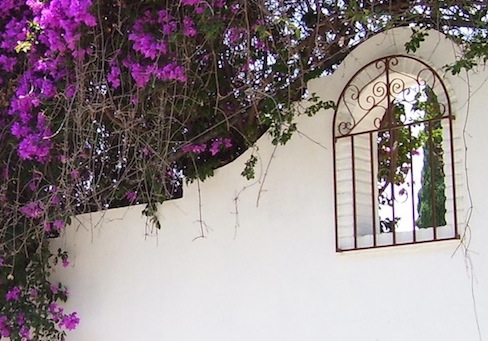
white wall with window and bougainvillea

Why didn’t I take more photographs, learn more words, record the stories and the history and the rumors that came my way? Is it because I was not yet a writer in the same way I am today? In part, I know that’s true. And I didn’t know one day I’d want to write a blog about this big love of mine. I was busy taking it all in, absorbing the way it felt inside me, this foreign country where I found such sweetness, such welcome, yet where I was still so much “the other,” my white americana self a sore thumb, standing out amidst the dark hair, the dark skin of the other people in the villages. I think in my usual way I paid more attention to emotions and interactions, to the nuances of finding my way in a culture so different from the one I grew up in. I didn’t document the details, not outer or inner, only let them pile up inside me. Now I am afraid I have set myself an impossible task, but it’s one I want very much to meet. And so, as the light wanes on my California evening, I take a deep breath and reach for trust. I will find ways to write about what I love. I have already begun. A bird I don’t know in the pine tree repeats one long sliding note. I take another breath, the pen loose now between my fingers, and I know dusk settles in Mexico in just this way.