So You Would Know (39)

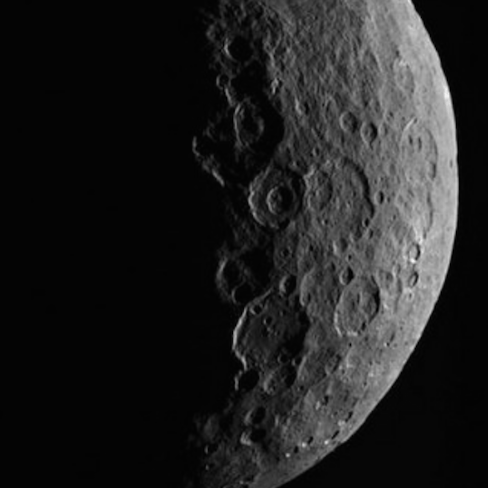
image of an asteroid

Did you think you’d be only a footnote for me when you were gone? It makes me sad all these years later, even though you didn’t choose me, even when the details of your face, your head, your ears begin to dim. But maybe we both believed the other could only love us a fraction of how much we loved them. Heartbreaking at first thought, neither of us believing we were worthy of that much love. But maybe instead what it points to is the enormity of the love we felt. If it was so huge, so surprising, even unfathomable how much I loved you or how much you loved me, then maybe it makes sense. Because even a fraction of that love would be immense. And ours was never a typical relationship, at any rate. We were never a couple. We didn’t celebrate our romance. We weren’t the kind to name an asteroid after ourselves or write I love you across the sky. But if I could go back now and name an asteroid for you, I’d do it. I’d want you to know you could never be a footnote. I didn’t think for one second you were a saint, though I know you thought I didn’t really see you with all your human flaws and ugliness. (Later, I think you knew I did, knew I saw you and still loved you.) But I would gladly name an asteroid for you, so you’d know where you fell on the wheel of my life. I’d spend hours poring over the sky chart to choose the best one, maybe somewhere in the top left corner. I’d make this grand-ish gesture so you’d know I never felt anything close to what I felt with you, drifting at the edge of sleep, warm skin to warm skin, the place it took me, that deep peace. So you would know I still think about you in odd moments, like Sunday mornings when I linger over the newspaper and wonder what it would be like to do that with you, to decide together what our next move would be. Pancakes or a nap? I’d gladly name an asteroid for you so you could know you are not a footnote. You are a bonfire.

[Editor’s note: This was written per the Day 4 prompt in the Two Sylvia’s Press advent calendar. “Write a poem in which you name an asteroid for someone you know. Use several or all of the following words: chart, fraction, saint, skin, bonfire, wheel, breakfast, dim, footnote.”]

Bird by Bird (38)

I like to play with my titles here. Song titles, famous expressions. In blogging it feels like we have more license to amuse ourselves. Here I am stealing the title of Anne Lamott’s book about writing. I saw it on my shelf just the other day. It seems to fit what I want to try to write about tonight, the bit by bit approach. One day when I was in my third year of teaching English I knew I needed to begin writing for myself again. I was building an online class on the fly, in addition to my other classes, and every Sunday I stayed up all night to get the next week’s materials in place for my students by Monday morning. I had no time. But I knew I didn’t want to get to the end of my life saying I’d always wanted to be a writer. So I decided to write eleven minutes a day. I sat on my stone porch in Hopland every morning and filled a page in my composition book. I don’t remember how it happened, but characters emerged. I began writing a novel. I don’t know if it was beginner’s luck or some quirk of timing or state of mind, or maybe because the characters were so crisp and so alive for me then, but I would just sit down and “enter in” to the story every day for those eleven minutes. I thought that’s how it worked, thought I would always be able to immerse myself in that way. But today I feel light years away from that, my imagination rusty, my hand creaky, my mind less agile, less willing or able to stretch, take leaps. So, yesterday I began a commitment to address a new writing prompt from Two Sylvias Press every day in December. I’ve done two now, and like my assignments for my recent MOOC, they are nothing to write home about. But I’m hoping I can quiet my critic, just keep practicing this act of letting go that used to come to me unbidden. It’s a tightrope act, finding my balance between reaching for this hope, writing with this goal in mind, and not going rigid with it. I think to soften I may return to reading Natalie Goldberg. Or maybe I’ll read Anne Lamott’s book again. In her story, when she has a big report to write for school, her father tells her to just take it “bird by bird.” So, I’m going to take this prompt by prompt, and wish for but not insist on limbering up in the process, pray for magic but not try to hold it in my fist. And in the meantime, the birds keep showing up, too, signposts still along my way. But that is a story for another day.

To You on this Day of Gratitude (37)

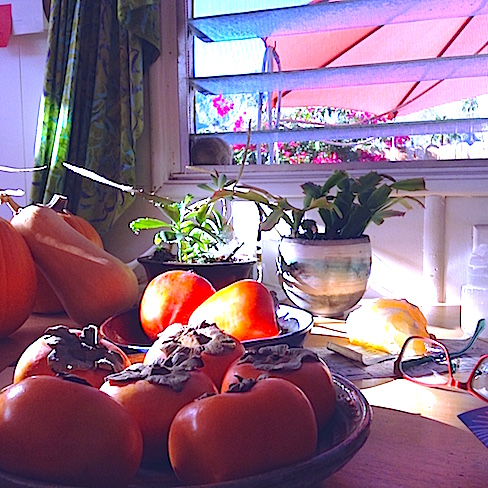
Persimmons, cactus, glasses on the messy kitchen table

Today’s my father’s birthday. He’d be 83. (Funny, isn’t it, how we do that with our dead?) When I was young, I always spent Thanksgiving with him. Maybe he somehow got that in the divorce. I remember his wife Jeannie and I laughing in the kitchen of their Sylmar home, black olives on the tips of all my fingers. Later, I brought my braided garlic French bread and tomato pesto soup to a Thanksgiving celebration at Colleen’s house in Sunland when we were young adults, and once in Sacramento, just the two of us that day, giddy on our pretend wine. And even later, Thanksgivings with Meri and her first husband, six or eight of us at the kitchen table playing Pictionary and rolling in the aisles. But decades ago it became a day I looked forward to spending alone. I like to let the day unfold, knowing there are three more days that follow, all without work, without plans. For years this was often my first day off in the fall semester, and even now these four days stand like a beacon, the blessing of a real break. I love knowing I can do what I feel like in each moment, the hours stretching like magic, like summer days in childhood, knowing I have no deadlines, no need to be ready to leave the house at a particular time. People often don’t understand my choice, and even now there’s a small voice in me who asks, “Is there something wrong with me?” For seeking solitude on a day when most people want to gather? So I’m making peace with this now, trying to trust it’s okay for me to make this choice. I turned down a chance to be with people I love today, nearby at Chimney Ranch. When I think of them together, part of me longs to be in their midst. Maybe it’s because I’m an only child, but today being alone calls me. It’s how I am able to have a sustained connection with myself, with this earth. I want to keep moving through the quiet of my day, the happy bird sounds in the courtyard, the soft sweater against my skin, the persimmons ripening on the blue plate my mother made, the changing slant of the sunlight as it moves with the day. I want to relish the bougainvillea blossoms, expand at the sight of the San Jacintos before me. And later in the afternoon I want to walk for hours in the stillness of this day, returning again and again to my glad and grateful heart. May those same moments of remembering to return come to you, too, to each of us over and again, today and always.

Love Still Trumps Hate: All Evidence to the Contrary (36)

Tuesday dread settles over me like a heavy coat, lead in the pockets. I fall asleep with a candle burning and a ceaseless prayer. Please don’t let him win. Wednesday I wake up and cry. I am surprised it hits me so hard. After, I do my sitting meditation. I practice metta. I don’t try to love Trump. I don’t try to love the people who voted for him. But I can hold them anonymously when I say metta for all beings everywhere. I can be inclusive of them in my practice because I believe we all deserve to be safe and free from harm. I believe we all deserve to live with ease and well being. We all deserve to know both deep joy and deep peace. But I don’t try to single them out for this, as you would in a traditional metta practice. I don’t want to try. Not yet, at least. Not now. Right now I am still too raw. Right now it is all I can do to keep my fear from grabbing me and sprinting off. Will he begin deporting people, pulling apart families? Will he try to take away our right to choose, strip away gay rights? I hear he doesn’t believe in global warming. Will he undo everything good people have fought so hard for for so long? I tell myself people who voted for him wanted to overthrow the government. It’s an understandable desire. But how could it not matter that he hates people of color? Women? Foreigners? How the hell could it not matter that he bragged about grabbing pussy, claimed Mexican immigrants are criminals and rapists? How can there be no lines drawn for the kind of person we even allow to run for president, much less elect? I cringe to think of all the white women who voted for him because their husbands told them to, women who have internalized the misogyny Trump embraces. (And there, perhaps, is my truer entry into compassion.) I know racism and misogyny and xenophobia never went away. But I never expected almost half the voters in this country to exalt them. I’d hoped just the fact that Trump was in the running was enough of a backlash. That it meant we were making progress in this world of ours. Now it looks like it will have to get worse before it gets better. So I’ll pray it doesn’t get too bad. I’ll pray it doesn’t last too long. I’ll pray this is how we expose and exorcise this kind of hate. And I’ll cling to being grateful and proud to be a Californian. On Wednesday morning when I look at the nice little west coast block of us, of Clinton states—California, Nevada, Oregon and Washington—I can’t help but wonder. Could we just secede? But maybe that’s the coward in me talking.

Onto the Page (35)

The third assignment I write for the MOOC doesn’t sing, but I feel better about it than the two that came before. The requirements are specific, a scene with three female characters with a fourth who comes along to “thwart their desires.” It’s the first time in this class I’ve had “real” characters come, and the fourth woman who arrives doesn’t behave at all as I’d imagined. It’s been a while since I’ve had characters acting on their own, and I love that part of writing fiction. My scene with these four women happens on a train, and the next assignment needs to take place after a catastrophe of some sort (either internal or external), so the train lends itself to that. I lie in bed this morning dreaming up bits and pieces of how I might continue with these women on the train. I see the two-story house in Oakland, watch Rachel working in the garden, hands in the dirt. And it comes to me that dreaming up fiction might be just as compelling as worrying about money or family, might take me away from being present with the same obsessive flair. But what a way to not be present. Dreaming up fiction beats focusing on my fears, no contest. And I’d be lying if I said I wasn’t thrilled to have fiction floating through me like this. It makes me giddy and grateful: for this free class, for my lighter work load, for the cooler mornings that let me lie in bed getting to know these women in my head instead of having to be out early sweeping the patio, feeding the birds, before the brutal heat descends. The southern sun sends blocks of yellow light across the wall of my room. I love winter mornings in this trailer home, look forward to a long string of them with childlike glee. All in a rush I feel the longing for all the years I might have been churning out fiction. I glimpse how it could feel to be old and know I have characters in my head who I might never get down on paper. I tally up the years. Could I have 30 years still ahead of me to write? More? I want them, every one of them. So I will need to make good use of them. I will need to savor every character, relish every story like a good, rich stew. And bring as many of them as I can onto the page before I die.

Happy Day of the Dead (34)

I am taking my first MOOC (massive open online course). It is presented by the International Writing Program at the University of Iowa. The first week before I wrote my own assignment, I read an incredible piece by one of the other participants. In a thousand words she’d built a whole compelling and creepy dystopian world, and made me care about the mother and daughter who lived there. It made it hard for me to write my own assignment. I couldn’t stop comparing my own writing to hers. It troubled me. I loved her piece for itself and for her sake, for the evidence that she’d so clearly entered in, had experienced the magic of fiction unfolding. It thrilled me for her. But I let it make my own writing feel pale and weak. It couldn’t stand up to hers. I am rusty at writing fiction, and in the first two assignments that magic hasn’t happened for me yet. But I haven’t given up, so that is something to feel grateful for, and maybe a little proud, too. I am being a writer. And it reminds me, too, that being a writer does not often match up with the easy, romantic image we have built. It means writing and even submitting work that is only the best we can do in the time allowed. It means envying a classmate for writing “so much better” than we can. It means slogging through a writing task when our critic keeps yelling at us to stop, to give up, to throw it all away. To take up house painting instead. But it also means getting to study craft, to listen to other writers talk about how they write. It means having a chance to practice even if it doesn’t always feel good, knowing it is all part of the writer’s journey. And it means always having the pleasure of reading the work of other writers, of being moved by their words, waking up. I read another piece by a classmate in this MOOC that will stay with me always. Her story doesn’t just lead me into the reality she builds or give me a glimpse into her characters. It changes my way of looking at the world. Hers is a conversation between two sisters in the spirit world visiting their family’s Day of the Dead altar. I’ve always thought about all these people making the offerings themselves, the favorite foods, the photographs. I’ve built my own altars, talked to my own dead. But until I read her piece, I never pictured these gatherings in the spirit world, how they might look forward to this event all year. Now I can see them whispering in anticipation, gathering to watch the altars being built here in our world. It brings things together for me, makes this a complete whole in a way it never was for me before. So, thank you, fellow writer. Y feliz día de los muertos a todos.

The Weaver at the Loom (33)

There are two white crowned sparrows, winter migrants, and two house finch in the tray feeders. The doves scattered earlier, probably a circling hawk. Now we have a bit of quiet in the courtyard, only the occasional melodic sounds from the sparrows and some goldfinch conversations coming from my neighbors’ tree. I love these daytime forays of the white crowned sparrows. Last year I almost never saw them. But I relished the sounds of them scavenging the fallen birdseed just before full light or in the late, late dusk before full dark. They are tender spirits, I think, quick to seek cover. Maybe the growing bougainvillea in the corner is making them more bold this year? Knowing they have a nearby retreat? Today I am battling a cold, so I am subdued, a running underlying sense of wanting to be asleep. But I feel good, too. The volunteer marigolds, over a hundred, I think, are in perfect time for the Day of the Dead. This morning their bright orange pops in the gray day. Halloween is the pagan new year, too, one of the eight main pagan holidays, a day when the veil between the worlds thins. I feel it all today in my courtyard, heralded by the hundred neon marigolds, by our migrating sparrows, by the absence of the sun. There are times when we can feel the earth turning, pivotal points like now with these looming holidays. We move more fully into the moon-dominated part of the year, from the fall equinox until the winter solstice. It feels perfect for my life right now, for my writing work, my healing, this turning inward that comes with the seasons. And it makes me even more grateful for the gift of extra time I’ve been given (regardless of the loss of income). The doves come back now in twos and threes, and the courtyard becomes busy with their steady pecking and their constant flutter. But if you listen hard, underneath their sounds you can hear Guy Gavriel Kay’s weaver at the loom. Do you hear her? The clack of the loom, the sound of the shuttle as we near next week when the veil between the worlds grows thinnest? And when you open your mouth, the air tastes like magic.