My Respect for Pigeons (34)

I’ve never been fond of pigeons. Even now, I admit I still tend to dismiss them, am less pleased to see a group of them on a telephone wire than a gathering of mourning doves, some strange bird snobbery at work in me. But now I remind myself of what I came to know of them in Mexico. When I lived in La Casa Azul, in the blue house in Todos Santos, I came to respect pigeons. They lived next door to me, in the eves of the artist’s studio, the man I rented my house from there. I always wondered if he initiated their residency, started the colony there on some whim, some fancy about the romance and quirkiness the studio should reflect, not realizing how it might grow. I never asked.

But I would sit perched on my tall wrought iron chair in my semi-third-floor roost and watch the pigeons fly together. I’d always loved the sounds they made nestled in the eves, the muted rounded coos, bird pillow talk. But I never really watched them fly before. I remember the first time I saw them take off for their morning flight, making big loops across the sky, flapping and gliding in tandem. I was struck by the vigor of their bird bodies, by their prowess in formation despite the quickness of their flight. They would launch into the air together every morning for the first looping flight, a burst of celebration for the day to come. In the late afternoon, they took flight again before dusk, a happy sky dance, a few last circles of gratitude and play before bed. And I would sit in my own roost, feet propped on the rebar railing before me, and marvel at the ease of their antics. Each time they took to the sky, I fluttered with awe.

Traveling (33)

Traveling is an odd thing. I bring myself with me wherever I go, but I don’t always feel like myself. I am still tethered to my home, feel its tug. I am tied to who I’ve left behind there. My cats occupy my space, glaring in their absence, a small prickle or a larger ache. Even when I go where I am known, even loved, I carry their absence, feel the tug of my tether. I am missing bits of my self, the one I have grown comfortable with over time, quiet mornings on the patio, the solar Christmas lights a happy glow on the hedge when I walk home in the new dark after dusk.

The birds here are not my birds. But when I reach in, find my way to fullness on the deck of this other home, their unfamiliar calls comfort me, companions in the quiet autumn morning. They tie me to my world, tingle my self, charm me silly. I feel the sun on my forehead, my ankles, my cheek wet from dog kisses. The house is waking up around me, and my eyes fill with warm tears, my breath deep and grateful in my lungs.

Mexicans Are (31)

It’s some strange hubris of travel to think we know a country or a people because we came and saw a slice of it, of them. How many different versions of the United States do you imagine foreign visitors carry home? Did they stay with family in the Appalachians? Visit a dude ranch in Arizona? Make a wrong turn into Watts one afternoon when they were looking for the Hollywood hills? My Mexico was made up of poor villagers. They are the bedrock on which I base my sense of who the Mexican people are. They are quick to laugh, treat their burdens with a light touch, pay a man to rake the dirt road in front of their home because he needs the pesos even more than they do.

I met a handful of wealthy Mexicans, came to know two handfuls of people who struck me as part of a burgeoning middle class, enough to understand some of the differences between the socioeconomic strata there, how education and money shape their world. Enough to know better than to base my assumptions about life on Mexico on the lives of poor people in rural villages. But not enough to keep me from doing it anyway. I still remember the look on my Senor Soto’s face when I made this mistake, embarrassed myself. “Es raro, no?” I asked him. That’s unusual, isn’t it? He’d just mentioned he and his wife had two children. I was surprised, though looking back on it now I realize all the middle class families I knew there had only two children. He was driving the taxi, so he couldn’t stop to stare at me, but I remember his piercing look. His voice was kind, but there was steel beneath it.

“You can’t do that,” he told me in Spanish. He’d agreed to let me practice my Spanish even though he was fluent in English. (He even taught me the difference between the words “writer” and “author.”) “You can’t make assumptions about all of us like that.” His gaze moved between me and the highway. I was sitting in the passenger seat. We were on our way to the airport in Guadalajara. “Many people have only one or two children,” he said. “It just depends.” I had known it, seen it already, and yet I blundered in, two feet in my mouth, insulting this well-read man who was fluent in two languages, whose son was attending the university, whose wife and he had practiced family planning. I nodded, blushing.

“Entiendo,” I said. I understand. “Lo siento.” I’m sorry. His kindness never faltered, but he’d put me in my place, and I was glad he did. If I might muster even a faint echo of his grace the next time I need to speak up, I’ll be grateful. I have his business card tucked in my wallet. The day I return, I’ll call to see if he can pick me up from the airport. Or maybe I’ll email him ahead of time, so I can know Senor Soto will be waiting for me there.

If Looks Could Kill (29)

When I first moved to Todos Santos I bought my produce from a place on the main drag, the road the two-lane highway became as it zagged through town. The woman there was never kind to me, a rarity in Mexico. I annoyed her with my questions and my faltering Spanish. She answered me in a sharp, curt voice. She looked at her friends, rolled her eyes, said things I couldn’t understand and laughed. I don’t know how long it took me to stop going there. I found a new place in the north of town, a kind of glitzy store for the expatriates, but the staff were sweet and helpful. I bought produce from a local organic farmer, an estadounidense who camped out on the sidewalk downtown two mornings a week. Once I bought a bag of arugula from him–huge dark green leaves like I’ve never seen before or since. I brought it to my friend Iris at Il Giardino, and someone at the restaurant sauteed it with a little oil and garlic. It’s still a favorite meal of mine, especially with the brown rice pasta I’m in love with now.

streets and shops in downtown Todos Santos

One day when I walked past the produce place where I used to shop, the woman made a point of glaring at me. I remember the way she held my passing glance, her head moving, slow and deliberate, to keep me in her gaze as I walked past the open air stall. For a moment, I wondered if she was angry with me because I stopped buying from her. But that was only my logic, only me trying to make sense of what was happening. But logic wouldn’t help me here. Because as I watched her, she bared her lips in a snarl and her cheeks pinched up. It was more fierce than a wild animal might have been, cornered and terrified, lashing out. The look in her eyes was pure hatred, her face made grotesque by it. I scuffed my toe on the pavement, stumbled, her venom like a blow. I turned my back and kept walking. My arms trembled, my cloth shopping bags suddenly too much to keep upright. I let them dangle as I climbed the hill toward home. I wondered how she could hate me that much. She didn’t even know me. But to her I was the ugly American. To her, I was the reason her once-tiny fishing village teetered on an unknown brink, invaded by foreigners building palatial homes north of town, the growing middle class of Mexicans only beginning to get their footing, the huge disparities creating terrible tension just beneath the surface of her world. To her, I was to blame for everything that was wrong with her life. I’ll never forget the look on her face or the shock of that poison spewing out at me.

Dark As Night (28)

Dark as night the heads of children racing back and forth across the plaza shouting, hair shiny in the early dusk. Dark as night the grackles roosting in the jacarandas of the zocoló. Dark the skin of every single body in the crowded square, except her. Old men, young women, clustered, Spanish a loud, steady murmur, the rapid curve of a summer creek, as steady as the grackles calling from the trees, a cacophony of conversation, a mad frenzied orchestra tuning up. Dark as night the glistening black feathers, dark the skin, dark the grackle silhouettes, dark of every being in the zocoló but her, her white skin a bruised thumb, dumb with her estadounidense self. She would lose her Puerto Rican friend over a careless email about walking through the plaza in that Sunday twilight, the dirty cement, the alien dark-skinned world, her senses dulled by too much beer. Not racism, though, only sinking in a sea of otherness, aching and alone. But now she dreams of it like dessert. She’ll go again, sit nodding, smiling on a bench, tears sliding down her face in the half light. Eyes closed, the symphony surrounds her. The grackles make her heart dance in her chest, bump against her ribs. She holds still in the center of that boisterous foreign world where language is music. Her white skin gets lost in the late dusk until her estadounidense self all but disappears. She sits there while the light slips away, until it feels right to be there in the heart of things, dark as night and plain as day.

[Editor’s note: This piece was begun with a writing prompt from my Monday night writing workshop led by Alaina Bixon. We were told to begin a poem with a cliche. Thank you, Alaina.]

Seasons (26)

I’ve heard the mockingbird singing from the top of the fan palm three mornings in a row. Today when I was lying on my back in the courtyard on my yoga mat, I listened to the verdin’s sweet three-note call. I pictured him sitting in the pine tree, his bright yellow cap and cheerful eyes hidden among the long green needles. Last week, both the hibiscus and the apricot mallow began to bloom again. The crickets have woken up, too. In spite of still mostly three-digit temperatures, they all recognize the secret signals, a heady mixture of the fewer hours of high heat each day, the angle of the sun making its way south, the nights in the seventies. And they aren’t grumbling like I am–tired of the heat, my tolerance used up–though they have more reason to than I who could escape it. They don’t indulge in weariness–they bounce. They celebrate in song, in bloom.

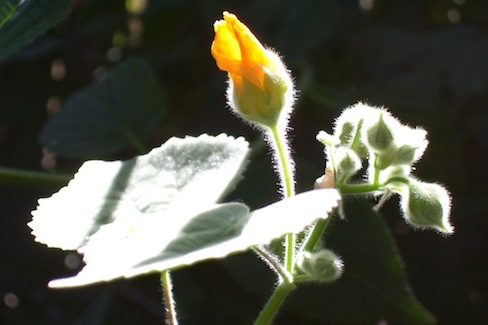
Apricot mallow with the sun shining on fuzzy leaves and one bloom

And their festivities cheer me on. I relish the feel of the cotton sheet over me in the early hours of the morning, the occasional weight of Sofia against leg or hip, missing for months now, a welcome surprise. I look forward to the day when I’ll be seeking the warmth of the sun on the patio when I do my yoga instead of hiding from it. I’ve lived in California most of my life, and still I bristle when someone tells me there are no seasons here. They are subtle but marked. Do not tell me otherwise. Soon the long clusters of green berries on the fan palm will ripen, and the starlings will feast, scattering in shiny black chattering when I walk outside. The days will grow shorter, the blue of the sky deeper. Riding my bike will become sheer bliss. Sometimes I think our desert, where some claim we have only two seasons, may mark the changes in the year more clearly than other parts of the state. Though I realize the changes are less visual than visceral. Here in the fall we begin to reawaken. We return to a state of grace, of ease in the outdoors.

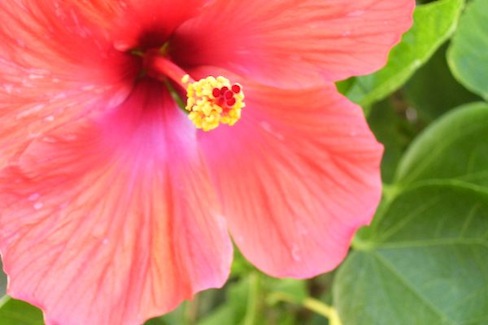
one red hibiscus bloom, cropped

The seasons were subtle in the places I lived in Mexico, too. But they were undeniable unless you just weren’t paying attention. In Todos Santos, the summer rains made for muggy heat, a boon for bugs, biting and otherwise. But it washed the dusty desert clean, changed the color of the world, the lush plant life made new. In winter you could go barefoot in the warm dry days. I remember sitting in my third-floor roost in La Casa Azul, my feet propped up against the rebar railing, marveling at being barefoot in the middle of January. You knew it was winter there by the nights. In Ajijic, jacarandas trumpeted the burgeoning spring, their lilac blossoms littering the cobblestones. The “rainbirds” were the harbingers of the summer rains, not birds at all but insects, a kind of cicada, I think. You could mark the onset of the rains on the calendar from the date you first heard the rainbirds sing. Autumn there meant a world of green, the hills bathed in all their new-growth glory after months of nightly rain. And fresh, sweet corn was everywhere.

Mango (25)

I pick the big green mango up from the counter, cradle it in my cupped hands. I probe the sides with gentle fingers. I am surprised by how quickly it has softened, even in our late summer heat, becoming almost ripe while I was away overnight celebrating Mami’s birthday. Yesterday in the late afternoon I placed it on the patio table beside a tiny vase of blossoms from my garden to honor the equinox.

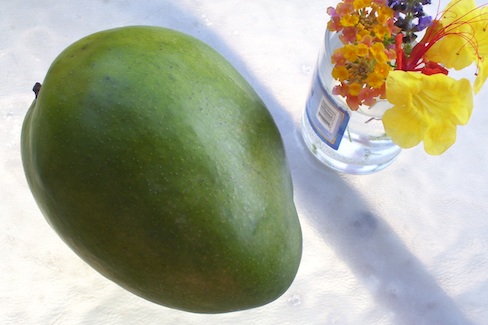
green mango with tiny vase of mixed blooms beside it

Now without knowing, I have brought the mango to my face. The sweet, spicy, astringent smell drifts across me. Tears fill my eyes like a yawn, that quick stretching yearning. For one long moment, the scent takes me to Todos Santos. I am sitting at my tall round wrought iron table in the courtyard at Las Flores, marveling over the ripe red mango that has appeared there as if conjured. Later, Alfredo mimes peeling and eating one, not even trying to name it for me, not knowing the word is the same in English except for our terrible American “a” that butchers its beauty. There are three little trees behind the main house. I pass them when I go to use the washing machine. Alfredo brings me more as the weeks go by, sharing the largesse as the season swells and ends. Always they appear on my little courtyard table like sweet offerings to the gods. Sometimes, when he has borrowed my binoculars to look for whales from the steps at the other side of the inn, he will return them to my table with a mango beside them. Back in my desert kitchen, a world away, I roll the big green mango in my palms, my thumbs brushing across it. I press my nose to the firm skin, inhaling, my lips touching, too, my pose a prayer.