I Have a Dream (53)

I spent Wednesday at a local resort, “day use” there my treat for spring break. I drank coffee and did my qi gong and my yoga on the cement beside the hot tub. It was warm from the sun, and I lay on my back and watched the fan palm leaves bend and bristle in the wind. I stood beside the wall of cloudy glass bricks, alone in my corner of that public world, and I kicked my legs forward and backward, punched the air before me, stood still at the end of the series, the dragon stands between the heavens and the earth. In between I floated in the hot water and let the tension leak out of my body and felt a dream emerge in me. The “Travel” section of the Sunday Times was about Mexico, and I read it greedily. It was focused on Mérida, a city in the Yucatán. Just like that, the desire to visit was alive in me. And somewhere in the midst of doing my qi gong in that hidden section of the resort, of floating in the hot water watching the San Jacinto mountains peeking out between the palm trees, of feeling the sun-warmed cement beneath my back, against my thighs while I twisted my spine and stretched my hips, a vision grew in me of a neighborhood in Mérida and a part I might play there one day. I dreamed a fountain and good food, a plaza garden, a co-op, a milpa, peace.

The DREAM Act (49)

I thought I’d read the DREAM Act had passed. But I just Googled it to confirm the details, and as far as I can tell it is still not law, even though it was introduced over a decade ago. But there does seem to be some kind of “deferred action” in place now with all the same basic parameters as the DREAM Act itself. If you are an immigrant who was under 16 when you came to this country, if you “have continuously resided in the U.S. for at least five years prior to June 15, 2012 and have been present in the U.S. on June 15, 2012,” if you were under 31 on June 15th of last year, if you are “currently in school, have graduated from high school, have a GED, or [are] an honorably discharged veteran of the U.S. Coast Guard or the U.S. Armed Forces,” and if you have not “been convicted of a felony offense, a ‘significant misdemeanor offense,’ three or more non-significant misdemeanors, or otherwise pose a threat to national security or public safety,” then you can apply for the deferred action. It isn’t clear to me what exactly the deferred action will get you, but the requirements are similar to that of the DREAM Act, so I am guessing the results run along the same lines, too. The DREAM Act allows for a 6-year path to citizenship involving fulfilling certain educational or military requirements. I read about a $495 fee, as well. And while it dismays me that we have fought over this for more than a decade, I’m glad to know we have at least put something in place. I know this will make a big difference for many of my community college students.

But I couldn’t help but feel discouraged by the rules, can’t help wishing we could embrace these young people more completely. I can’t help but wonder if there is any option in place for people to work off their fees during the process. Do we offer payment plans? And I can’t help but think about the brother and sister who are age 30 and 32. My heart sinks at the thought of being so close and not being eligible. I can see that 32-year-old woman, her heart breaking that she missed the age cutoff. But I see her smiling at her brother six years from now, her heart proud, swelling for his big happiness, his big day, becoming a United States citizen. Could we leave her behind more fully, hurt her in any bigger way?

[Editor’s note: The website I quote is available here. And that last rule sounds like it’s open to all kinds of messy interpretation, hmm?]

Dreaming Home (46)

I’ve longed for ages for a home where I felt like I could spend the rest of my life. When I moved to Sonoma County, it was the first time I had that feeling about a place. I remember driving home from Santa Rosa on Guerneville Road past green farms, the oak-studded hills before me. Look where I live, I thought. When I moved into La Casa Azul in Todos Santos, it was the first time I had that feeling about an actual dwelling. Things went terribly awry with my landlord there, but I remember that giddy feeling, thinking I’d found the home of my dreams. I remember wondering if I’d be able to negotiate the wrought iron spiral staircase when I grew old.

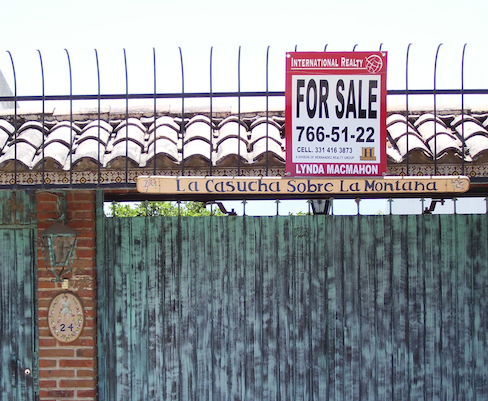
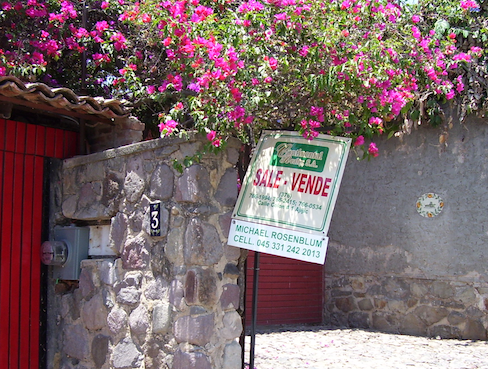
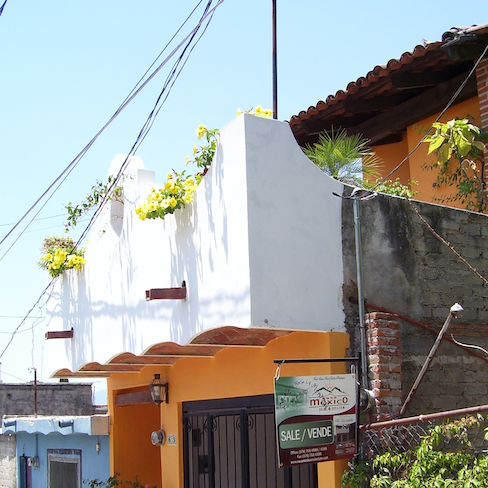
Over the years I’ve built a habit of studying the yards, examining the homes whenever I walk down the street. “Oh, I could live there,” I’d say to myself, caught by the wrap around porch or the climbing wisteria, both pleasure and longing evoked by my ritual, a bittersweet practice. When I lived in Ajijic where buying a home might have been one day more within my reach, I photographed for sale signs. I remember one advertising an empty lot of neatly turned earth, a beautiful brick wall surrounding it, a blue metal gate. I went as far as to look at two homes for sale up in the hills. One was all white and one was green, and they were both two stories tall with miradores that made them seem like three-story homes. I don’t remember any details about the houses themselves, only those marvelous rooftop patios, the views of the village spread out below them, the lake in the distance. I would have lived on those roofs.

for sale sign, white veranda, yellow blossoms

for sale sign, metal gate

for sale sign, bougainvillea and rock wall

Now in my unexpected southern California life, thanks to two dear friends and the workings of a generous universe, I’m on the threshold of having my longing met in the old trailer home I’ve just bought. I don’t get to take possession of it, so to speak, until April, but it has possessed me from day one. It has grabbed me by my viscera, invoking big dreams of a magic home I can grow old in, tending my garden and writing my books, the stark place transformed little by little in the intervening years to lushness and color, where my birds will want to linger chatting together in the bougainvillea or the palos verdes. I can see myself sipping tea on my patio there years from now, watching the sun disappear behind my mountains, the sparrows and the mourning doves scritching among the leftover seeds in the late afternoon quiet. I don’t have words to say how grateful I am, how full this makes me, how much awe it awakens. But I seem determined to try anyway, to fall short but maybe brush the feathers of the thing in my attempt. Thank you, universe. Thank you, dwelling gods. Thank you, especially, my good friends. Thank you.

I Carry My Longing (32)

I carry Mexico inside me in a way I’ve never known before. It’s half longing, half comfort, I think, as though the country is part of my bedrock now from my short stay–unexpected, surprising, constant. Other places reside in me, too. The open fields of Sonoma County, Sebastopol’s apple orchards alive in the white of full bloom. But they live quietly, rich moist earth breathing peace. I loved it there. For the first time I thought, I could spend the rest of my life here. But I don’t dream of going back, not like with Mexico, though I don’t rule it out. I dream again and again of going back to Mexico. I imagine really moving there this time, not just going like I did before, for a year or two, maybe forever, not returning in a rush to the United States. I can see myself there, sitting in my walled garden, sparrows and white-winged doves in the bougainvillea, daily walks along the malecón, the boardwalk, watching my volcano across the lake. I can picture myself older, taking extra care moving across the cobblestone streets.

Day to day, I hold the longing to return, to make Mexico my own. It lives in the crook of my elbows, hides behind my knees. And yet I wonder if I will ever make that choice. Questions rise in me, yeast in the dough. Can I live again with spiders the size of my hand? What about feeling like “the other” there? Would I grow used to it, morph into new skin, my roots sinking deep in foreign soil? Would my life in the United States fade like a dream? I think it might. I can imagine missing people here, urging them to visit me there. I can imagine missing the conveniences, Trader Joe’s, the rules of a bureaucracy where I can know what to expect. But I can’t picture me living in Mexico and carrying this same longing for life in the United States. When I think of living in Mexico again, I only picture being home.

Dark As Night (28)

Dark as night the heads of children racing back and forth across the plaza shouting, hair shiny in the early dusk. Dark as night the grackles roosting in the jacarandas of the zocoló. Dark the skin of every single body in the crowded square, except her. Old men, young women, clustered, Spanish a loud, steady murmur, the rapid curve of a summer creek, as steady as the grackles calling from the trees, a cacophony of conversation, a mad frenzied orchestra tuning up. Dark as night the glistening black feathers, dark the skin, dark the grackle silhouettes, dark of every being in the zocoló but her, her white skin a bruised thumb, dumb with her estadounidense self. She would lose her Puerto Rican friend over a careless email about walking through the plaza in that Sunday twilight, the dirty cement, the alien dark-skinned world, her senses dulled by too much beer. Not racism, though, only sinking in a sea of otherness, aching and alone. But now she dreams of it like dessert. She’ll go again, sit nodding, smiling on a bench, tears sliding down her face in the half light. Eyes closed, the symphony surrounds her. The grackles make her heart dance in her chest, bump against her ribs. She holds still in the center of that boisterous foreign world where language is music. Her white skin gets lost in the late dusk until her estadounidense self all but disappears. She sits there while the light slips away, until it feels right to be there in the heart of things, dark as night and plain as day.

[Editor’s note: This piece was begun with a writing prompt from my Monday night writing workshop led by Alaina Bixon. We were told to begin a poem with a cliche. Thank you, Alaina.]

Africa? (27)

I dream I am in a foreign country. I drive across a sprawling city where there are no tall buildings, and all the roads cross on the diagonal. Later, I am in a big high-ceilinged room with a hundred children. They are all busy talking in a language I don’t recognize. When I leave, I drive on a narrow dirt road barely as wide as my car. The road peters out into a path, wide enough for people or burros, and in the dark I picture people walking there. The sides of the trail are covered with sand, spotted with scrubby vegetation, though I have the sense of trees in the distance, and open, undeveloped land that goes on and on toward the east. I turn the car around, thinking about my afternoon with the children.

My mind is working on the differences between this world and my own. I feel like I did when I first moved to Baja California Sur. I was glad I had driven there even though the driving itself was nightmarish. But it gave me a clear sense of the vast wilderness that lay between me and the border, long open distances like in the dream. I remember in those first weeks in Todos Santos noticing all the differences between the two worlds, my mind on overdrive, always comparing, contrasting, wondering, discerning.
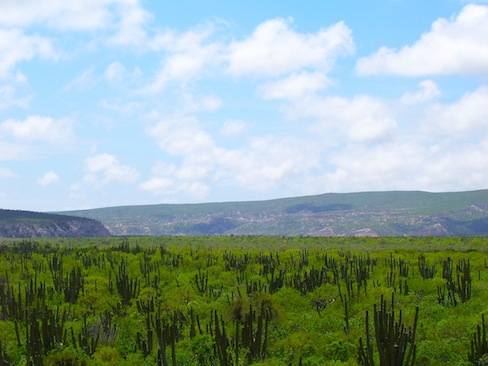
image of sky and lush wild green with mountains in the distance

There were little things and big ones everywhere I looked. In Mexico, the check is never brought to your table at a restaurant until you ask for it. In Mexico, you never approach someone in a store only to blurt our your question or your demand. You say good afternoon, buenas tardes. ¿Como está? How are you? You make contact first, present, courteous. In Mexico, you might sit on the patio reading or working online. You might forget you are in another world. But then you glance over your shoulder and see an iguana as big as your leg from the knee down, as thick around as your muscled calf. He is eating leaves in a nearby tree, his chewing slow and relaxed. He seems benign, but to have him munching yards away from your table is surreal.

In my dream, as I get the car turned around and head back the way I came on the dirt road, I remember how it felt when I couldn’t quiet my brain, couldn’t stop taking the measure of all things. I am doing it, too, in the dream, comparing the culture of this undeveloped country with my own. I watch the sandy banks beside the road in the headlights. I like this foreign land. But it will be much harder, I think, to come to understand the differences between this world and mine without knowing the language here. I’ll have to get to work on that.
Culture Shock (15)

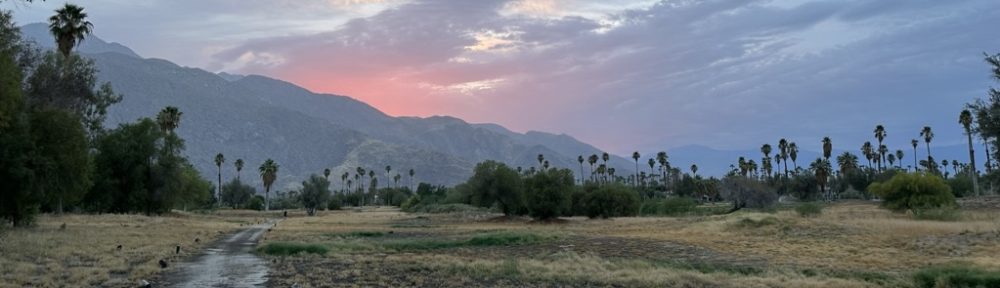
The cats and I crossed the border from Sonoyta, Mexico, three years ago on the second of July. I sang “California Here [We] Come” most of the way through Arizona. Near the California border, we were perched on a ridge on the highway with lightning breaking beside us, my fingers white where they gripped the wheel, the thunder drowning out the beat of my heart. But it cooled the air, welcome relief from the July heat, the desert washed clean around us, alive in scents and color. We bogged down just west of Blythe, an accident on the interstate, and I dipped a washcloth into a bucket of ice water, squeezing it out again and again on the heads of my two cats. I remember running ice cubes over my own forehead, across the back of my neck, along the curve of my collar bone. I decided I was being groomed in some fashion, learning a new kind of endurance on that journey. I would feel that again in the weeks that followed our new lives in the Coachella Valley, coming to terms with the lethal summers, knowing the heat could kill me.

Close-up of Mexican birds of paradise_orange blooms and buds

I took comfort in the bright orange blooms of the Mexican birds of paradise that laced my new home. I thought it was a happy omen. I remember sitting that first evening on the lawn of the motel across the street from the apartment I’d rented over the internet, using their wireless to send emails to Mexico, letting people know we’d arrived, safe, sound, staggered by the feat. I remember walking in the days that followed, feeling like I’d landed on another planet with the wide, clean streets, the expensive landscaping, the manicured everything. After the narrow cobblestone streets of Ajijic that had been my world, being here couldn’t have felt more foreign. I remember feeling like an alien, desperate to connect with the Mexicans who crossed my path, the woman in the mall restroom, the tailor near my new home, the bartender at the Mexican restaurant who told me the owner there was from Guadalajara. I was stripped of the need to speak Spanish, but I didn’t want to stop. It felt wrong. And everywhere I looked, I saw signs of wealth, and you could walk for miles without being able to buy a bottle of water in the brutal heat.

I wanted a tiendita on every block, even in the residential neighborhoods. I wanted brown skin, black hair, warm, laughing bodies greeting each other in the streets, greeting me. I craved the rich, textured, vivid world I’d left behind. I felt small and unveiled, vulnerable, alone. I missed Ana and Rodolfo so much it hurt, an ache that didn’t go away. I didn’t want to be here. I only wanted to be there, in that other world that already seemed like a dream, all those hundreds of miles away, where I’d left all the food that had flavor, all the color that had depth, all the people who met me with an open heart, warm brown eyes meeting mine. I wanted fruta picada on every corner, tortillas delivered every morning, still warm, the sound of the tamale man calling in the early night. I wanted the life that had become mine. I wanted to go home.