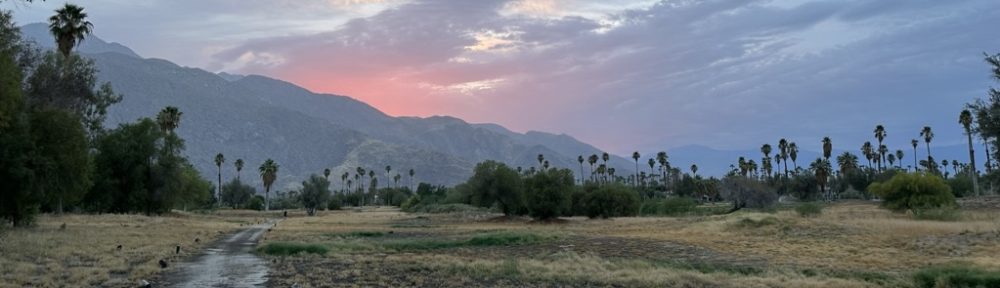
What a Wonderful World

This is the note I wrote to go out with my Christmas cards this year. They have a colorful tree and the words “What a wonderful world” on the front of the card. I thought I’d like to share it here with all of the rest of you, too. Happy new era. Happy holidays.
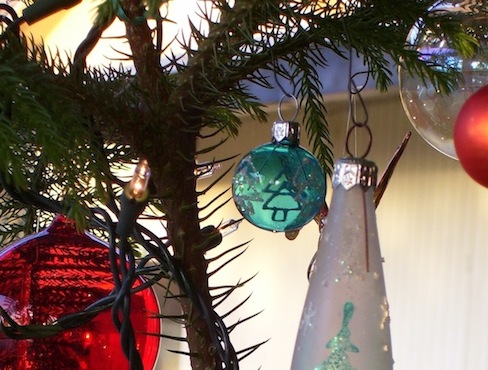
image of ornaments on a tree

I first reached for this card because I liked the cool, artsy tree, the newsprint and paint. Texture and color pull me. The words on the cover conjure Louis Armstrong.
“I see friends shaking hands,” he sings in his rich, unmistakeable voice, “saying how do you do. They’re really saying, I love you.” The song was released the year before Martin Luther King, Jr. was killed. But you can hear the love in Armstrong’s voice. He was courageous enough, large enough, to believe in us, in spite of all evidence to the contrary. So when the phrase makes me pause, makes me wonder if it’s okay to choose this card given all the violence, all the hate, all the tragedy in our world, I can’t help but think there’s something wrong with that, something wrong that I should hesitate. These things don’t make the words untrue, do they? It is a world full of wonder—big sky, palo verde trees, grackles, people helping. It’s the world my father saw, the small wonders, a person’s profile in that gnarl of tide-washed wood, the magic bean sprouts he brought for my dog Sanji when she was dying, the label he made on his old manual typewriter still taped to the jar, crisp in memory, a cherished item when he died just weeks after she did. It makes me want to cry for him, for both of them gone now these 27 years. But it’s layered in me, the way they loved me, the way I’ll love them always. They are composted in me, rich, fertile soil, my carpet, my gifts, my wonder. And this is the time to look to those we love today, remember they are our diamonds, our emeralds, to run our fingers through them, these gemstones of ours, to spread them out in the morning sunlight or kiss the fire of their facets in the shining of the moon. Bring warm scarves, bundle them forward in the quiet almost-winter afternoon, count ourselves lucky. What a wonderful world.
On Calling Home (36)

I’m trying to get it together to mail a package to Ana and Rodolfo for Christmas this year, something the whole family can enjoy. I failed to get it there in time before, sent something late two years ago, incomplete. This year I have a puzzle, a night scene that looks like Italy. I went to buy vegetable seeds yesterday for the milpa, but True Value didn’t have their new stock in yet. I want to get some photos made for them, maybe the Mexican marigolds in my garden, pictures of my cats napping on the patio. I worry they’ll think I’ve forgotten them. The last time I spoke to Ana was in January when I called to talk to Isabel on the day of her quinceanero. I never called back to see if her card arrived with the magic Mexican pesos still tucked inside it, worn bills I had carried in my wallet for years like good luck charms.

I’ve thought of calling often, mornings like this when I sit quiet on the patio and let my thoughts wander back to Ajijic, with Ana and Rodolfo always at the heart of it. I especially wanted to call them on el dia de los muertos and for Thanksgiving, too. I wonder if they celebrated it there this year, the expatriate’s customs rubbing off on the locals. They are people I am grateful for, so I wanted to call to let them know. But I didn’t. I haven’t called since that morning in January, the whole family in a happy flurry getting ready for Isabel’s big day. And I ache for not hearing their voices, not learning las noticias, the news. But something keeps stopping me from calling, and I ask myself again and again what it is. I’m pretty sure it’s not the difficulty of speaking Spanish over the phone, the disadvantage of not having their facial expressions and their gestures to help me out. I suspect, instead, it is the way the thought of them squeezes my heart.

Still, for the fullness of the moment, hearing their familiar voices on the phone, reveling in the sound of their laughter, of laughing together though we’re 1600 miles apart–I tell myself to call soon. That richness is worth the small heartbreak sure to follow.

Traveling (33)

Traveling is an odd thing. I bring myself with me wherever I go, but I don’t always feel like myself. I am still tethered to my home, feel its tug. I am tied to who I’ve left behind there. My cats occupy my space, glaring in their absence, a small prickle or a larger ache. Even when I go where I am known, even loved, I carry their absence, feel the tug of my tether. I am missing bits of my self, the one I have grown comfortable with over time, quiet mornings on the patio, the solar Christmas lights a happy glow on the hedge when I walk home in the new dark after dusk.

The birds here are not my birds. But when I reach in, find my way to fullness on the deck of this other home, their unfamiliar calls comfort me, companions in the quiet autumn morning. They tie me to my world, tingle my self, charm me silly. I feel the sun on my forehead, my ankles, my cheek wet from dog kisses. The house is waking up around me, and my eyes fill with warm tears, my breath deep and grateful in my lungs.

Mexicans Are (31)

It’s some strange hubris of travel to think we know a country or a people because we came and saw a slice of it, of them. How many different versions of the United States do you imagine foreign visitors carry home? Did they stay with family in the Appalachians? Visit a dude ranch in Arizona? Make a wrong turn into Watts one afternoon when they were looking for the Hollywood hills? My Mexico was made up of poor villagers. They are the bedrock on which I base my sense of who the Mexican people are. They are quick to laugh, treat their burdens with a light touch, pay a man to rake the dirt road in front of their home because he needs the pesos even more than they do.

I met a handful of wealthy Mexicans, came to know two handfuls of people who struck me as part of a burgeoning middle class, enough to understand some of the differences between the socioeconomic strata there, how education and money shape their world. Enough to know better than to base my assumptions about life on Mexico on the lives of poor people in rural villages. But not enough to keep me from doing it anyway. I still remember the look on my Senor Soto’s face when I made this mistake, embarrassed myself. “Es raro, no?” I asked him. That’s unusual, isn’t it? He’d just mentioned he and his wife had two children. I was surprised, though looking back on it now I realize all the middle class families I knew there had only two children. He was driving the taxi, so he couldn’t stop to stare at me, but I remember his piercing look. His voice was kind, but there was steel beneath it.

“You can’t do that,” he told me in Spanish. He’d agreed to let me practice my Spanish even though he was fluent in English. (He even taught me the difference between the words “writer” and “author.”) “You can’t make assumptions about all of us like that.” His gaze moved between me and the highway. I was sitting in the passenger seat. We were on our way to the airport in Guadalajara. “Many people have only one or two children,” he said. “It just depends.” I had known it, seen it already, and yet I blundered in, two feet in my mouth, insulting this well-read man who was fluent in two languages, whose son was attending the university, whose wife and he had practiced family planning. I nodded, blushing.

“Entiendo,” I said. I understand. “Lo siento.” I’m sorry. His kindness never faltered, but he’d put me in my place, and I was glad he did. If I might muster even a faint echo of his grace the next time I need to speak up, I’ll be grateful. I have his business card tucked in my wallet. The day I return, I’ll call to see if he can pick me up from the airport. Or maybe I’ll email him ahead of time, so I can know Senor Soto will be waiting for me there.

La Milpa (18)

One time when I did say yes to Mexico, I got to visit Rodolfo’s milpa, the one south of the carretera, the highway, just west of Ajijic. We rode the bus together, Ana and Rodolfo and their daughters Isabel and Mariane and I. Milpa translate’s literally as cornfield, but Rodolfo grew other vegetables, too. They were all nourished by the nightly summer rains. Every year at harvest they had a gathering at his other milpa, north of the highway somewhere. They roasted elote over a big open fire, the corn in their husks, drank tequila, danced. I don’t know how I missed it, but it breaks my heart now to think I may have passed it up. I hadn’t been there long yet, so I maybe I was too shy, but I know I would have done anything to get there in that second summer. But I left that year when the corn was still growing.

The milpa was a few blocks more to the south, between the carretera and the lake. We walked together on the country road in the late summer afternoon. I remember being transported when I followed Rodolfo through the rows of corn. They must have been twelve feet tall. It was another world inside them, all pale green light, moist earth and growing things. He brought us to a makeshift table in the distant heart of the field. Rodolfo picked a handful of pepinos, cucumbers, and washed them with a gallon of water he’d carried with him on the bus. He had a knife to slice them, and Ana produced limes and salt and chile. We ate pepinos picados in our little spot carved out from the forest of corn, and I remember being charmed and oh so grateful they had wanted me to come.

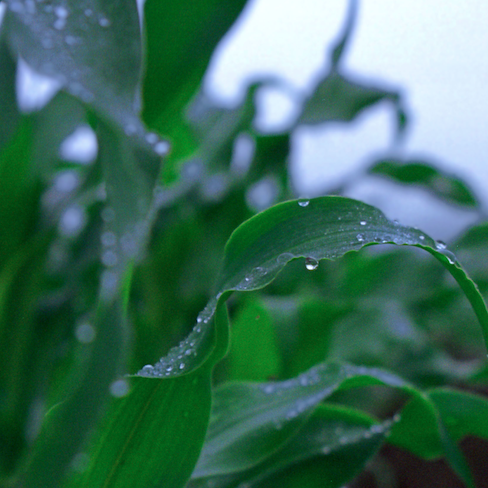
corn plant leaves with raindrops © Tomo Yun

It began to rain, and I licked lime and salt from my fingers. We grabbed everything and ran down the road, laughing, the rain coming down in fat drops, pelting us as we ran. Rodolfo led us to a half-built home a block away. We stood in an unfinished room while the rain beat down on the metal roof, nibbling on brownies I had bought from a cafe in town and crunching crisp red apples. I have always loved the sound of rain on a metal roof, the smell of the first drops hitting dusty earth. I was glad for the water going to the milpa.

Rodolfo talked about the half-built home, abandoned now. It belonged to a friend of his, and when he looked around, I could see in his eyes the way he imagined it in his mind, picturing it fixed up, livable. But Ana only rolled her eyes. She was not eager to live in the country. Over my dead body, she might have said. But I could see it, too, the place restored, the dream of it. Rodolfo and I looked at each other and smiled. Who knew?

[Cornfield photograph cropped from the full version, © Tomo Yun at www.yunphoto.net/en/. Used with permission.]

Cinco de Mayo Martín (6)

A young man is standing at the bus stop when I arrive. “Do you speak Spanish?” he asks me. We end up talking on the bus together, trading off between English and Spanish, and we don’t stop until over an hour later when we reach my bus stop. It is such a joy. His name is Martín. He lives in Mexicali and is doing my planned trip in reverse, Greyhound from Mexicali to Indio, then our local buses. He is twenty-seven, and he is tall. It runs in his family, his town. From the Spaniards? We wonder out loud. His accent when he speaks English sounds more European than Mexican to me, and I wonder where his teacher was from. I think he may have more English than my Spanish, but he has no chance to practice. Would I be the only estadounidense there? The only gringa? He loves Mexicali, wants to spend the rest of his life there. I tell him I felt that way for the first time when I moved to Sonoma County. He lived in L.A. for a few months when he was fifteen. He was lonely, I think. He missed fútbol.

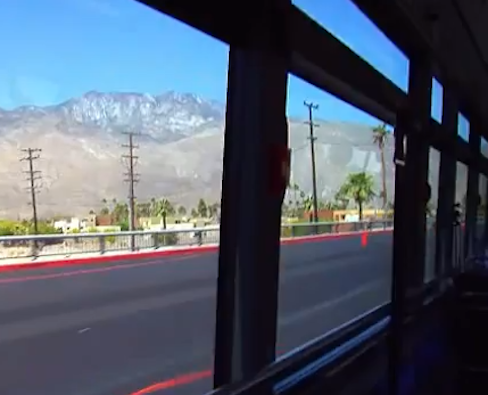
mountains visible through the bus window

I tell him about the near miss I have just had outside the casino after my Kentucky Derby day with Auntie Christel, how the runaway car might have hit me, only seconds to separate me from its path, stopping on the corner to take stock. “Fue muy ‘creepy,'” I tell him. He gives me the Spanish word for it. Espeluznante? I tell him how grateful I am to be here, safe, alive. He tells me his own story, at a party the week before, moved to go home early only to find his mother lying on the floor. How grateful. We understand each other, the bigness of the events. He is young, I tell him, to be going through this with his mother’s illness. I was twenty-four when my stepfather died, Martín’s age when my father died. I think he knows I know. But there are differences. I hope his mother will get well, and when I needed to call 911, I bumbled, my adrenaline blocking my brain. But Martín became clear-headed and superhuman, scooping his heavy mother into his arms, getting her to the hospital. And he remembered all the details in the process, to bring the phone, grab her meds, lock the door. It was a huge victory for him, and so validating, I think, knowing he could do so well in an emergency. But later, like the time I pulled the big dog off my cat Trair and threw him across the yard, Martín was sore for days. We laugh. I feel glad for him, and proud, even as my heart breaks a little that he needs to go through this.

I ask him to tell me about Mexicali. He names a plaza, and somewhere else that is a good place to walk. I scribble them down on the envelope my horseracing money was in. I will hunt for them when I go, think of him. We don’t exchange phone numbers, and as soon as I am home I am sorry. I would have liked to visit him in Mexicali, meet his family. So now I fantasize his sister in Desert Hot Springs will find my blog, read about my Cinco de Mayo Martín, put us in touch. I am talking on the phone, telling my friend Janice about our meeting, about the sweetness of it, how glad we both were, how grateful. I realize in the telling how meeting Martín felt like a reunion. Maybe one day I will walk in the Plaza Calafia at dusk and find Martín and his mother sitting on a bench, and we will sit together and listen to the birds roosting in the trees. Maybe I will come upon his whole family, strolling one late fall afternoon in the Campos UABC, and Martín and I will have our second reunion. Ah, mucho gusto, Martín. Qué te vayas bien.