La Milpa (18)

One time when I did say yes to Mexico, I got to visit Rodolfo’s milpa, the one south of the carretera, the highway, just west of Ajijic. We rode the bus together, Ana and Rodolfo and their daughters Isabel and Mariane and I. Milpa translate’s literally as cornfield, but Rodolfo grew other vegetables, too. They were all nourished by the nightly summer rains. Every year at harvest they had a gathering at his other milpa, north of the highway somewhere. They roasted elote over a big open fire, the corn in their husks, drank tequila, danced. I don’t know how I missed it, but it breaks my heart now to think I may have passed it up. I hadn’t been there long yet, so I maybe I was too shy, but I know I would have done anything to get there in that second summer. But I left that year when the corn was still growing.

The milpa was a few blocks more to the south, between the carretera and the lake. We walked together on the country road in the late summer afternoon. I remember being transported when I followed Rodolfo through the rows of corn. They must have been twelve feet tall. It was another world inside them, all pale green light, moist earth and growing things. He brought us to a makeshift table in the distant heart of the field. Rodolfo picked a handful of pepinos, cucumbers, and washed them with a gallon of water he’d carried with him on the bus. He had a knife to slice them, and Ana produced limes and salt and chile. We ate pepinos picados in our little spot carved out from the forest of corn, and I remember being charmed and oh so grateful they had wanted me to come.

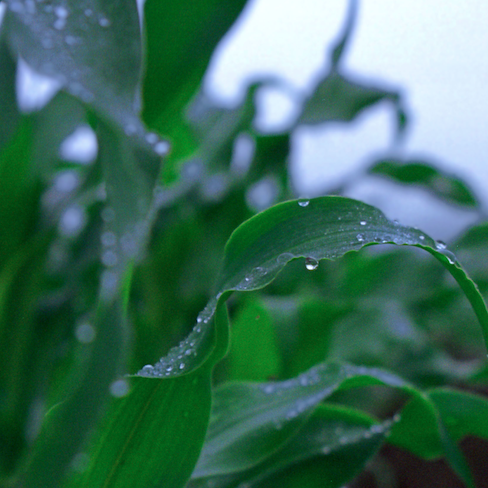
corn plant leaves with raindrops © Tomo Yun

It began to rain, and I licked lime and salt from my fingers. We grabbed everything and ran down the road, laughing, the rain coming down in fat drops, pelting us as we ran. Rodolfo led us to a half-built home a block away. We stood in an unfinished room while the rain beat down on the metal roof, nibbling on brownies I had bought from a cafe in town and crunching crisp red apples. I have always loved the sound of rain on a metal roof, the smell of the first drops hitting dusty earth. I was glad for the water going to the milpa.

Rodolfo talked about the half-built home, abandoned now. It belonged to a friend of his, and when he looked around, I could see in his eyes the way he imagined it in his mind, picturing it fixed up, livable. But Ana only rolled her eyes. She was not eager to live in the country. Over my dead body, she might have said. But I could see it, too, the place restored, the dream of it. Rodolfo and I looked at each other and smiled. Who knew?

[Cornfield photograph cropped from the full version, © Tomo Yun at www.yunphoto.net/en/. Used with permission.]

The Trouble with Attachments (14)

Three years ago on the first of July I was driving west across northern Mexico in the late afternoon. I planned to spend my last night in the country near the little border town of Sonoyta. I wanted to cross into Arizona early the next morning. The weather had been kind to us, clouds hugging our toll road for the past three days, but it was still hot. Undeveloped desert stretched in all directions. The night before, we stayed at a wonderful motel, but I can’t remember where it was. I only remember there were big trees and grassy areas, wild ferns, lush growth in contrast to the sparse desert. I walked to see the nearby river from the overpass, and on my way back to my room a big truck drove past me. It was filled with pigs. They were screaming, as though they knew where they were going. I’ll never forget the sound or the feeling of helpless terror it conveyed. I remembered reading (in a romance novel!) that pigs are almost as intelligent as dolphins. Now when I miss bacon I remember their screams.

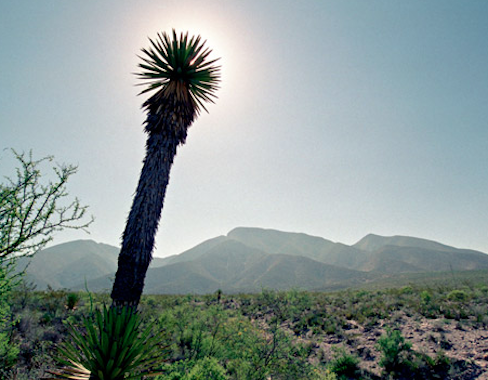
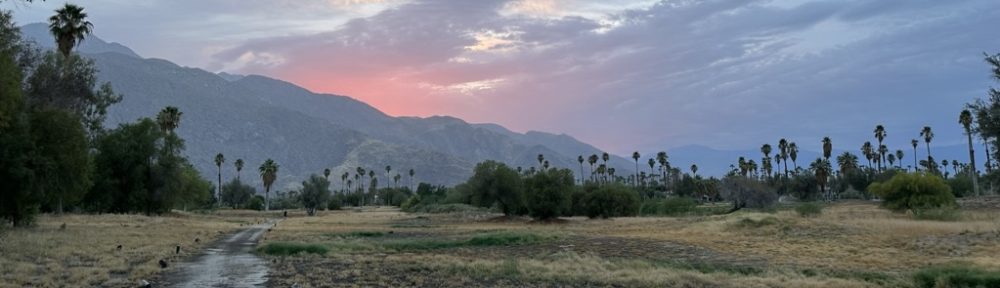
Desert and mountains copyright Tommy Huynh

Later, I ate dinner on the patio. I lingered through the late afternoon and evening by the pool. It was safe and soothing, my oasis in a stressful journey from Jalisco with my two cats. But as is my wont, I decided I would try to repeat this luxury the following night. This is where I went astray. In the afternoon when I was about an hour or so from the border, I saw a motel in the middle of nowhere, sitting alone on the right-hand side of the highway. It was new, and the man in the office was warm and kind. But I had it in my head I wanted a pool. He told me about a motel with a pool in the next town (whose name also escapes me now, and no staring at my worn and folded map evokes an answer), so I thanked him and drove on. I found the motel and checked in. And little by little I discovered this was where the army stayed. There was a pool, all right, but it was crowded with young army men on their off shifts. I was damn well going to swim anyway, and swim I did, weaving in and out of the boisterous young men. I chatted with one, treading water in the deep end, and that’s when I got the skinny on the place. It turned out they came and went all night long.

It wasn’t only the incredible, constant noise that marred my night. It was the energy of the military outside my door and the sight of all those young men carrying machine guns, that even after almost two years in Mexico I never learned to see without a little skip in my heart. To this day I am convinced my last night on the other side of the border would have been filled with big sweetness if I’d only stayed at the place that caught my eye, not had my heart set on a pool at all costs, been content with my previous night’s oasis without being greedy and trying to grab after more. But there was sweetness in the early morning hours there. I couldn’t get Sable out from under the bed when I was ready to leave, and one of the army guys who was out by the pool offered to help me. I couldn’t have done it alone, and I owe him a debt and my big gratitude. Maybe he was the reason I was there.

[Editor’s note: This photo is by Tommy Huynh. He holds the copyright, and you can find it on his website: http://www.lumika.org/mexico/natural_scenes/14.htm. Used here with his permission. And on another note, I got a chuckle out of my title here. I wondered if people would think I was going to talk about problems with attached files! ;-) ]

Alpiste (13)

“The pine tree is coming down in two weeks,” my landlord yelled at me. He was angry with me at the time. I’m hoping he didn’t really mean it, doesn’t follow through with his threat. Our pine tree has been through so much. She should never have been planted in this desert to begin with. Fierce wind took more than half of her away before I came. She was haggard, drying, teetering, it seemed, brushing close to death. But she rallied, and now the shade she casts is doubled, maybe tripled. And the spots for birds to perch or shelter have multiplied, as well. I pray she’ll be protected, pray she’ll thrive. I would hate to see her taken, a mean recompense for having grabbed onto life with such grit, such gusto. I’d be afraid, too, losing her would mean losing even more of the birds who like to linger in our little corner of the world.

Already there are fewer birds here than before. The bulk of the house sparrows have disappeared again, and the doves don’t fill the tray feeder in the mornings like they used to, all packed together, a picture I never did capture properly, all those pretty bird butts ringing the wooden frame. When I first began to notice their absence, in my usual fashion, I wondered if it was because of me. Had I been found wanting? Later, I considered other possibilities, but my first thought was I had not been enough in some way. Could it be the desert rats, cute little guys with big dark chocolate eyes, who eat the remaining seeds in the night? Do they eat bird eggs? Attack birds? I don’t know. I worry, too, it is because I switched to the cheaper bird seed. My new attempts at being frugal and the fact I can bring the twenty-pound bag home from True Value on the back of my bike has me using the dull, dusty feed with cracked corn and milo.

In Hopland I bought a hundred pounds or more at a time and blended them myself. It was cheaper that way, but it was a big procedure, up to my armpits in the plastic bags to mix them. But I loved the way the seeds moved through my fingers, rich with oils and colors. In Ajijic, I could walk to the next block over and buy my bird seed from my favorite tiendita there. They would scoop up the alpiste and weigh it in a plastic bolsa. I could get just half a kilo at a time, stroll home with it, so easy. I miss that. I always suspected folks were cooking with it, too, but I never asked. I know it can be used to make atole, a common hot drink, a comfort. But I trust many of my neighbors were feeding it to their birds, as well. On my block and the next, I would hear the exotic birds calling from the entryways of homes as I walked by. I didn’t know alpiste was canary seed until I moved back to the United States and went hunting it down for my bird seed blend.

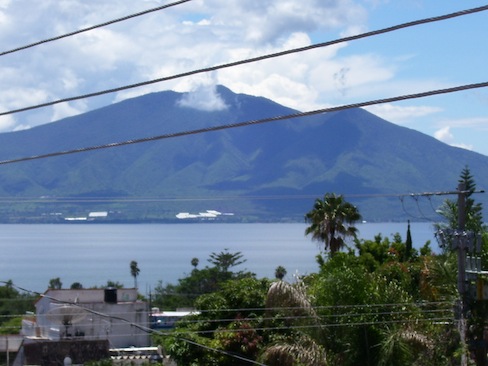
view of Lake Chapala from my veranda

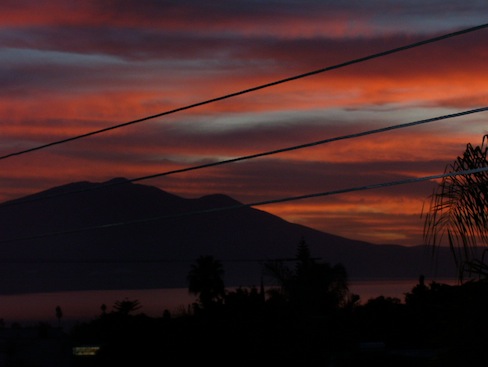
View of lake from veranda after sunset

I had sparrows in Ajijic, too, though never more than three or four at a time, and one dear hummingbird with a feather out of place. (He was the hardest to say goodbye to, after Ana and Rodolfo. I cried when I took his feeder down and left him with a paper cup of sugar water. He sat on the wire and watched me for a long time.) There were no trees on my block there, no real shelter, but still the sparrows would materialize at the tray feeder, eat the alpiste, chat among themselves. I’d sit on my veranda looking at the lake and listening to their quiet exchange.

Now in my courtyard I think again about buying a more expensive seed blend. Maybe I’ll offer it as a special treat from time to time. Or maybe I’ll begin winning more writing contests, left and right and left again, and I won’t even blink at the idea of returning to the rich, pretty birdseed my birds here became accustomed to. I hear the house sparrows behind me now, soft, muted, rounded sounds, satisfied from a midday snack, enjoying the shade of the pyracanthas and the cooling mist the dry, hot wind wafts their way in small puffs.

The sun reaches my feet, burns my right arm and hip as I write, but I keep going, leaning, crooked, toward my remaining shade. I remember the quiet chatter from my sparrows in Ajijic. I relish them in memory even as I savor the soft murmurs behind me now in the hedge. And even though the heat is still climbing, and even though I have much to do still as the day unfolds, I stop, linger, feeling oh so lucky, loving our little desert courtyard, this small oasis on a hot, busy day.

The Moon and the Stars (11)

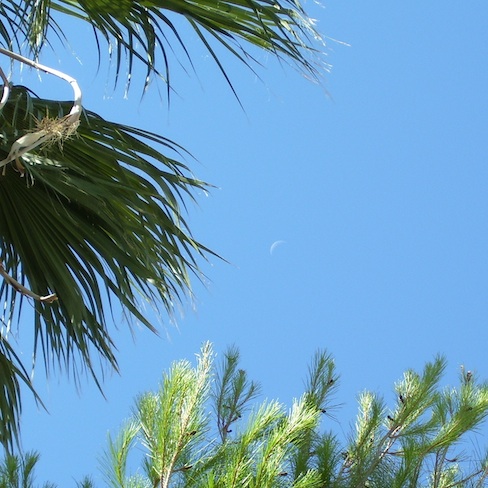
I am sitting cross-legged on my purple yoga mat in the courtyard. I sweep my arms up, my eyes following my hands in their arc. I see a thin sickle of moon framed between the big fan palm and the pine tree, white against the pale blue sky. In the act of drawing breath, of sweeping my arms up, the flicker of thought comes to me to look for the moon. I’d seen it two days in a row from under the pine tree when I filled the finch feeder with thistle seeds. And now, just as I am thinking it may not be visible, that it rises later and later each day, the moon appears. It always surprises me, the unexpected gift of it, a greeting and a message, both. Whenever it finds me, it makes me stop, brings me present, tells me I am not alone. Hello, little one. Here I am. Here we are together.

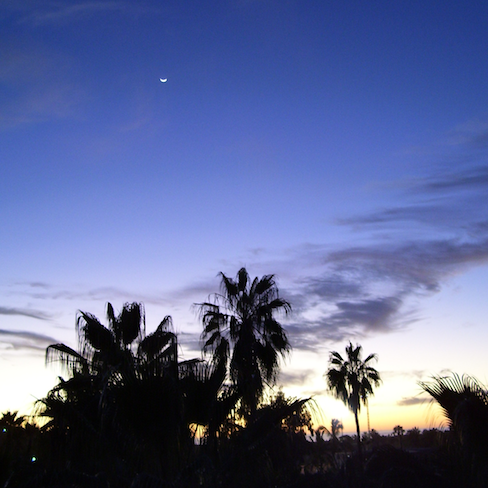
moon with palm and pine

It feels like divine intervention, makes me feel tended with exquisite care, the moon placed just so, my gaze angled just so, positioned and poised to receive the gift, the true present. When it happens, I feel affirmed. I am in the exact spot I am meant to be, at the exact time. I have stopped on Palo Fierro, that day the raven and the mockingbird danced across the sky, showing me the late morning moon. I have stopped on Benito Juarez in Ajijic, neck craned, blocking the narrow banqueta, my eyes traveling across the vivid fuchsia bougainvillea trailing over the orange wall to find the half moon waiting for me in the afternoon sky.

The first stars in the evening feel a bit like this, too. When I walk at dusk I look for them, alert for that one moment when the sun’s light lessens its hold on the heavens and that first starry glimmer appears. I don’t know many names of the stars and the planets, but I am fond of Venus. When I lived in Todos Santos, it may have been Venus who greeted me in my semi-third floor roost. I’d sit outside under the small corner of roof in a tall chair beside the low parapet. I spent all my free time up there, when I wasn’t working or out walking, feet propped on the metal railing, my world spread out below. I faced southwest. In the mornings I would lean out to the east to watch flamingo clouds, listen to the village roosters taking roll. In the afternoons I’d watch the sun glint off my sliver of sea.

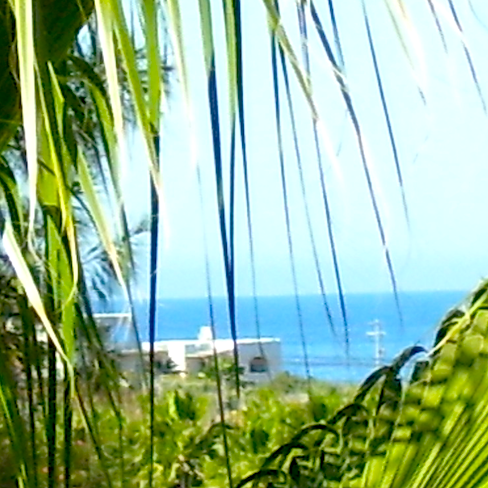
sliver of sea from roost in Todos Santos

moon and Todos Santos sunset from my roost

I can’t count the evenings I sat to watch the sun sink into it, the whole Pacific ablaze. After, I’d watch my hill to the south lose its outline against the blue black sky. But before the colors disappeared, when I spotted that first big shining planet, and after I made my wish, I’d lean way out over the rebar rail, twisting to search for the other stars who made a big cross against the evening sky. I saw it once long after I moved back to the United States, but it was in the wrong part of the sky, at a strange angle, my cross but not. I want to say it is the Southern Cross, but I don’t know where that comes from, like the odd word that pops into your head when you’re working on a crossword puzzle, just as likely to be wrong as it is to be right. I discovered the long narrow cross on my own one night in Todos Santos, and I looked for it every evening after. It felt like the moon feels to me, like a companion, a familiar presence. You are not alone. It whispered to me, sitting in my perch in the late dusk or the dark of early night. And I was ever grateful, I who was so far from home in a foreign land, no firm earth beneath my feet.

Manna from Heaven (9)

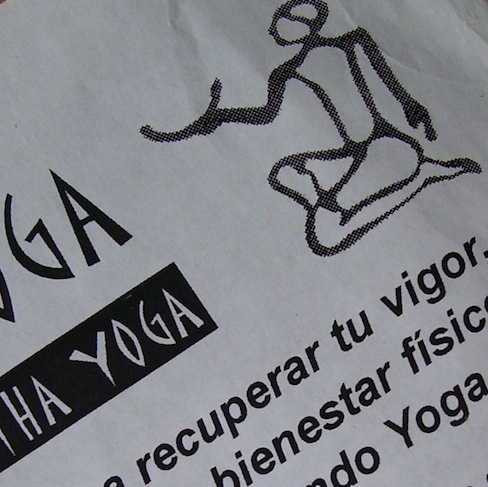
It is April, my first spring break in ten years. I am indulging in yerba maté this week, and my first cup of tea is exquisite. I walked with my lime umbrella this morning, neon green against the bright clouded sky, the rain a gentle rhythm against the fabric, the storm clouds clinging to the rims of our mountains. It made me wish I had my camera. Now the sun is shining and the barest spattering of rain is coming down. My father told me there are Native Americans who believe when this happens, this joining of rain and sunlight, a new moose is born. Today there are two new moose. My empty teacup beside me on the patio table, I open my notebook to write. A small white rectangle of paper drifts out of it, falls into my lap. Auntie Christel’s old cell phone number is scrawled on one side. I turn it over and see it is the tiny flyer for yoga classes in Ajijic. At first, I just stare at the little slip of paper in my hand, dumbstruck. It may as well have fallen from the sky, I think, than to flutter out of my composition book like that, a piece of the world I left behind.

cropped image of the yoga flyer

My mind begins to work again. It must have slipped in the other day when I was using my notebook as a table, writing thank you cards against my knees, paying the dentist bill, when I had my pathetic address book out, stuffed with a crazed fat pile of other little scraps of paper collected over the last handful of years. I remember I picked up the flyer at the health food store in Ajijic, the one next to the nursery at the bottom of my hill, on the frontage road beside the carretera. I bought big bags of yerba maté there from Argentina, the best I’d ever tasted, and the herbal tincture for Sofia’s urinary tract issues. I read the flyer now, surprised I don’t know all the words. When I lived there, I wasn’t really working to build my vocabulary, was just trying to keep up from day to day. I’d understood the gist of the words on the flyer, and that was all I needed. But now I am struck by the language, and I remember the woman wasn’t in practice for the expatriate community there. Indeed, if she had been, I think, the flyer would have been in English. She taught the Mexican community, maybe Mexican tourists, as well. I look up “bienestar,” well-being. “Come and recover your vigor, health and physical well-being.”

I have returned to yoga at last after long years of abandoning it, and now I wonder what it might have been like if I’d returned years earlier. What if I had acted on the longing that awoke in me when I picked this up that day in Ajijic? Would my life have moved differently? I remember the woman taught out of her home in La Floresta. It was in a neighborhood south of the highway, a block, maybe two from the lake on an east-west street. I saw a sign for yoga on a wall there in one of my wanderings. I loved the feeling of those streets, the oldness, the buckled sidewalks, the moss on colored walls, the big trees, the birds, the quiet. The sign for yoga was on a nine-foot painted wall beside a metal gate, a bell. There were huge old trees that canopied the yard behind the wall. I remember standing outside admiring it all. I ached to return to yoga there, to let the peace of that place permeate me. But I didn’t get myself there, and then I moved away.

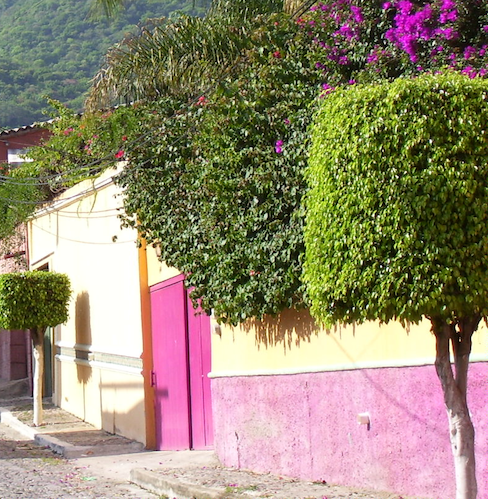
wall with fuchsia metal door

“Hatha yoga is a discipline that teaches the natural way to live,” her flyer says, and I am struck by that now, by how simple and how true it is. I’m grateful I’ve returned to the practice after more than a decade. And holding this slip of paper in my hands, stroking the Spanish words, evidence of my life in another world, I am struck again by the generous nature of the universe. How many many times are we offered these gifts, these chances to be supported? If I had stayed in Ajijic, would I have made my way one summer morning to Evelia Lara’s home behind that wall, my body eager to return to the practice, the cobblestones wet beneath my feet from last night’s rain? I wonder, and I rub my thumb across the scrap of paper from another life. I marvel, too, at the way it fell from the sky today, manna for All Things Mexico.

Things (8)

I don’t have many physical objects to stand for the time I lived in Mexico. I think if my departure had been less quick, maybe I’d have made a point to come back with more things, mementos of my time there. But I had a “knowing” I needed to return to the States, and I left four days later. So I never bought one of those bright-colored baskets the man I liked would carry around Ajijic. I’d had my eye on the big clothes hamper. And I came back with only the one small skeleton, not the collection of dia de los muertos figures I’d imagined. I wanted to buy blankets and rugs, the texture and color that calls me to that country. But I came back without them.

So instead it was the incidental things that returned with us, Lolita Roja packed to her gills with our ordinary possessions. I used the rest of the cinnamon I’d bought in Ajijic in the first few months of our return to the States, and when it was empty, I kept the narrow plastic spice jar for a long time, reluctant to recycle it, its bright orange lid and its Mexican label a strange keepsake. My fondness for the little canela container went beyond the norm. It had lived with us there. And I stretched my aspirin for years, doling out each aspirina tablet like treasure. I loved the Mexican aspirin. I meant to buy more the day I spent in Algodones, but I forgot. They come in small rectangular sheets. You poke them out of their little plastic resting places through the foil backing. You only had to take one. (I did the milligram math when I first moved to Baja California Sur.) They were so handy for slipping into a small zipper pocket. And you could just buy one sheet if you wanted to: eight aspirin. It’s one of the things I love about Mexico–you aren’t penalized if you only have enough money to buy a small amount. The culture isn’t like ours. It’s not all about the more you can afford to buy the less you have to pay for it.

cactus start in waterglass on windowsill

I brought back dried marigold blossoms from the Aldama planters. They have thrived here in my desert garden, my “Mexican marigolds” I wrote about in last year’s blog. They are one of the dearest things I have to remember Mexico by. And on my bathroom windowsill I have another, this little cactus I found in Ajijic. It’s still in the small calcified water glass I placed it in when I first got back to the Aldama apartment with it. When I crossed the border, it was hiding in the trunk. I didn’t know what the rules were, and I wasn’t willing to risk losing this small living evidence of the world I’d left behind. I’ve thought I should plant it in my garden, that it would be happy here. But I haven’t been able to bring myself to do it, our time here uncertain, and I’m still not willing to risk parting with it.

I remember how excited I was the first time it sent out a tiny new shoot. And I remember when I found it, lying in the dirt below its parent plant on the side of the road just west of Ajijic. I’d headed past the cemetery, walked until the road ran to dirt, kept going, all unplanned. I came to big fields with running horses, half-finished dwellings made of red brick. The sounds of the cars on the carretera were faint as I walked, and now and then I caught a glimpse of the lake two blocks south of me. In time I came upon the giant parent cactus, ten feet tall, sprawled behind a brick wall. I stopped on the road to study it. There was a tree in bloom beside it, big puffy cotton-like blossoms. I wanted to come back with my camera. I stood in the road for a long time taking it all in. I felt something ease in me. I hadn’t known how much I needed to get away, how much I’d craved open space, earth beneath my feet, solitude. I soaked up rural Mexico, released breath I didn’t know I was holding, gave thanks. And when I was ready to walk on, I found this little piece of cactus lying in the dirt beside the wall, and I carried it home with care.

Cinco de Mayo Martín (6)

A young man is standing at the bus stop when I arrive. “Do you speak Spanish?” he asks me. We end up talking on the bus together, trading off between English and Spanish, and we don’t stop until over an hour later when we reach my bus stop. It is such a joy. His name is Martín. He lives in Mexicali and is doing my planned trip in reverse, Greyhound from Mexicali to Indio, then our local buses. He is twenty-seven, and he is tall. It runs in his family, his town. From the Spaniards? We wonder out loud. His accent when he speaks English sounds more European than Mexican to me, and I wonder where his teacher was from. I think he may have more English than my Spanish, but he has no chance to practice. Would I be the only estadounidense there? The only gringa? He loves Mexicali, wants to spend the rest of his life there. I tell him I felt that way for the first time when I moved to Sonoma County. He lived in L.A. for a few months when he was fifteen. He was lonely, I think. He missed fútbol.

mountains visible through the bus window

I tell him about the near miss I have just had outside the casino after my Kentucky Derby day with Auntie Christel, how the runaway car might have hit me, only seconds to separate me from its path, stopping on the corner to take stock. “Fue muy ‘creepy,'” I tell him. He gives me the Spanish word for it. Espeluznante? I tell him how grateful I am to be here, safe, alive. He tells me his own story, at a party the week before, moved to go home early only to find his mother lying on the floor. How grateful. We understand each other, the bigness of the events. He is young, I tell him, to be going through this with his mother’s illness. I was twenty-four when my stepfather died, Martín’s age when my father died. I think he knows I know. But there are differences. I hope his mother will get well, and when I needed to call 911, I bumbled, my adrenaline blocking my brain. But Martín became clear-headed and superhuman, scooping his heavy mother into his arms, getting her to the hospital. And he remembered all the details in the process, to bring the phone, grab her meds, lock the door. It was a huge victory for him, and so validating, I think, knowing he could do so well in an emergency. But later, like the time I pulled the big dog off my cat Trair and threw him across the yard, Martín was sore for days. We laugh. I feel glad for him, and proud, even as my heart breaks a little that he needs to go through this.

I ask him to tell me about Mexicali. He names a plaza, and somewhere else that is a good place to walk. I scribble them down on the envelope my horseracing money was in. I will hunt for them when I go, think of him. We don’t exchange phone numbers, and as soon as I am home I am sorry. I would have liked to visit him in Mexicali, meet his family. So now I fantasize his sister in Desert Hot Springs will find my blog, read about my Cinco de Mayo Martín, put us in touch. I am talking on the phone, telling my friend Janice about our meeting, about the sweetness of it, how glad we both were, how grateful. I realize in the telling how meeting Martín felt like a reunion. Maybe one day I will walk in the Plaza Calafia at dusk and find Martín and his mother sitting on a bench, and we will sit together and listen to the birds roosting in the trees. Maybe I will come upon his whole family, strolling one late fall afternoon in the Campos UABC, and Martín and I will have our second reunion. Ah, mucho gusto, Martín. Qué te vayas bien.