Dreaming Home (46)

I’ve longed for ages for a home where I felt like I could spend the rest of my life. When I moved to Sonoma County, it was the first time I had that feeling about a place. I remember driving home from Santa Rosa on Guerneville Road past green farms, the oak-studded hills before me. Look where I live, I thought. When I moved into La Casa Azul in Todos Santos, it was the first time I had that feeling about an actual dwelling. Things went terribly awry with my landlord there, but I remember that giddy feeling, thinking I’d found the home of my dreams. I remember wondering if I’d be able to negotiate the wrought iron spiral staircase when I grew old.

Over the years I’ve built a habit of studying the yards, examining the homes whenever I walk down the street. “Oh, I could live there,” I’d say to myself, caught by the wrap around porch or the climbing wisteria, both pleasure and longing evoked by my ritual, a bittersweet practice. When I lived in Ajijic where buying a home might have been one day more within my reach, I photographed for sale signs. I remember one advertising an empty lot of neatly turned earth, a beautiful brick wall surrounding it, a blue metal gate. I went as far as to look at two homes for sale up in the hills. One was all white and one was green, and they were both two stories tall with miradores that made them seem like three-story homes. I don’t remember any details about the houses themselves, only those marvelous rooftop patios, the views of the village spread out below them, the lake in the distance. I would have lived on those roofs.
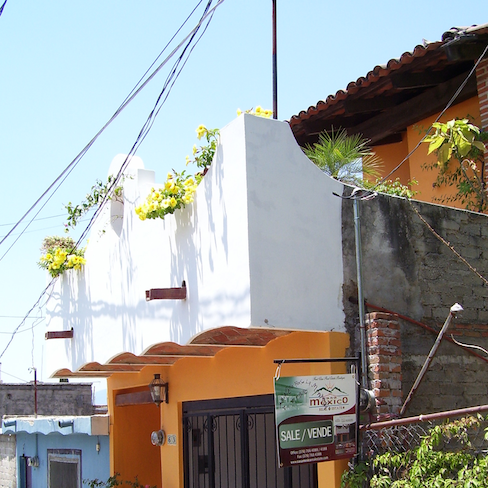
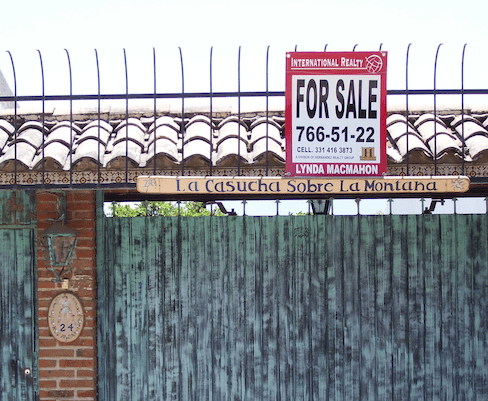
for sale sign, white veranda, yellow blossoms

for sale sign, metal gate

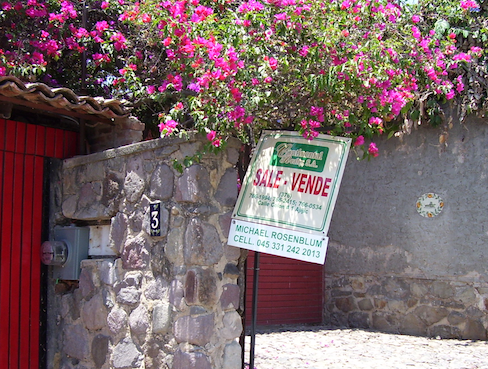
for sale sign, bougainvillea and rock wall

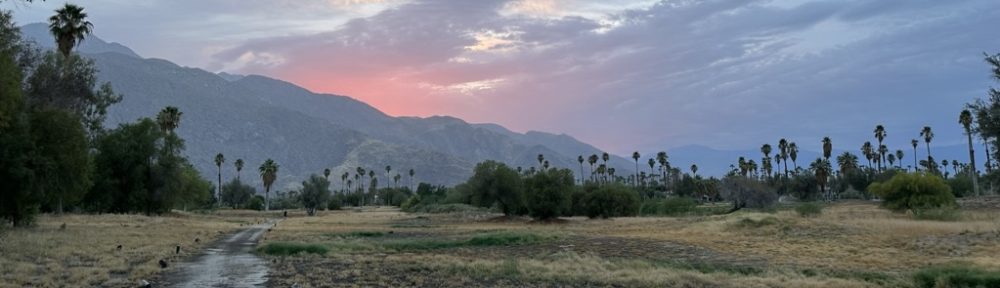
Now in my unexpected southern California life, thanks to two dear friends and the workings of a generous universe, I’m on the threshold of having my longing met in the old trailer home I’ve just bought. I don’t get to take possession of it, so to speak, until April, but it has possessed me from day one. It has grabbed me by my viscera, invoking big dreams of a magic home I can grow old in, tending my garden and writing my books, the stark place transformed little by little in the intervening years to lushness and color, where my birds will want to linger chatting together in the bougainvillea or the palos verdes. I can see myself sipping tea on my patio there years from now, watching the sun disappear behind my mountains, the sparrows and the mourning doves scritching among the leftover seeds in the late afternoon quiet. I don’t have words to say how grateful I am, how full this makes me, how much awe it awakens. But I seem determined to try anyway, to fall short but maybe brush the feathers of the thing in my attempt. Thank you, universe. Thank you, dwelling gods. Thank you, especially, my good friends. Thank you.
What a Wonderful World

This is the note I wrote to go out with my Christmas cards this year. They have a colorful tree and the words “What a wonderful world” on the front of the card. I thought I’d like to share it here with all of the rest of you, too. Happy new era. Happy holidays.

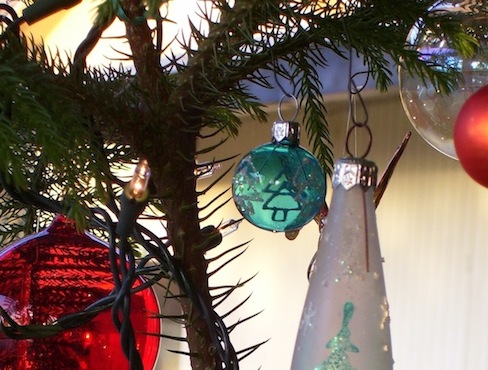
image of ornaments on a tree

I first reached for this card because I liked the cool, artsy tree, the newsprint and paint. Texture and color pull me. The words on the cover conjure Louis Armstrong.
“I see friends shaking hands,” he sings in his rich, unmistakeable voice, “saying how do you do. They’re really saying, I love you.” The song was released the year before Martin Luther King, Jr. was killed. But you can hear the love in Armstrong’s voice. He was courageous enough, large enough, to believe in us, in spite of all evidence to the contrary. So when the phrase makes me pause, makes me wonder if it’s okay to choose this card given all the violence, all the hate, all the tragedy in our world, I can’t help but think there’s something wrong with that, something wrong that I should hesitate. These things don’t make the words untrue, do they? It is a world full of wonder—big sky, palo verde trees, grackles, people helping. It’s the world my father saw, the small wonders, a person’s profile in that gnarl of tide-washed wood, the magic bean sprouts he brought for my dog Sanji when she was dying, the label he made on his old manual typewriter still taped to the jar, crisp in memory, a cherished item when he died just weeks after she did. It makes me want to cry for him, for both of them gone now these 27 years. But it’s layered in me, the way they loved me, the way I’ll love them always. They are composted in me, rich, fertile soil, my carpet, my gifts, my wonder. And this is the time to look to those we love today, remember they are our diamonds, our emeralds, to run our fingers through them, these gemstones of ours, to spread them out in the morning sunlight or kiss the fire of their facets in the shining of the moon. Bring warm scarves, bundle them forward in the quiet almost-winter afternoon, count ourselves lucky. What a wonderful world.

Traveling (33)

Traveling is an odd thing. I bring myself with me wherever I go, but I don’t always feel like myself. I am still tethered to my home, feel its tug. I am tied to who I’ve left behind there. My cats occupy my space, glaring in their absence, a small prickle or a larger ache. Even when I go where I am known, even loved, I carry their absence, feel the tug of my tether. I am missing bits of my self, the one I have grown comfortable with over time, quiet mornings on the patio, the solar Christmas lights a happy glow on the hedge when I walk home in the new dark after dusk.

The birds here are not my birds. But when I reach in, find my way to fullness on the deck of this other home, their unfamiliar calls comfort me, companions in the quiet autumn morning. They tie me to my world, tingle my self, charm me silly. I feel the sun on my forehead, my ankles, my cheek wet from dog kisses. The house is waking up around me, and my eyes fill with warm tears, my breath deep and grateful in my lungs.

Mexicans Are (31)

It’s some strange hubris of travel to think we know a country or a people because we came and saw a slice of it, of them. How many different versions of the United States do you imagine foreign visitors carry home? Did they stay with family in the Appalachians? Visit a dude ranch in Arizona? Make a wrong turn into Watts one afternoon when they were looking for the Hollywood hills? My Mexico was made up of poor villagers. They are the bedrock on which I base my sense of who the Mexican people are. They are quick to laugh, treat their burdens with a light touch, pay a man to rake the dirt road in front of their home because he needs the pesos even more than they do.

I met a handful of wealthy Mexicans, came to know two handfuls of people who struck me as part of a burgeoning middle class, enough to understand some of the differences between the socioeconomic strata there, how education and money shape their world. Enough to know better than to base my assumptions about life on Mexico on the lives of poor people in rural villages. But not enough to keep me from doing it anyway. I still remember the look on my Senor Soto’s face when I made this mistake, embarrassed myself. “Es raro, no?” I asked him. That’s unusual, isn’t it? He’d just mentioned he and his wife had two children. I was surprised, though looking back on it now I realize all the middle class families I knew there had only two children. He was driving the taxi, so he couldn’t stop to stare at me, but I remember his piercing look. His voice was kind, but there was steel beneath it.

“You can’t do that,” he told me in Spanish. He’d agreed to let me practice my Spanish even though he was fluent in English. (He even taught me the difference between the words “writer” and “author.”) “You can’t make assumptions about all of us like that.” His gaze moved between me and the highway. I was sitting in the passenger seat. We were on our way to the airport in Guadalajara. “Many people have only one or two children,” he said. “It just depends.” I had known it, seen it already, and yet I blundered in, two feet in my mouth, insulting this well-read man who was fluent in two languages, whose son was attending the university, whose wife and he had practiced family planning. I nodded, blushing.

“Entiendo,” I said. I understand. “Lo siento.” I’m sorry. His kindness never faltered, but he’d put me in my place, and I was glad he did. If I might muster even a faint echo of his grace the next time I need to speak up, I’ll be grateful. I have his business card tucked in my wallet. The day I return, I’ll call to see if he can pick me up from the airport. Or maybe I’ll email him ahead of time, so I can know Senor Soto will be waiting for me there.

Mango (25)

I pick the big green mango up from the counter, cradle it in my cupped hands. I probe the sides with gentle fingers. I am surprised by how quickly it has softened, even in our late summer heat, becoming almost ripe while I was away overnight celebrating Mami’s birthday. Yesterday in the late afternoon I placed it on the patio table beside a tiny vase of blossoms from my garden to honor the equinox.

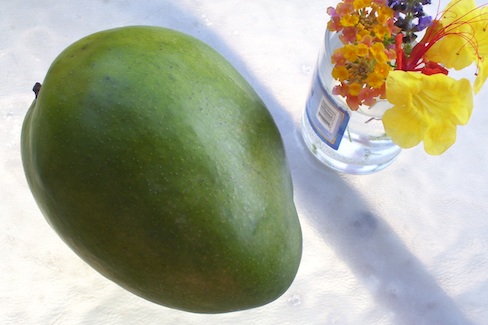
green mango with tiny vase of mixed blooms beside it

Now without knowing, I have brought the mango to my face. The sweet, spicy, astringent smell drifts across me. Tears fill my eyes like a yawn, that quick stretching yearning. For one long moment, the scent takes me to Todos Santos. I am sitting at my tall round wrought iron table in the courtyard at Las Flores, marveling over the ripe red mango that has appeared there as if conjured. Later, Alfredo mimes peeling and eating one, not even trying to name it for me, not knowing the word is the same in English except for our terrible American “a” that butchers its beauty. There are three little trees behind the main house. I pass them when I go to use the washing machine. Alfredo brings me more as the weeks go by, sharing the largesse as the season swells and ends. Always they appear on my little courtyard table like sweet offerings to the gods. Sometimes, when he has borrowed my binoculars to look for whales from the steps at the other side of the inn, he will return them to my table with a mango beside them. Back in my desert kitchen, a world away, I roll the big green mango in my palms, my thumbs brushing across it. I press my nose to the firm skin, inhaling, my lips touching, too, my pose a prayer.

Refrigerator Blues (21)

When I moved into La Casa Azul, the refrigerator was filled with old food. It was sitting, skewed, on top of two old wooden pallets, and there was mold and rust everywhere. I threw out the food, scrubbed each surface with soap. When I brought its condition up with the man who handled the rental for the famous Mexican artist who owned the blue house, Umberto looked blank and suggested I paint over it. I didn’t let this mar my new dream home. The building was alive with color and light. I felt like I could spend the rest of my life there. I’d never felt that way before. When I moved into my current home, my landlord emphasized the importance of the hedges being watered, of my not interfering with the automatic timer. When I discovered the timer didn’t work, I told my landlord. “Do you have a hose?” he asked. Last year he stopped having the hedges trimmed, though I’ve fought for them to be done again twice now in the past six months. But the pyracanthas have been getting more and more bare, my privacy in my courtyard garden now more illusion than real. And then my refrigerator died, and he wheeled a “new” one for me upright down the road from around the block, rattling and bumping along the asphalt. My jaw dropped. I spent three hours cleaning it out and trying to get the marks out of the floor, only to discover it didn’t work anymore. It shouldn’t have been a surprise.

kitchen of La Casa Azul, door open to the patio, orange walls

But it wasn’t just the hassle of the refrigerator. It was cumulative. The hedges might be dying. Could it really be from lack of water? “Do you have a hose?” rang in my mind. “Puedes pintarlo,” Umberto had said. You can paint it. And before I left Todos Santos, the refrigerator stopped working all together. I didn’t even ask them to fix it. Things had deteriorated beyond that. I lived out of my two little ice chests. I felt helpless in Todos Santos, trapped. In the end I fled my beloved Casa Azul. I’ll always be glad I did, and I’ll always regret it couldn’t have worked out differently. When the wealthy Mexican artist refused to give me back the $700 he owed me from my deposits, the bad fridge was one of his reasons. The memory still brings me to wall of anger, the stone cold against my fingers. So when I found myself living out of my ice chests again here, I know the rest of this was at work beneath the surface. I was desperate to get away, out of all proportion to the circumstances. I threw myself once more into looking for a mobile home, contemplating buying a trailer, even looking at other rentals. But then my landlord gave me his refrigerator, and the panic eased. I am now soaking the hedges every other day, hoping they’ll revive. And I’m thankful I’m not fleeing. I know when the day comes, it will be hard to leave my enchanted courtyard garden. I don’t want it to come in haste, unsettled, my need to escape eclipsing everything. I want the peace of mind to cherish what I have through that last day, still obscured in mist, be it in two months or twelve years. If I could do it over again, I would stroll through the kitchen at La Casa Azul with all my gladness and all my gratitude sitting there beside my grief. I would run my hand against the orange wall, take in the sunlight and the colors and relive that last goodbye without the taint of despair, my clear heart cheering in a loud and grateful voice.

Where I Belong (20)

Today I cross the carretera, choose the little bus that goes through the village first. I like the little bus best. It’s more simple, more bare bones, has no curtains, no cushions. All the windows are flung open, and kids in their school uniforms chatter and laugh and shout. Older Mexican women get on with their heavy groceries, sometimes only riding for a few blocks along the narrow cobblestone streets. I like being drenched in the bustle. By the time we get back up to the highway again, things have quieted. The after-school flurry is over.

The bus heads west. I breathe in wet earth from last night’s rain. I settle into my seat. I am going again to the next town over, to San Juan Cosolá. The wind blows in, making straight dark hair dance against the backs before me. The driver has the radio up loud, and ranchera music washes around us like the summer air. In the midst of all that is familiar, that for all its foreign-ness has become home to me, I am overcome. It happens to me often on this stretch of road, a kind of Mexican enchantment, I think. But still I am surprised. I am taken by a big burst of joy to be living here in Mexico, joy washed by gratitude that makes my eyes brim.

glimps of Lake Chapala

I look out the window, my throat tight, my heart pushing against my ribs. I watch the hills, a swathe of color on my right. I catch glimpses of the lake in the distance on my left. My mouth is open now, my jaw loose, half taking it all in, half awe. I wonder if part of what overtakes me on these bus rides is that seated on the bus among these dark-headed people, I feel a part of things. We are in this together, this riding on the bus with the air rushing in and the music resonating in our bones. On the bus, I feel like I belong.