Crossing (30)

I am fascinated by the boundaries between us. Borders between countries, lines drawn on rock, boundaries between people, between cultures–arbitrary or innate, they separate us, define us. But boundaries aren’t just barriers. They provide the arena for moving back and forth between the two. They offer the possibility of exchange. I can ride the charter bus from the Coachella Valley to Algodónes. I can walk across the border and be in Mexico. One line, drawn no doubt by nations after war, shouldn’t be able to make so much difference. I’ve studied the border from the bus, the way the fence runs through the desert, a jagged monster, the sprawling remains of extraterrestrials. I can find no clues, no evidence that one side of the fence should be so different from the other.
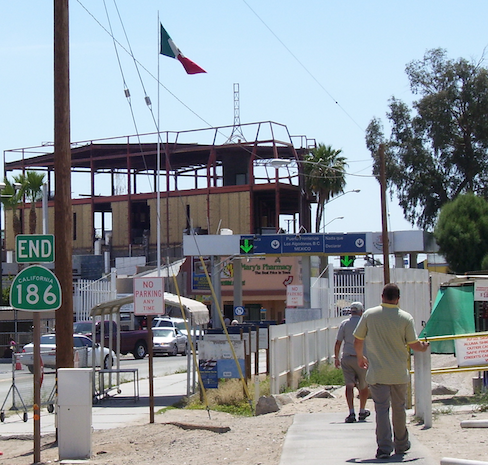
shot of the border looking toward Mexico from the U.S.

But walk a few yards toward el otro lado, the other side, and you can feel the change. It is of the body, I believe, and not the mind, yet I return to it again and again and again, wanting to make sense of it, trying to figure it out. When I walk across, my body knows I’m in a foreign country. Because I lived there once, it feels like coming home, but this is a comfort of the heart, I think, the soul, and not the body. The body knows this is not the land where it was raised. It’s not geography. My scrutiny of the fence line across the desert between us revealed nothing, only made me marvel, knowing just across it lives another world, a stone’s throw only, two crows flying. The land doesn’t change at the border, but we breathe different air. Spanish diphthongs and mariachi and sidewalks all sing Mexico. Grackles call out in their native tongue. Our bodies know.
Dark As Night (28)

Dark as night the heads of children racing back and forth across the plaza shouting, hair shiny in the early dusk. Dark as night the grackles roosting in the jacarandas of the zocoló. Dark the skin of every single body in the crowded square, except her. Old men, young women, clustered, Spanish a loud, steady murmur, the rapid curve of a summer creek, as steady as the grackles calling from the trees, a cacophony of conversation, a mad frenzied orchestra tuning up. Dark as night the glistening black feathers, dark the skin, dark the grackle silhouettes, dark of every being in the zocoló but her, her white skin a bruised thumb, dumb with her estadounidense self. She would lose her Puerto Rican friend over a careless email about walking through the plaza in that Sunday twilight, the dirty cement, the alien dark-skinned world, her senses dulled by too much beer. Not racism, though, only sinking in a sea of otherness, aching and alone. But now she dreams of it like dessert. She’ll go again, sit nodding, smiling on a bench, tears sliding down her face in the half light. Eyes closed, the symphony surrounds her. The grackles make her heart dance in her chest, bump against her ribs. She holds still in the center of that boisterous foreign world where language is music. Her white skin gets lost in the late dusk until her estadounidense self all but disappears. She sits there while the light slips away, until it feels right to be there in the heart of things, dark as night and plain as day.

[Editor’s note: This piece was begun with a writing prompt from my Monday night writing workshop led by Alaina Bixon. We were told to begin a poem with a cliche. Thank you, Alaina.]

Africa? (27)

I dream I am in a foreign country. I drive across a sprawling city where there are no tall buildings, and all the roads cross on the diagonal. Later, I am in a big high-ceilinged room with a hundred children. They are all busy talking in a language I don’t recognize. When I leave, I drive on a narrow dirt road barely as wide as my car. The road peters out into a path, wide enough for people or burros, and in the dark I picture people walking there. The sides of the trail are covered with sand, spotted with scrubby vegetation, though I have the sense of trees in the distance, and open, undeveloped land that goes on and on toward the east. I turn the car around, thinking about my afternoon with the children.

My mind is working on the differences between this world and my own. I feel like I did when I first moved to Baja California Sur. I was glad I had driven there even though the driving itself was nightmarish. But it gave me a clear sense of the vast wilderness that lay between me and the border, long open distances like in the dream. I remember in those first weeks in Todos Santos noticing all the differences between the two worlds, my mind on overdrive, always comparing, contrasting, wondering, discerning.

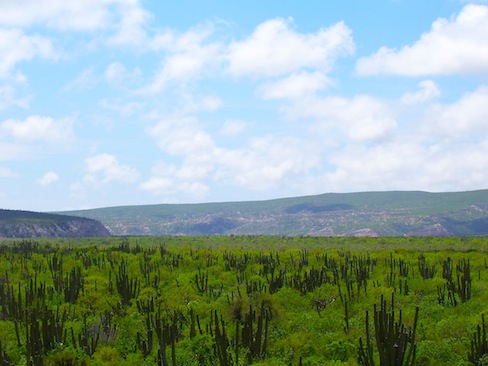
image of sky and lush wild green with mountains in the distance

There were little things and big ones everywhere I looked. In Mexico, the check is never brought to your table at a restaurant until you ask for it. In Mexico, you never approach someone in a store only to blurt our your question or your demand. You say good afternoon, buenas tardes. ¿Como está? How are you? You make contact first, present, courteous. In Mexico, you might sit on the patio reading or working online. You might forget you are in another world. But then you glance over your shoulder and see an iguana as big as your leg from the knee down, as thick around as your muscled calf. He is eating leaves in a nearby tree, his chewing slow and relaxed. He seems benign, but to have him munching yards away from your table is surreal.

In my dream, as I get the car turned around and head back the way I came on the dirt road, I remember how it felt when I couldn’t quiet my brain, couldn’t stop taking the measure of all things. I am doing it, too, in the dream, comparing the culture of this undeveloped country with my own. I watch the sandy banks beside the road in the headlights. I like this foreign land. But it will be much harder, I think, to come to understand the differences between this world and mine without knowing the language here. I’ll have to get to work on that.

Seasons (26)

I’ve heard the mockingbird singing from the top of the fan palm three mornings in a row. Today when I was lying on my back in the courtyard on my yoga mat, I listened to the verdin’s sweet three-note call. I pictured him sitting in the pine tree, his bright yellow cap and cheerful eyes hidden among the long green needles. Last week, both the hibiscus and the apricot mallow began to bloom again. The crickets have woken up, too. In spite of still mostly three-digit temperatures, they all recognize the secret signals, a heady mixture of the fewer hours of high heat each day, the angle of the sun making its way south, the nights in the seventies. And they aren’t grumbling like I am–tired of the heat, my tolerance used up–though they have more reason to than I who could escape it. They don’t indulge in weariness–they bounce. They celebrate in song, in bloom.

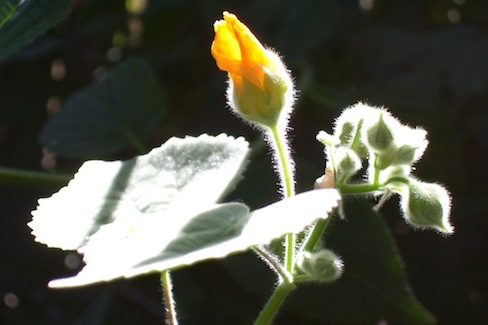
Apricot mallow with the sun shining on fuzzy leaves and one bloom

And their festivities cheer me on. I relish the feel of the cotton sheet over me in the early hours of the morning, the occasional weight of Sofia against leg or hip, missing for months now, a welcome surprise. I look forward to the day when I’ll be seeking the warmth of the sun on the patio when I do my yoga instead of hiding from it. I’ve lived in California most of my life, and still I bristle when someone tells me there are no seasons here. They are subtle but marked. Do not tell me otherwise. Soon the long clusters of green berries on the fan palm will ripen, and the starlings will feast, scattering in shiny black chattering when I walk outside. The days will grow shorter, the blue of the sky deeper. Riding my bike will become sheer bliss. Sometimes I think our desert, where some claim we have only two seasons, may mark the changes in the year more clearly than other parts of the state. Though I realize the changes are less visual than visceral. Here in the fall we begin to reawaken. We return to a state of grace, of ease in the outdoors.

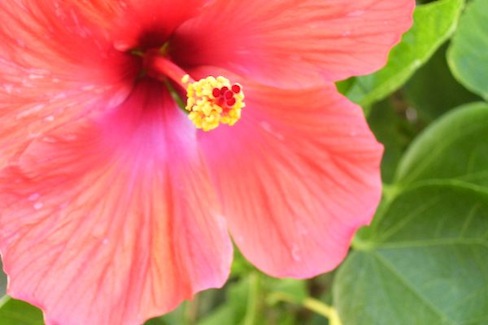
one red hibiscus bloom, cropped

The seasons were subtle in the places I lived in Mexico, too. But they were undeniable unless you just weren’t paying attention. In Todos Santos, the summer rains made for muggy heat, a boon for bugs, biting and otherwise. But it washed the dusty desert clean, changed the color of the world, the lush plant life made new. In winter you could go barefoot in the warm dry days. I remember sitting in my third-floor roost in La Casa Azul, my feet propped up against the rebar railing, marveling at being barefoot in the middle of January. You knew it was winter there by the nights. In Ajijic, jacarandas trumpeted the burgeoning spring, their lilac blossoms littering the cobblestones. The “rainbirds” were the harbingers of the summer rains, not birds at all but insects, a kind of cicada, I think. You could mark the onset of the rains on the calendar from the date you first heard the rainbirds sing. Autumn there meant a world of green, the hills bathed in all their new-growth glory after months of nightly rain. And fresh, sweet corn was everywhere.

Mango (25)

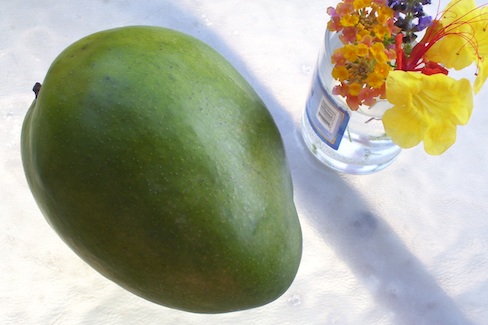
I pick the big green mango up from the counter, cradle it in my cupped hands. I probe the sides with gentle fingers. I am surprised by how quickly it has softened, even in our late summer heat, becoming almost ripe while I was away overnight celebrating Mami’s birthday. Yesterday in the late afternoon I placed it on the patio table beside a tiny vase of blossoms from my garden to honor the equinox.

green mango with tiny vase of mixed blooms beside it

Now without knowing, I have brought the mango to my face. The sweet, spicy, astringent smell drifts across me. Tears fill my eyes like a yawn, that quick stretching yearning. For one long moment, the scent takes me to Todos Santos. I am sitting at my tall round wrought iron table in the courtyard at Las Flores, marveling over the ripe red mango that has appeared there as if conjured. Later, Alfredo mimes peeling and eating one, not even trying to name it for me, not knowing the word is the same in English except for our terrible American “a” that butchers its beauty. There are three little trees behind the main house. I pass them when I go to use the washing machine. Alfredo brings me more as the weeks go by, sharing the largesse as the season swells and ends. Always they appear on my little courtyard table like sweet offerings to the gods. Sometimes, when he has borrowed my binoculars to look for whales from the steps at the other side of the inn, he will return them to my table with a mango beside them. Back in my desert kitchen, a world away, I roll the big green mango in my palms, my thumbs brushing across it. I press my nose to the firm skin, inhaling, my lips touching, too, my pose a prayer.

Scorpions and Besoconas (24)

I am watering the palm trees and the bougainvillea in the side yard when I think I see a small scorpion curled up against the faded red cement. Even as the possibility takes shape in my mind I have already washed it away. I stand barefoot on the wet stepping stone and point my nearsighted eyes around the edges, hunting for that familiar form. I don’t see the scorpion, but there are dried blossoms everywhere, evidence of my careless gardening. It would be easy to blend in. I bend close to the ground, afraid of spotting it, my wet toes curling at the thought. The scorpions I removed, again and again and again, from our blue house in Todos Santos come back to me now. I can’t remember my exact method, only the stiffness of my arms extended in front of me as I carried the scorpion out to the back patio and with each slow step the stifling of my urge to shriek and fling it violently away.

There were spiders in that home, too. I remember one black body crawling up the orange kitchen wall. It was bigger than my hand, my fingers spread wide. I left it alone, managed not to scream, not go running down the dirt road, gibbering in horror. I shudder even now, make another quick check around the circumference of my feet. All clear. I hose down my knees, my shins, wriggle my toes against the glistening cement. Did I really see a scorpion just now? And if I did, was it dead or alive? I shiver, go back to my watering. There are some things I don’t miss about living in Mexico, I think, as I turn to retrace my steps along the walkway. I wonder if some things, like spiders the size of plates, might even make me hesitate to live there again.

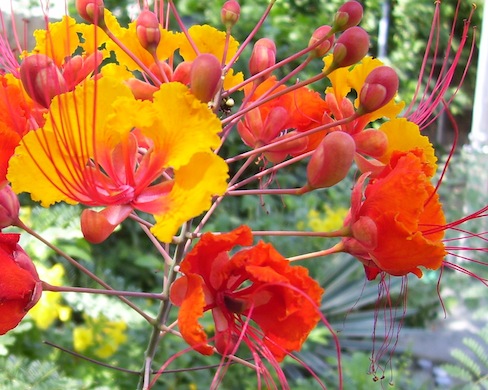
Close-up of Mexican birds of paradise blossoms and buds

I shake my head, as if I could dislodge the thought, and walk through the cool wet to water my tecoma and my Mexican birds of paradise. They are both spilling out of their ceramic pots, encroaching on the path, lush and stunning in their messy late summer opulence. I see the painted gecko peeking out behind them, and I remember the high-pitched kissing sounds of the besoconas who lived in the palapa roof of our first Todos Santos rental. I liked their company, and I miss their cheerful noise. I remember, too, they are great eaters of bugs.

La Milpa (18)

One time when I did say yes to Mexico, I got to visit Rodolfo’s milpa, the one south of the carretera, the highway, just west of Ajijic. We rode the bus together, Ana and Rodolfo and their daughters Isabel and Mariane and I. Milpa translate’s literally as cornfield, but Rodolfo grew other vegetables, too. They were all nourished by the nightly summer rains. Every year at harvest they had a gathering at his other milpa, north of the highway somewhere. They roasted elote over a big open fire, the corn in their husks, drank tequila, danced. I don’t know how I missed it, but it breaks my heart now to think I may have passed it up. I hadn’t been there long yet, so I maybe I was too shy, but I know I would have done anything to get there in that second summer. But I left that year when the corn was still growing.

The milpa was a few blocks more to the south, between the carretera and the lake. We walked together on the country road in the late summer afternoon. I remember being transported when I followed Rodolfo through the rows of corn. They must have been twelve feet tall. It was another world inside them, all pale green light, moist earth and growing things. He brought us to a makeshift table in the distant heart of the field. Rodolfo picked a handful of pepinos, cucumbers, and washed them with a gallon of water he’d carried with him on the bus. He had a knife to slice them, and Ana produced limes and salt and chile. We ate pepinos picados in our little spot carved out from the forest of corn, and I remember being charmed and oh so grateful they had wanted me to come.

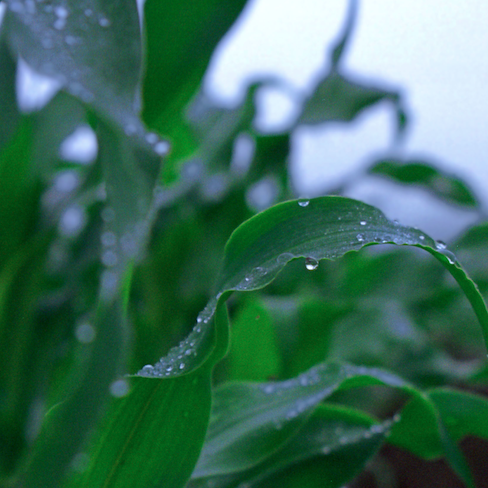
corn plant leaves with raindrops © Tomo Yun

It began to rain, and I licked lime and salt from my fingers. We grabbed everything and ran down the road, laughing, the rain coming down in fat drops, pelting us as we ran. Rodolfo led us to a half-built home a block away. We stood in an unfinished room while the rain beat down on the metal roof, nibbling on brownies I had bought from a cafe in town and crunching crisp red apples. I have always loved the sound of rain on a metal roof, the smell of the first drops hitting dusty earth. I was glad for the water going to the milpa.

Rodolfo talked about the half-built home, abandoned now. It belonged to a friend of his, and when he looked around, I could see in his eyes the way he imagined it in his mind, picturing it fixed up, livable. But Ana only rolled her eyes. She was not eager to live in the country. Over my dead body, she might have said. But I could see it, too, the place restored, the dream of it. Rodolfo and I looked at each other and smiled. Who knew?

[Cornfield photograph cropped from the full version, © Tomo Yun at www.yunphoto.net/en/. Used with permission.]