The Blind Man (42)

In Ajijic there was a blind man who I came to know a little. I can’t remember his name now. I’ve forgotten it, and the names of other people, names I thought would stay with me always. Was it Luis? The name pops up now, but I can’t be sure. He had a blind person’s cane, red and white, and carried a cup with him. I would see him at the Wednesday tianguis, the outdoor market, or standing in front of one of the supermercados that catered to the expatriates and the tourists. I don’t remember him ever asking for money. There were a few old women there who were pushy and demanding beggars, an odd entitlement I’ve never encountered before. But the blind man was only there with his cup, always cheerful, never pushy. I came to know him a little. We would talk about his family, about the thunder the night before, about what he might be able to do in order to still contribute to his family, about how much he’d like to learn how to play a musical instrument. I remember feeling good when he would recognize me. When I had the money, I would tuck a bill into one of this shirt pockets, tell him in a quiet voice how much I was sticking in there. Because I left so suddenly, I never said goodbye to him. It’s one of my small regrets. But I console myself with pictures of me finding him again one day, of him still remembering me, of being able to explain. “Lo siento mucho que no te dije adios, Luis.” I’m so sorry I didn’t tell you goodbye. “Yo te pensaba muchas veces desde me fui.” I’ve thought of you many times since I went away. I think of him still. I hope one day I find him well.

New Year’s, Too (40)

I don’t remember the noise of New Year’s Eve in Ajijic. But after October with the steady rotation of the statue of Guadalupe from church to church, rockets marking the progression every morning at 5am, and the two weeks of our saint’s festival, culminating in whole days of almost ceaseless explosions–not to mention having lived through the rainy season with the cascading thunder (!)–I am betting New Year’s Eve seemed quiet there in comparison.

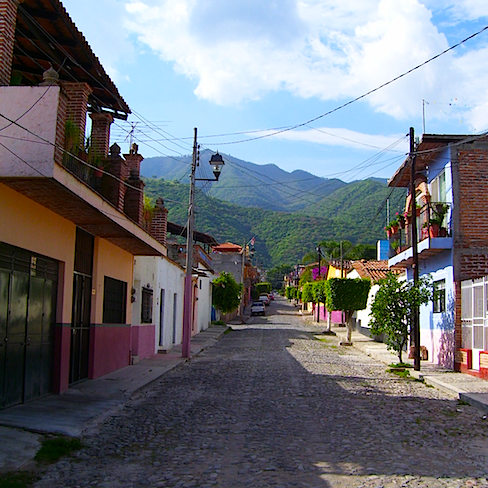
Cobblestone street in Ajijic

I do remember walking through the village on New Year’s Day, spying the evidence of street fires in every neighborhood. Everything was rather impressively cleaned up, no trash or half-burned logs or even big ashes left in the road from the last embers. But you could see the charcoal remains dusting the cobblestones every block or two, and you could feel the quiet, everyone asleep after the big night. Later I learned from Ana they would make tamales and have a fire in front of their own house on Zapata. They would stay up all night, eating and drinking and enjoying each other, the family, the neighbors, nearby friends. Staying up all night seemed to be part of the tradition, though I didn’t ask why. One truly greets the new year that way, I am thinking, more than only marking midnight.

Now every year I picture them together in the street on New Year’s Eve, the firelight dancing on brown faces, dark shining hair. I imagine Rodolfo has made his pipián, and there is a big metal pot filled with homemade tamales, and the corn husk wrappers pile up beside it as the night moves toward the dawn. I can almost taste the masa, can almost hear them singing. Happy new year, everyone.

Felíz Año Nuevo (39)

crossroads with corner market

In Todos Santos, I could see the bonfire in the dirt crossroads beside the corner market two doors down from La Casa Azul. Rockets bombarded the last night of the year, and the flash of firecrackers fell across the ceiling and the tall walls in my second story bedroom.

window and light on the tall walls

I was supposed to go to Iris’s for the evening celebration. I’d imagined driving over before dark, but she called me from a restaurant downtown where they had all ended up to let me know they wouldn’t be home until later. It took what wind was left in me, buffeted as I was from the neighborhood fiesta. I imagined trying to squeeze my red Jetta past all the other fires in the streets between my center of the old village and Iris’s home in el otro lado, fireworks arcing across my car, fingers gripping white on the steering wheel. I chickened out, hunkered down at home with the cats while the wild party crashed around our barrio. Felíz año nuevo.

What a Wonderful World

This is the note I wrote to go out with my Christmas cards this year. They have a colorful tree and the words “What a wonderful world” on the front of the card. I thought I’d like to share it here with all of the rest of you, too. Happy new era. Happy holidays.

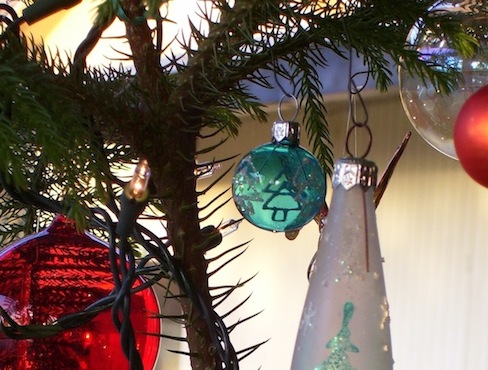
image of ornaments on a tree

I first reached for this card because I liked the cool, artsy tree, the newsprint and paint. Texture and color pull me. The words on the cover conjure Louis Armstrong.
“I see friends shaking hands,” he sings in his rich, unmistakeable voice, “saying how do you do. They’re really saying, I love you.” The song was released the year before Martin Luther King, Jr. was killed. But you can hear the love in Armstrong’s voice. He was courageous enough, large enough, to believe in us, in spite of all evidence to the contrary. So when the phrase makes me pause, makes me wonder if it’s okay to choose this card given all the violence, all the hate, all the tragedy in our world, I can’t help but think there’s something wrong with that, something wrong that I should hesitate. These things don’t make the words untrue, do they? It is a world full of wonder—big sky, palo verde trees, grackles, people helping. It’s the world my father saw, the small wonders, a person’s profile in that gnarl of tide-washed wood, the magic bean sprouts he brought for my dog Sanji when she was dying, the label he made on his old manual typewriter still taped to the jar, crisp in memory, a cherished item when he died just weeks after she did. It makes me want to cry for him, for both of them gone now these 27 years. But it’s layered in me, the way they loved me, the way I’ll love them always. They are composted in me, rich, fertile soil, my carpet, my gifts, my wonder. And this is the time to look to those we love today, remember they are our diamonds, our emeralds, to run our fingers through them, these gemstones of ours, to spread them out in the morning sunlight or kiss the fire of their facets in the shining of the moon. Bring warm scarves, bundle them forward in the quiet almost-winter afternoon, count ourselves lucky. What a wonderful world.

Here’s to No More Sneers (38)

Learning a language is hard. I’ve studied Spanish off and on for most of my life, and still I am far from what I consider true fluency. When I first moved to Mexico, my words were molasses, poured in fits and starts, agonizing for Mexicans used to their light rail speech. But with very few exceptions, busy retail folks who were fluent in English and wanted me to just get on with it, the people I tried to speak to showed genuine welcome for my efforts, helped me when they could, all smiles and nods and encouragement.

You have to be willing to look like an idiot to learn a new language. You have to do what we are so bad at in this country, feel foolish and stumbling, bumble your way through it, reach for humor if you can in your embarrassment. It’s the only way to move forward. In Mexico, the people in my world there let this be the best it could be. It was still awkward. We don’t like to look stupid. But their reception of my halting, error-ridden Spanish made it okay to keep going, keep practicing. Their welcome of my efforts balanced out the excruciating discomfort.

I wish I could say we returned this favor for immigrants in the United States. And I’m sure in some cases it is returned, kind estadounidenses nodding and smiling and making every effort they can to understand, to appreciate the stumbling English, to welcome the effort. But more times than I can count, instead I see native English speakers here grow rigid when they hear a Mexican accent. Their faces stiffen. Mouths sneer. They seem critical and impatient. In many cases, the immigrant may actually be relatively fluent in English, but the heavy accent alone seems enough to trigger this ugly response.

And if we know how hard it is to learn a second language, how much one needs to practice and practice, feeling like a fool the whole time—is it any wonder many immigrants don’t make themselves this vulnerable as often as they might? If they learn to expect an 80/20 chance, perhaps, that their efforts will be treated with contempt? How many times would you put yourself out on that trembling limb for any occasion where life doesn’t require you to speak a foreign tongue?

Not to Mention (37)

I become granite when I hear “English only” bandied about in this country. I don’t even try to be civil. All respect flies away. I am mean and hard, an unreasoning wall. I’ve even heard people complain about Spanish signage in Home Depot. How do they think this can hurt them? “These people should learn to speak the language,” they say. They mean Mexicans. My teeth clench. My skin crawls. I want to spit on them.

“How many languages do you speak?” I want to howl. Do you have any idea how hard it is to learn another language? Not to mention the fact that our corner of the country used to be Mexico. Not to mention the fact that when California became a state it was under the condition that it be bilingual. If we hadn’t broken that pledge, those of us who came up through the public schools here would all speak Spanish fluently. If we hadn’t broken that pledge, maybe I wouldn’t have to listen to the screaming racism underneath their words. Maybe I wouldn’t have to turn to stone.

On Calling Home (36)

I’m trying to get it together to mail a package to Ana and Rodolfo for Christmas this year, something the whole family can enjoy. I failed to get it there in time before, sent something late two years ago, incomplete. This year I have a puzzle, a night scene that looks like Italy. I went to buy vegetable seeds yesterday for the milpa, but True Value didn’t have their new stock in yet. I want to get some photos made for them, maybe the Mexican marigolds in my garden, pictures of my cats napping on the patio. I worry they’ll think I’ve forgotten them. The last time I spoke to Ana was in January when I called to talk to Isabel on the day of her quinceanero. I never called back to see if her card arrived with the magic Mexican pesos still tucked inside it, worn bills I had carried in my wallet for years like good luck charms.

I’ve thought of calling often, mornings like this when I sit quiet on the patio and let my thoughts wander back to Ajijic, with Ana and Rodolfo always at the heart of it. I especially wanted to call them on el dia de los muertos and for Thanksgiving, too. I wonder if they celebrated it there this year, the expatriate’s customs rubbing off on the locals. They are people I am grateful for, so I wanted to call to let them know. But I didn’t. I haven’t called since that morning in January, the whole family in a happy flurry getting ready for Isabel’s big day. And I ache for not hearing their voices, not learning las noticias, the news. But something keeps stopping me from calling, and I ask myself again and again what it is. I’m pretty sure it’s not the difficulty of speaking Spanish over the phone, the disadvantage of not having their facial expressions and their gestures to help me out. I suspect, instead, it is the way the thought of them squeezes my heart.

Still, for the fullness of the moment, hearing their familiar voices on the phone, reveling in the sound of their laughter, of laughing together though we’re 1600 miles apart–I tell myself to call soon. That richness is worth the small heartbreak sure to follow.