Salsa that Sings (17)

Sortera gave me some extra ripe heirloom tomatoes at the farmer’s market Saturday morning. “¿Para mi?” I asked, surprised, pleased. She nodded.

Para salsa.

Ah, muchas gracias,” I said. “¡Que bueno!” I thought for a moment. I big grin came over my face, the child who has figured out something wonderful. “Tengo chips!” I declared, and she smiled back at me. What luck.

I was so glad she offered them to me again. The last time I had hesitated, demurring, suggesting she might want to make salsa from them. (So dumb, this one—of course she could have all the tomatoes she wanted. This was her family’s business.) I know I upset her. I was able to convince her I’d love to have the tomatoes. But in Mexico there should not be any hesitation, only the resounding “Yes.” You accept all that’s offered.

I’m not sure I could ever learn to do that. I know when I lived there I turned things down, begged off because of my work, my lack of time. On New Year’s Eve in Todos Santos, I called Iris to tell her I wouldn’t be coming to their family celebration after all. I felt terrible about it, but I didn’t want to drive past all the bonfires in the streets, through all the fireworks. I was afraid, hid out at home instead. In Ajijic, I turned down more than one invitation to visit my neighbor Ramona, though I don’t think she ever took offense. I think I may have even bowed out once from attending the harvest celebration at the milpa, and I’d undo that in a heartbeat now if I could.

The truth is I was working a lot–too much still then, I think–so much of my time in Mexico spent at home, hunched over my laptop. Though that work allowed me to be living there, so my lament can’t be too strong. Still, I regret not learning more, not leaving with more knowledge, not bringing back more concrete memories. I wish I’d asked Ramona to show me how to make salsa in her molcajete, her basalt mortar. She worked for hours in her dark kitchen, making almost everything from scratch, filling the traditional female role for her big family. She would have been happy to teach me, I think. It would have given us something to do together, too, would have been better than our awkward but heartfelt greetings, our shy but regular exchanges of small gifts, our attempts at chatting when I say with her family in their living room.

And Rodolfo would have permitted me to watch him cook, I’m sure. I know he loved for me to get so much pleasure from what he prepared. I could have learned how to make pipian from a master. And when I made salsa from Sortera’s tomatoes now in my southern California home, even if I made it in the blender, it would sing to me of Mexico. Instead, it makes me miss it more.

Banished Again (16)

Almost a third of my year is already over, and still I struggle with my chosen focus for this year’s blog. My friend Colleen once suggested I could stick with it for awhile and then abandon it at some point later in the year. “But I don’t want to abandon it,” I told her. My tone was cranky, miffed, defensive. I had made this choice, and there were endless possibilities to write about within it. There was no reason to give up on it. There was every reason to persevere. But in the time since our conversation, her suggestion whispers in my ear from time to time. It tries to seduce me. Stubborn creature that I am, I shush it. I turn my head away, present it with my back. I refuse to listen. And yet, when the whisper comes, when I feel the warm breath on my ear, it is a siren call. Today, I even counted on my fingers. If I stayed with Mexico for six months, when would half a year arrive? October? It wasn’t soon enough.

“But I don’t want to abandon it,” I say again out loud. There is no icky tone now, no crankiness, no bridling at a sibling’s suggestion. I really don’t want to abandon it, even as the idea of letting it go calls to me, full moon to high tide. But I am afraid. I was out of town, two short trips back to back, weeks lost to preparations, to journeys, to recovery. I am a week behind on my blog, me who wanted not to fall behind this year, not to spend time playing catch-up. But I know there is more than the ordinary resistance to writing behind my delay. I glimpse part of my problem–trying to write about all things Mexico is not only my fear of failure, of not doing it justice. I think fear lives in the fact it is so complex. It is not simple for me to think about Mexico. I can’t make broad, clear claims because it is all too layered, too complicated for that. My mind is always studying the complexity, weighing the distinctions, wondering about the reasons. I become overwhelmed. How do I capture the intricacies? I know in my heart I need to write about the specifics, not worry about whether or not the largeness of things seeps in. But my head worries about oversimplifying, about getting it wrong.

How do I write about the racism I felt there? Will my readers understand how tiny the percentage of people were who faced me with resentment, even hatred? How can I tackle something like that without talking about all the reasons their feelings are understandable, without comparing it to what people of color face every day in the United States? How do I take on something so big in one blog post? How do I explain my longing for life among Mexicans, for their natural grace, that warm and gracious generosity? Will my readers believe I think people in the United States can’t be as welcoming? Do I really want to try to dissect our stereotypes in 500 words? And what about the idea that most of what I know about the Mexican people comes from only one strata of society? People make claims all the time that are not true for all of Mexico. It is not one thing. It is not only Baja California Sur and Jalisco. The United States is not only Alaska and New Jersey.

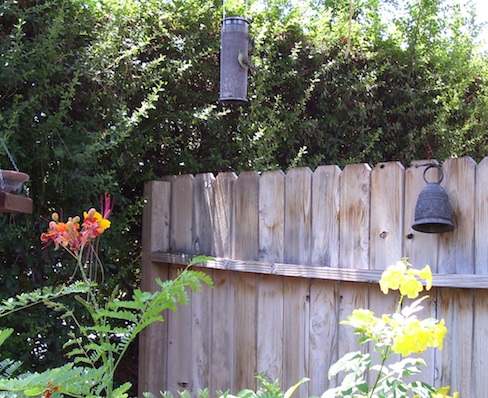
Goldfinch on tube feeder with Mexican birds of paradise and tecoma blossoms

I sigh and take a sip of water, set the glass on the patio table beside me. I listen to the quiet sound of the misters, watch a goldfinch alight on the thistle feeder. “No,” I say, a laugh in my voice now, “The United States is not only Alaska and New Jersey.” I shake my head, a small smile on my face. I am satisfied in the aftermath of release, my fears banished again in the act of relinquishing them to the page, a second exorcism on this chosen path. Mexico is not only Baja California Sur and Jalisco, but I will write about them anyway. I will write what I know. I will write what I believe, what I think, what I wonder, and I will trust my readers with the rest.

Exorcising Demons (7)

It’s my seventh week, and still I’m afraid each time I won’t have anything “good” to write. I worry I won’t be able to enter in, that “having” to tie my post to Mexico will make it boring or contrived. I worry because I think I have already told you all my good stories about Mexico, my first whale, my magic walking loop in Guanajuato. What else? I have brainstormed lists of things I can write about, and still every week I’m afraid. And I don’t want to spend all year afraid. I want to break through this. Surely I can find things I want to say about a place that goes so deep in me, whose images swim through my days, wade through my sleeping dreams, whose people live inside me–vivid, dark skinned, brown eyes alert and present. I want to find my way in and stay there, watch my blog grow, be happy with what I touch, excited about what’s to come, each new waiting post a pleasure, another chance to write about what I love, what moves me, makes me feel, come alive. I want to banish the damn fear once and for all. (Does it ever work that way?)

Brian laughed at me when I told him. “I’m sorry, ” he said, still laughing his wonderful laugh. “I’m afraid you simply can’t feel that way.” He was teasing but not teasing. I know it defies logic, is ludicrous in light of my scribbled lists of topics. But each week I become tight, braced, hands out in front of me, warding off monsters. Nothing to say? Nothing worth reading? Nothing I can remember well enough? So make it up, I think. You told your readers you might write fiction. So, write fiction, then. Easier said. Maybe I’m really afraid I can’t do Mexico justice. How can I bring Ana to life, laughing in the living room on Aldama? Rodolfo, offering me a taste of his exquisite pipián, eager, watching my reaction? Iris, a wonderful sly smile on her face, bringing me my birthday dinner at Il Giardino? How can I let you know what they meant to me, alone in a strange country, my lifelines there? How can I explain why I almost never call them, how even now my heart breaks a little and my eyes fill? How they weren’t only my anchors, my buoys in a foreign land, but they seemed to love me so completely, took me just as I was, found joy in me?

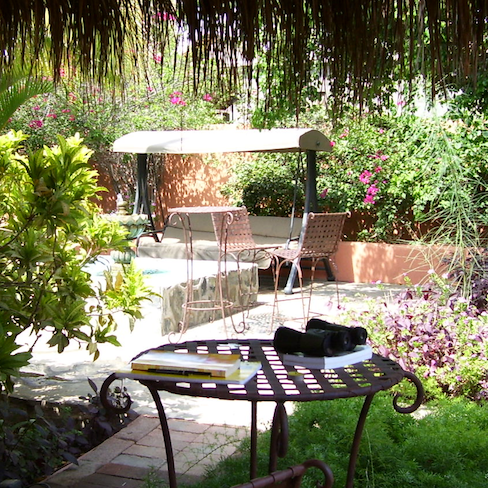
patio at Las Flores Posada in Todos Santos, my writing notebook on the table

I wipe tears away with the back of my hand from where they pool above my upper lip. One stray one slides down my left cheek. The misters cool the pre-dusk air, and a hummingbird alights on one pointy tip of the big cactus, taking in their moist cloud. For now, my fears abate, chased off by this release, I think, and because I’ve touched these memories for myself, even if I am no more confident of presenting them to you. I breathe, and sigh, sip my water, listen to the evening chatter of the house sparrows in the hedge behind me, the pwitter of the mourning dove’s wings as he flutters to the ground from his perch atop the wooden fence in search of fallen thistle seeds. Maybe, I think, I only need to become present to do this without fear. And maybe that’s where I’m afraid of failing.

[Editor’s note: This photo shows my writing notebook and binoculars on the patio at Las Flores in Todos Santos, Baja California Sur.]

Cinco de Mayo Martín (6)

A young man is standing at the bus stop when I arrive. “Do you speak Spanish?” he asks me. We end up talking on the bus together, trading off between English and Spanish, and we don’t stop until over an hour later when we reach my bus stop. It is such a joy. His name is Martín. He lives in Mexicali and is doing my planned trip in reverse, Greyhound from Mexicali to Indio, then our local buses. He is twenty-seven, and he is tall. It runs in his family, his town. From the Spaniards? We wonder out loud. His accent when he speaks English sounds more European than Mexican to me, and I wonder where his teacher was from. I think he may have more English than my Spanish, but he has no chance to practice. Would I be the only estadounidense there? The only gringa? He loves Mexicali, wants to spend the rest of his life there. I tell him I felt that way for the first time when I moved to Sonoma County. He lived in L.A. for a few months when he was fifteen. He was lonely, I think. He missed fútbol.

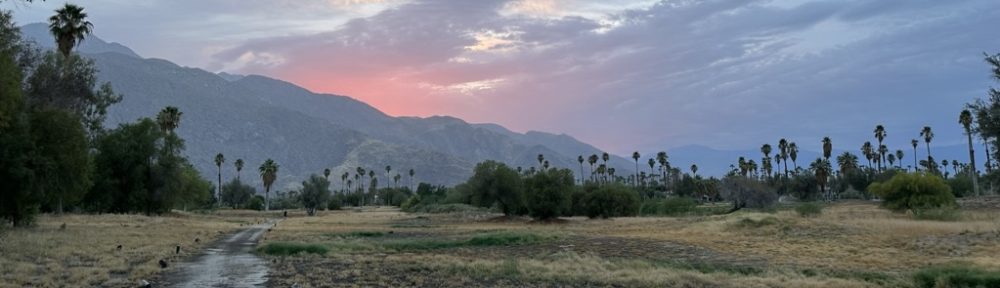
mountains visible through the bus window

I tell him about the near miss I have just had outside the casino after my Kentucky Derby day with Auntie Christel, how the runaway car might have hit me, only seconds to separate me from its path, stopping on the corner to take stock. “Fue muy ‘creepy,'” I tell him. He gives me the Spanish word for it. Espeluznante? I tell him how grateful I am to be here, safe, alive. He tells me his own story, at a party the week before, moved to go home early only to find his mother lying on the floor. How grateful. We understand each other, the bigness of the events. He is young, I tell him, to be going through this with his mother’s illness. I was twenty-four when my stepfather died, Martín’s age when my father died. I think he knows I know. But there are differences. I hope his mother will get well, and when I needed to call 911, I bumbled, my adrenaline blocking my brain. But Martín became clear-headed and superhuman, scooping his heavy mother into his arms, getting her to the hospital. And he remembered all the details in the process, to bring the phone, grab her meds, lock the door. It was a huge victory for him, and so validating, I think, knowing he could do so well in an emergency. But later, like the time I pulled the big dog off my cat Trair and threw him across the yard, Martín was sore for days. We laugh. I feel glad for him, and proud, even as my heart breaks a little that he needs to go through this.

I ask him to tell me about Mexicali. He names a plaza, and somewhere else that is a good place to walk. I scribble them down on the envelope my horseracing money was in. I will hunt for them when I go, think of him. We don’t exchange phone numbers, and as soon as I am home I am sorry. I would have liked to visit him in Mexicali, meet his family. So now I fantasize his sister in Desert Hot Springs will find my blog, read about my Cinco de Mayo Martín, put us in touch. I am talking on the phone, telling my friend Janice about our meeting, about the sweetness of it, how glad we both were, how grateful. I realize in the telling how meeting Martín felt like a reunion. Maybe one day I will walk in the Plaza Calafia at dusk and find Martín and his mother sitting on a bench, and we will sit together and listen to the birds roosting in the trees. Maybe I will come upon his whole family, strolling one late fall afternoon in the Campos UABC, and Martín and I will have our second reunion. Ah, mucho gusto, Martín. Qué te vayas bien.