On Calling Home (36)

I’m trying to get it together to mail a package to Ana and Rodolfo for Christmas this year, something the whole family can enjoy. I failed to get it there in time before, sent something late two years ago, incomplete. This year I have a puzzle, a night scene that looks like Italy. I went to buy vegetable seeds yesterday for the milpa, but True Value didn’t have their new stock in yet. I want to get some photos made for them, maybe the Mexican marigolds in my garden, pictures of my cats napping on the patio. I worry they’ll think I’ve forgotten them. The last time I spoke to Ana was in January when I called to talk to Isabel on the day of her quinceanero. I never called back to see if her card arrived with the magic Mexican pesos still tucked inside it, worn bills I had carried in my wallet for years like good luck charms.

I’ve thought of calling often, mornings like this when I sit quiet on the patio and let my thoughts wander back to Ajijic, with Ana and Rodolfo always at the heart of it. I especially wanted to call them on el dia de los muertos and for Thanksgiving, too. I wonder if they celebrated it there this year, the expatriate’s customs rubbing off on the locals. They are people I am grateful for, so I wanted to call to let them know. But I didn’t. I haven’t called since that morning in January, the whole family in a happy flurry getting ready for Isabel’s big day. And I ache for not hearing their voices, not learning las noticias, the news. But something keeps stopping me from calling, and I ask myself again and again what it is. I’m pretty sure it’s not the difficulty of speaking Spanish over the phone, the disadvantage of not having their facial expressions and their gestures to help me out. I suspect, instead, it is the way the thought of them squeezes my heart.

Still, for the fullness of the moment, hearing their familiar voices on the phone, reveling in the sound of their laughter, of laughing together though we’re 1600 miles apart–I tell myself to call soon. That richness is worth the small heartbreak sure to follow.
My Respect for Pigeons (34)

I’ve never been fond of pigeons. Even now, I admit I still tend to dismiss them, am less pleased to see a group of them on a telephone wire than a gathering of mourning doves, some strange bird snobbery at work in me. But now I remind myself of what I came to know of them in Mexico. When I lived in La Casa Azul, in the blue house in Todos Santos, I came to respect pigeons. They lived next door to me, in the eves of the artist’s studio, the man I rented my house from there. I always wondered if he initiated their residency, started the colony there on some whim, some fancy about the romance and quirkiness the studio should reflect, not realizing how it might grow. I never asked.

But I would sit perched on my tall wrought iron chair in my semi-third-floor roost and watch the pigeons fly together. I’d always loved the sounds they made nestled in the eves, the muted rounded coos, bird pillow talk. But I never really watched them fly before. I remember the first time I saw them take off for their morning flight, making big loops across the sky, flapping and gliding in tandem. I was struck by the vigor of their bird bodies, by their prowess in formation despite the quickness of their flight. They would launch into the air together every morning for the first looping flight, a burst of celebration for the day to come. In the late afternoon, they took flight again before dusk, a happy sky dance, a few last circles of gratitude and play before bed. And I would sit in my own roost, feet propped on the rebar railing before me, and marvel at the ease of their antics. Each time they took to the sky, I fluttered with awe.

I Carry My Longing (32)

I carry Mexico inside me in a way I’ve never known before. It’s half longing, half comfort, I think, as though the country is part of my bedrock now from my short stay–unexpected, surprising, constant. Other places reside in me, too. The open fields of Sonoma County, Sebastopol’s apple orchards alive in the white of full bloom. But they live quietly, rich moist earth breathing peace. I loved it there. For the first time I thought, I could spend the rest of my life here. But I don’t dream of going back, not like with Mexico, though I don’t rule it out. I dream again and again of going back to Mexico. I imagine really moving there this time, not just going like I did before, for a year or two, maybe forever, not returning in a rush to the United States. I can see myself there, sitting in my walled garden, sparrows and white-winged doves in the bougainvillea, daily walks along the malecón, the boardwalk, watching my volcano across the lake. I can picture myself older, taking extra care moving across the cobblestone streets.

Day to day, I hold the longing to return, to make Mexico my own. It lives in the crook of my elbows, hides behind my knees. And yet I wonder if I will ever make that choice. Questions rise in me, yeast in the dough. Can I live again with spiders the size of my hand? What about feeling like “the other” there? Would I grow used to it, morph into new skin, my roots sinking deep in foreign soil? Would my life in the United States fade like a dream? I think it might. I can imagine missing people here, urging them to visit me there. I can imagine missing the conveniences, Trader Joe’s, the rules of a bureaucracy where I can know what to expect. But I can’t picture me living in Mexico and carrying this same longing for life in the United States. When I think of living in Mexico again, I only picture being home.

Mexicans Are (31)

It’s some strange hubris of travel to think we know a country or a people because we came and saw a slice of it, of them. How many different versions of the United States do you imagine foreign visitors carry home? Did they stay with family in the Appalachians? Visit a dude ranch in Arizona? Make a wrong turn into Watts one afternoon when they were looking for the Hollywood hills? My Mexico was made up of poor villagers. They are the bedrock on which I base my sense of who the Mexican people are. They are quick to laugh, treat their burdens with a light touch, pay a man to rake the dirt road in front of their home because he needs the pesos even more than they do.

I met a handful of wealthy Mexicans, came to know two handfuls of people who struck me as part of a burgeoning middle class, enough to understand some of the differences between the socioeconomic strata there, how education and money shape their world. Enough to know better than to base my assumptions about life on Mexico on the lives of poor people in rural villages. But not enough to keep me from doing it anyway. I still remember the look on my Senor Soto’s face when I made this mistake, embarrassed myself. “Es raro, no?” I asked him. That’s unusual, isn’t it? He’d just mentioned he and his wife had two children. I was surprised, though looking back on it now I realize all the middle class families I knew there had only two children. He was driving the taxi, so he couldn’t stop to stare at me, but I remember his piercing look. His voice was kind, but there was steel beneath it.

“You can’t do that,” he told me in Spanish. He’d agreed to let me practice my Spanish even though he was fluent in English. (He even taught me the difference between the words “writer” and “author.”) “You can’t make assumptions about all of us like that.” His gaze moved between me and the highway. I was sitting in the passenger seat. We were on our way to the airport in Guadalajara. “Many people have only one or two children,” he said. “It just depends.” I had known it, seen it already, and yet I blundered in, two feet in my mouth, insulting this well-read man who was fluent in two languages, whose son was attending the university, whose wife and he had practiced family planning. I nodded, blushing.

“Entiendo,” I said. I understand. “Lo siento.” I’m sorry. His kindness never faltered, but he’d put me in my place, and I was glad he did. If I might muster even a faint echo of his grace the next time I need to speak up, I’ll be grateful. I have his business card tucked in my wallet. The day I return, I’ll call to see if he can pick me up from the airport. Or maybe I’ll email him ahead of time, so I can know Senor Soto will be waiting for me there.

Crossing (30)

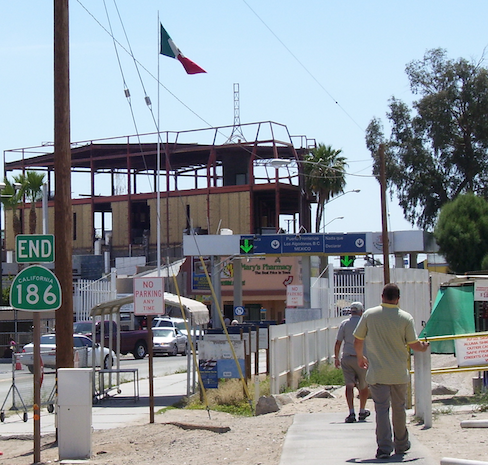
I am fascinated by the boundaries between us. Borders between countries, lines drawn on rock, boundaries between people, between cultures–arbitrary or innate, they separate us, define us. But boundaries aren’t just barriers. They provide the arena for moving back and forth between the two. They offer the possibility of exchange. I can ride the charter bus from the Coachella Valley to Algodónes. I can walk across the border and be in Mexico. One line, drawn no doubt by nations after war, shouldn’t be able to make so much difference. I’ve studied the border from the bus, the way the fence runs through the desert, a jagged monster, the sprawling remains of extraterrestrials. I can find no clues, no evidence that one side of the fence should be so different from the other.

shot of the border looking toward Mexico from the U.S.

But walk a few yards toward el otro lado, the other side, and you can feel the change. It is of the body, I believe, and not the mind, yet I return to it again and again and again, wanting to make sense of it, trying to figure it out. When I walk across, my body knows I’m in a foreign country. Because I lived there once, it feels like coming home, but this is a comfort of the heart, I think, the soul, and not the body. The body knows this is not the land where it was raised. It’s not geography. My scrutiny of the fence line across the desert between us revealed nothing, only made me marvel, knowing just across it lives another world, a stone’s throw only, two crows flying. The land doesn’t change at the border, but we breathe different air. Spanish diphthongs and mariachi and sidewalks all sing Mexico. Grackles call out in their native tongue. Our bodies know.

If Looks Could Kill (29)

When I first moved to Todos Santos I bought my produce from a place on the main drag, the road the two-lane highway became as it zagged through town. The woman there was never kind to me, a rarity in Mexico. I annoyed her with my questions and my faltering Spanish. She answered me in a sharp, curt voice. She looked at her friends, rolled her eyes, said things I couldn’t understand and laughed. I don’t know how long it took me to stop going there. I found a new place in the north of town, a kind of glitzy store for the expatriates, but the staff were sweet and helpful. I bought produce from a local organic farmer, an estadounidense who camped out on the sidewalk downtown two mornings a week. Once I bought a bag of arugula from him–huge dark green leaves like I’ve never seen before or since. I brought it to my friend Iris at Il Giardino, and someone at the restaurant sauteed it with a little oil and garlic. It’s still a favorite meal of mine, especially with the brown rice pasta I’m in love with now.

streets and shops in downtown Todos Santos

One day when I walked past the produce place where I used to shop, the woman made a point of glaring at me. I remember the way she held my passing glance, her head moving, slow and deliberate, to keep me in her gaze as I walked past the open air stall. For a moment, I wondered if she was angry with me because I stopped buying from her. But that was only my logic, only me trying to make sense of what was happening. But logic wouldn’t help me here. Because as I watched her, she bared her lips in a snarl and her cheeks pinched up. It was more fierce than a wild animal might have been, cornered and terrified, lashing out. The look in her eyes was pure hatred, her face made grotesque by it. I scuffed my toe on the pavement, stumbled, her venom like a blow. I turned my back and kept walking. My arms trembled, my cloth shopping bags suddenly too much to keep upright. I let them dangle as I climbed the hill toward home. I wondered how she could hate me that much. She didn’t even know me. But to her I was the ugly American. To her, I was the reason her once-tiny fishing village teetered on an unknown brink, invaded by foreigners building palatial homes north of town, the growing middle class of Mexicans only beginning to get their footing, the huge disparities creating terrible tension just beneath the surface of her world. To her, I was to blame for everything that was wrong with her life. I’ll never forget the look on her face or the shock of that poison spewing out at me.

Dark As Night (28)

Dark as night the heads of children racing back and forth across the plaza shouting, hair shiny in the early dusk. Dark as night the grackles roosting in the jacarandas of the zocoló. Dark the skin of every single body in the crowded square, except her. Old men, young women, clustered, Spanish a loud, steady murmur, the rapid curve of a summer creek, as steady as the grackles calling from the trees, a cacophony of conversation, a mad frenzied orchestra tuning up. Dark as night the glistening black feathers, dark the skin, dark the grackle silhouettes, dark of every being in the zocoló but her, her white skin a bruised thumb, dumb with her estadounidense self. She would lose her Puerto Rican friend over a careless email about walking through the plaza in that Sunday twilight, the dirty cement, the alien dark-skinned world, her senses dulled by too much beer. Not racism, though, only sinking in a sea of otherness, aching and alone. But now she dreams of it like dessert. She’ll go again, sit nodding, smiling on a bench, tears sliding down her face in the half light. Eyes closed, the symphony surrounds her. The grackles make her heart dance in her chest, bump against her ribs. She holds still in the center of that boisterous foreign world where language is music. Her white skin gets lost in the late dusk until her estadounidense self all but disappears. She sits there while the light slips away, until it feels right to be there in the heart of things, dark as night and plain as day.

[Editor’s note: This piece was begun with a writing prompt from my Monday night writing workshop led by Alaina Bixon. We were told to begin a poem with a cliche. Thank you, Alaina.]