Culture Shock (15)

The cats and I crossed the border from Sonoyta, Mexico, three years ago on the second of July. I sang “California Here [We] Come” most of the way through Arizona. Near the California border, we were perched on a ridge on the highway with lightning breaking beside us, my fingers white where they gripped the wheel, the thunder drowning out the beat of my heart. But it cooled the air, welcome relief from the July heat, the desert washed clean around us, alive in scents and color. We bogged down just west of Blythe, an accident on the interstate, and I dipped a washcloth into a bucket of ice water, squeezing it out again and again on the heads of my two cats. I remember running ice cubes over my own forehead, across the back of my neck, along the curve of my collar bone. I decided I was being groomed in some fashion, learning a new kind of endurance on that journey. I would feel that again in the weeks that followed our new lives in the Coachella Valley, coming to terms with the lethal summers, knowing the heat could kill me.
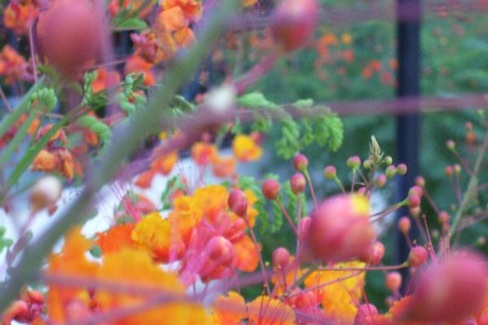
Close-up of Mexican birds of paradise_orange blooms and buds

I took comfort in the bright orange blooms of the Mexican birds of paradise that laced my new home. I thought it was a happy omen. I remember sitting that first evening on the lawn of the motel across the street from the apartment I’d rented over the internet, using their wireless to send emails to Mexico, letting people know we’d arrived, safe, sound, staggered by the feat. I remember walking in the days that followed, feeling like I’d landed on another planet with the wide, clean streets, the expensive landscaping, the manicured everything. After the narrow cobblestone streets of Ajijic that had been my world, being here couldn’t have felt more foreign. I remember feeling like an alien, desperate to connect with the Mexicans who crossed my path, the woman in the mall restroom, the tailor near my new home, the bartender at the Mexican restaurant who told me the owner there was from Guadalajara. I was stripped of the need to speak Spanish, but I didn’t want to stop. It felt wrong. And everywhere I looked, I saw signs of wealth, and you could walk for miles without being able to buy a bottle of water in the brutal heat.

I wanted a tiendita on every block, even in the residential neighborhoods. I wanted brown skin, black hair, warm, laughing bodies greeting each other in the streets, greeting me. I craved the rich, textured, vivid world I’d left behind. I felt small and unveiled, vulnerable, alone. I missed Ana and Rodolfo so much it hurt, an ache that didn’t go away. I didn’t want to be here. I only wanted to be there, in that other world that already seemed like a dream, all those hundreds of miles away, where I’d left all the food that had flavor, all the color that had depth, all the people who met me with an open heart, warm brown eyes meeting mine. I wanted fruta picada on every corner, tortillas delivered every morning, still warm, the sound of the tamale man calling in the early night. I wanted the life that had become mine. I wanted to go home.
Alpiste (13)

“The pine tree is coming down in two weeks,” my landlord yelled at me. He was angry with me at the time. I’m hoping he didn’t really mean it, doesn’t follow through with his threat. Our pine tree has been through so much. She should never have been planted in this desert to begin with. Fierce wind took more than half of her away before I came. She was haggard, drying, teetering, it seemed, brushing close to death. But she rallied, and now the shade she casts is doubled, maybe tripled. And the spots for birds to perch or shelter have multiplied, as well. I pray she’ll be protected, pray she’ll thrive. I would hate to see her taken, a mean recompense for having grabbed onto life with such grit, such gusto. I’d be afraid, too, losing her would mean losing even more of the birds who like to linger in our little corner of the world.

Already there are fewer birds here than before. The bulk of the house sparrows have disappeared again, and the doves don’t fill the tray feeder in the mornings like they used to, all packed together, a picture I never did capture properly, all those pretty bird butts ringing the wooden frame. When I first began to notice their absence, in my usual fashion, I wondered if it was because of me. Had I been found wanting? Later, I considered other possibilities, but my first thought was I had not been enough in some way. Could it be the desert rats, cute little guys with big dark chocolate eyes, who eat the remaining seeds in the night? Do they eat bird eggs? Attack birds? I don’t know. I worry, too, it is because I switched to the cheaper bird seed. My new attempts at being frugal and the fact I can bring the twenty-pound bag home from True Value on the back of my bike has me using the dull, dusty feed with cracked corn and milo.

In Hopland I bought a hundred pounds or more at a time and blended them myself. It was cheaper that way, but it was a big procedure, up to my armpits in the plastic bags to mix them. But I loved the way the seeds moved through my fingers, rich with oils and colors. In Ajijic, I could walk to the next block over and buy my bird seed from my favorite tiendita there. They would scoop up the alpiste and weigh it in a plastic bolsa. I could get just half a kilo at a time, stroll home with it, so easy. I miss that. I always suspected folks were cooking with it, too, but I never asked. I know it can be used to make atole, a common hot drink, a comfort. But I trust many of my neighbors were feeding it to their birds, as well. On my block and the next, I would hear the exotic birds calling from the entryways of homes as I walked by. I didn’t know alpiste was canary seed until I moved back to the United States and went hunting it down for my bird seed blend.

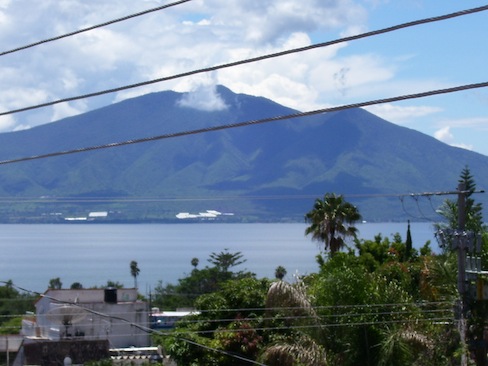
view of Lake Chapala from my veranda

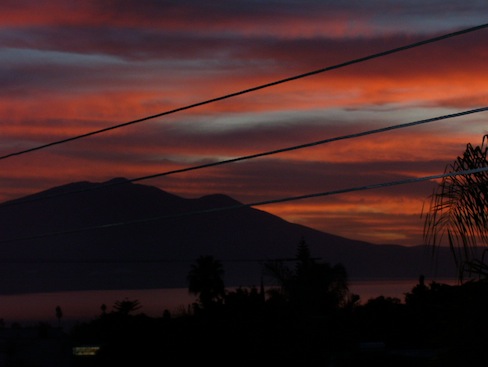
View of lake from veranda after sunset

I had sparrows in Ajijic, too, though never more than three or four at a time, and one dear hummingbird with a feather out of place. (He was the hardest to say goodbye to, after Ana and Rodolfo. I cried when I took his feeder down and left him with a paper cup of sugar water. He sat on the wire and watched me for a long time.) There were no trees on my block there, no real shelter, but still the sparrows would materialize at the tray feeder, eat the alpiste, chat among themselves. I’d sit on my veranda looking at the lake and listening to their quiet exchange.

Now in my courtyard I think again about buying a more expensive seed blend. Maybe I’ll offer it as a special treat from time to time. Or maybe I’ll begin winning more writing contests, left and right and left again, and I won’t even blink at the idea of returning to the rich, pretty birdseed my birds here became accustomed to. I hear the house sparrows behind me now, soft, muted, rounded sounds, satisfied from a midday snack, enjoying the shade of the pyracanthas and the cooling mist the dry, hot wind wafts their way in small puffs.

The sun reaches my feet, burns my right arm and hip as I write, but I keep going, leaning, crooked, toward my remaining shade. I remember the quiet chatter from my sparrows in Ajijic. I relish them in memory even as I savor the soft murmurs behind me now in the hedge. And even though the heat is still climbing, and even though I have much to do still as the day unfolds, I stop, linger, feeling oh so lucky, loving our little desert courtyard, this small oasis on a hot, busy day.

Cinco de Mayo Martín (6)

A young man is standing at the bus stop when I arrive. “Do you speak Spanish?” he asks me. We end up talking on the bus together, trading off between English and Spanish, and we don’t stop until over an hour later when we reach my bus stop. It is such a joy. His name is Martín. He lives in Mexicali and is doing my planned trip in reverse, Greyhound from Mexicali to Indio, then our local buses. He is twenty-seven, and he is tall. It runs in his family, his town. From the Spaniards? We wonder out loud. His accent when he speaks English sounds more European than Mexican to me, and I wonder where his teacher was from. I think he may have more English than my Spanish, but he has no chance to practice. Would I be the only estadounidense there? The only gringa? He loves Mexicali, wants to spend the rest of his life there. I tell him I felt that way for the first time when I moved to Sonoma County. He lived in L.A. for a few months when he was fifteen. He was lonely, I think. He missed fútbol.

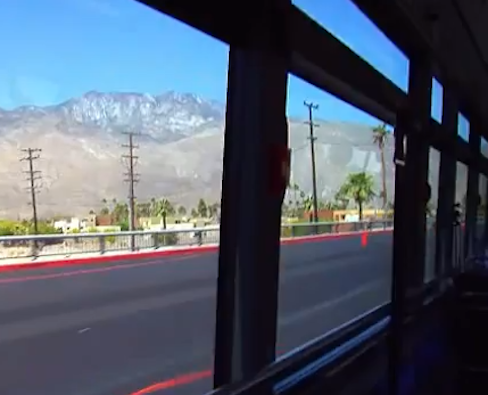
mountains visible through the bus window

I tell him about the near miss I have just had outside the casino after my Kentucky Derby day with Auntie Christel, how the runaway car might have hit me, only seconds to separate me from its path, stopping on the corner to take stock. “Fue muy ‘creepy,'” I tell him. He gives me the Spanish word for it. Espeluznante? I tell him how grateful I am to be here, safe, alive. He tells me his own story, at a party the week before, moved to go home early only to find his mother lying on the floor. How grateful. We understand each other, the bigness of the events. He is young, I tell him, to be going through this with his mother’s illness. I was twenty-four when my stepfather died, Martín’s age when my father died. I think he knows I know. But there are differences. I hope his mother will get well, and when I needed to call 911, I bumbled, my adrenaline blocking my brain. But Martín became clear-headed and superhuman, scooping his heavy mother into his arms, getting her to the hospital. And he remembered all the details in the process, to bring the phone, grab her meds, lock the door. It was a huge victory for him, and so validating, I think, knowing he could do so well in an emergency. But later, like the time I pulled the big dog off my cat Trair and threw him across the yard, Martín was sore for days. We laugh. I feel glad for him, and proud, even as my heart breaks a little that he needs to go through this.

I ask him to tell me about Mexicali. He names a plaza, and somewhere else that is a good place to walk. I scribble them down on the envelope my horseracing money was in. I will hunt for them when I go, think of him. We don’t exchange phone numbers, and as soon as I am home I am sorry. I would have liked to visit him in Mexicali, meet his family. So now I fantasize his sister in Desert Hot Springs will find my blog, read about my Cinco de Mayo Martín, put us in touch. I am talking on the phone, telling my friend Janice about our meeting, about the sweetness of it, how glad we both were, how grateful. I realize in the telling how meeting Martín felt like a reunion. Maybe one day I will walk in the Plaza Calafia at dusk and find Martín and his mother sitting on a bench, and we will sit together and listen to the birds roosting in the trees. Maybe I will come upon his whole family, strolling one late fall afternoon in the Campos UABC, and Martín and I will have our second reunion. Ah, mucho gusto, Martín. Qué te vayas bien.

Grackles Bring Me Home (4)

My cats and I and Lolita Roja, trusty red Jetta, loyal companion, were heading south on the highway that runs along the western coast of mainland Mexico, sporadic snatches of blue off to our right, the Sea of Cortez. We’d arrived the night before on the ferry from La Paz in Baja California Sur. As the light grew, I remember feeling like I had returned to civilization after nine months in uncharted desert wilderness. I drove through the first highway toll booth and stopped just on the other side to buy ice from the small tienda there. I remember it as though we’d moved from black and white to technicolor, my first sensory experience of the mainland, Dorothy and Toto in that first glimpse of Munchkinland. I remember colors, painted concrete, a kind of careful tendedness, and a sea of bird sounds. Rows of trees–cypresses, I think–lined both sides of the road, filled with big black birds greeting the day. It was madness. They were all talking at once, wild, animated, exotic. I didn’t know then they were grackles, but I was awed by them, and I remember a deep sense of having stepped into another world, not in Kansas anymore. I loved those noisy birds, trees that talked, alive with loud, squawking black fruit.

I left those sheer numbers behind a few days later in San Blas, for the most part, though we had our share of grackles along Lake Chapala, too. I’ve met them three times here since I’ve been back in the States–once when I was trespassing on a golf course in south Palm Springs, once in 29 Palms and once at dusk in the big trees in the parking lot of my neighborhood Ralph’s. But always only a handful, and mostly they’ve been absent. I’ve missed them. They were comforting, somehow, a familiar thread of sound embedded in my life in Jalisco. Last week I walked through Algodones in the state of Baja California. I wanted to find the Colorado River there. I walked alone on dirt roads, wary at first, the U.S.-trained fear of Mexico having seeped into me in recent years without my knowing. I shrugged it off, began to relish my return to this foreign land I’ve come to love. I passed homes part ruins and part unfinished construction, fresh laundry flapping in las brisas, dogs and children watching me from the fronts of houses, bougainvillea and cactus tended along the fence lines. The colors and textures, the richness that is Mexico saturated my starved estadounidense self. Just before the river, I came to a grove of trees alive in grackles. I stopped in the middle of the road and listened to their wild vocalizations, a mad delight rising in my belly, my chest. I felt like I was coming home.

Agradecimiento (2)

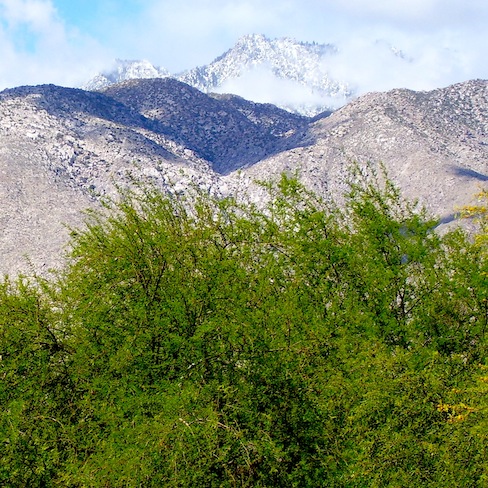
“I always like to end our practice by embracing our gratitude,” Janet says. We are seated on our yoga mats, hands pressed together before our hearts, elbows out. We are in the park on a Saturday morning in April, ringed by a circle of desert acacia. Big tufts of yellow lie spent in the grass around us, and the San Jacintos tower in the west, close enough to touch.

desert acacia with San Jacinto mountains behind them

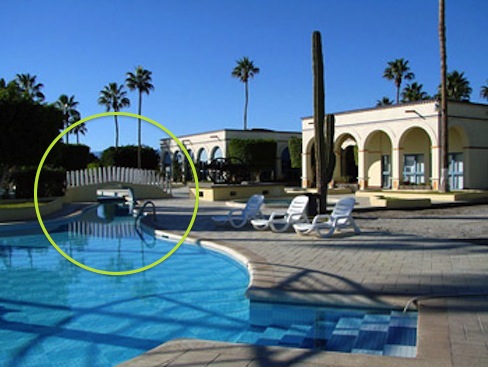
Gratitude, I think. Agradecimiento. I am crouched in shallow water in the motel pool, just below a tiny bridge seeking shade. I am grateful I am not driving, my two miserable cats unwilling passengers, my heart in my throat every time we pass an oncoming semi, no shoulders on the mountain highway, a mere six inches of margin, no room for error. I breathe for the first time in three days. The July air in Loreto is muggy and hot, the water warm but wet, life-giving. I am crouched beside a Mexican woman in her early forties. I talk to her in my excruciating Spanish, and she is patient, kind. “Mi corazon es muy lleno,” I say. My heart is very full. I feel connected to her, fellow travelers escaping the sun in Baja California Sur, scrunched together in the same small patch of shade. Her son is playing nearby. “Tengo muchas gracias para todos,” I say. I have much thank you in order for everything. She smiles, nods, doesn’t laugh at me.

picture of the Loreto motel pool, the little bridge circled

“Agradecimiento,” she says, teaching me the word for gratitude, from the verb agradecer, to thank or to be grateful for. She tells me more, examples of how to use various forms of the word in sentences, but this is what I walk away with. I try it out, happy to have been fed a word that holds so much meaning for me, happy to be having my first Mexican conversation that has depth, speaking in Spanish.

“Tengo mucho agradecimiento,” I say. I have much gratitude. I grin at her, a big, proud, childlike grin, and she grins back.

“Take a moment to be thankful for the people around you,” Janet says, “for sharing this practice today.” The sound of the woman’s son splashing in the warm water under that little bridge recedes. I hear a plane flying south, a car driving past on Miraleste. A raven caws from the north, and a mockingbird begins to sing from his perch in one of the acacias. My heart is full, lleno, quiet. We all bow forward, hands to our hearts. “Namaste.”

[Editor’s note: This second photo that shows the little bridge we were under is not mine. It is a promotional photo from the motel, La Pinta Desert Inn Hotel in Loreto, Baja California Sur, Mexico.]