The Tender New Year (44)

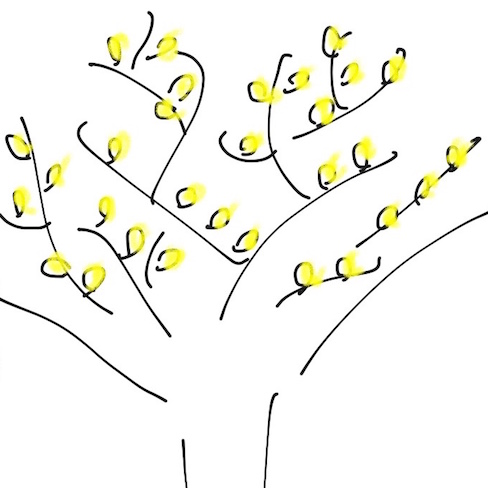
drawing of yellow fluffs on branches

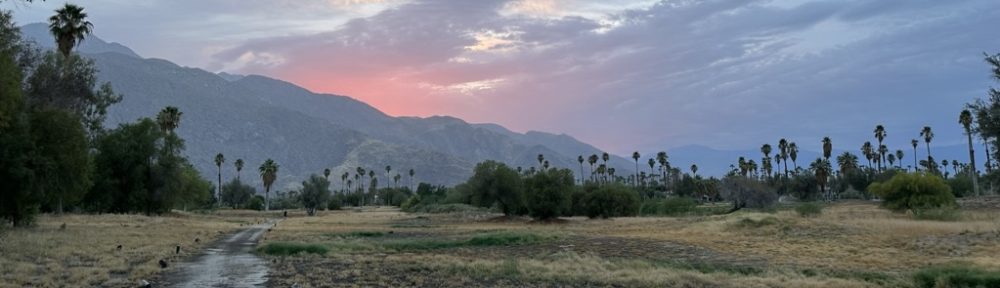
For the first time in ages, I’m enjoying the luxury of easing into the new year. I took the week off, and I’ve been attending special daily sessions at our meditation center. At first, I was going to plan a demanding daily schedule of writing and sitting practice to accompany these evenings of sitting and teaching. “I’m afraid I won’t be able to stick to my schedule,” I said. Marylou and Richard and I were sitting together on their patio. Richard suggested in the kindest of ways I might be more easy with myself. At the time, I felt defensive and not understood. “Retreats are supposed to be challenging,” I grumbled. But later, I let his gentle words sink through me, and I ease off of expecting so much of myself. Instead of pushing, I let myself sleep in, dawdle over tea, do my morning writing and sitting practices propped up in bed with the San Jacintos stretched out before me. I make soup, nap, read, eat popcorn. Each evening I step outside, close the door behind me. The solar Christmas lights in the bougainvillea greet me in the dark courtyard. One night the crescent moon is cupping Venus. The next night Mars and the waxing moon and Venus are all in a row. They accompany me on my half-hour walk to the meditation center, the air brisk on my face, my scarves soft and warm against my ears. After, the stars walk me home. One morning midway through, I cry without knowing why. But I trust in the rightness of it. One afternoon I fight on the phone with a loved one. I make her cry. When I hang up, I remember to hold my self-hatred with kindness, identify the swirl of other feelings, five in all. I picture them nested in my open palms, the tenderness immense. One day during the teaching I am overcome. To think, we are all here wanting to heal, working toward becoming the peace we want to see in the world. What a gift to be able to do this together. On day seven, a morning session, I look back as I leave my courtyard and see scores of goldfinch in the bare branches of my neighbor’s tree, like ornaments, like lemons. I walk to the center, happy I am me, so glad for these eight days of practice, for the connection with this sangha, this community. The air is cold on my face, but I am warm in my layers. I feel the way I used to feel on a winter night flanked by Sofia and Sable, their small weights warm against my calves, my belly. I would lie there in the quiet dark and cry because I knew I must be the luckiest woman in the world.

This Old Shoe (42)

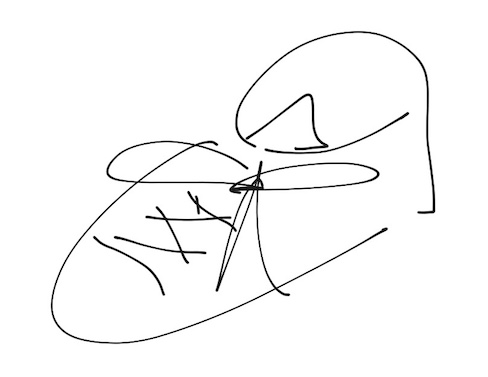
oldshoe

You come to me in a dream and hand me an old shoe. I raise an eyebrow. You grin at me. What does this mean? Why have you brought me an old shoe? I don’t ask. There is something endearing in the gesture, I think, even though it baffles me. A favorite dog, maybe, bringing their most prized possession to their beloved human. Me. You love me, even after all these years. Even though you know me and all my ugliness. When you first hand me the shoe, I think about St. Nicholas Day. Do I fill the shoe for you with presents like my German mother did for me? But it’s too late, I think. St. Nicholas Day was more than a week ago. So what does this mean? Why have you brought me an old shoe? I hold it flat on both open palms and study it. It’s an old tennis shoe, dirty white, worn almost through at the toe. And then I know. This is the shoe you were wearing all those years ago on the day I asked you if you thought you could fall in love with me. You scuffed this shoe against the white linoleum like a kid. “Like that,” you said. I look up from the shoe, and you are still grinning at me. I grin back. You see on my face that I’ve figured it out. This old shoe is my anniversary present.

My New Old Friends (41)

big cup of tea on bright colored blankets

It rains off and on, steady and quiet in the night. When I prop myself up on my elbows to peer over the windowsill in the early morning, I see a swathe of pale orange across the southern sky. Half awake and planning to go back to sleep again, I look west and see a rainbow. I grab my lime green umbrella and my mini iPad and juggle them in the rain to take a picture, goofy and awkward, but it’s no use. The image doesn’t begin to capture the light in it, the magic. I make oatstraw and alfalfa tea and climb back under the covers, my feet cold from my foray. I sip my hot tea and watch the mountains, shrouded in mist. I listen to my birds. My thoughts drift to a colleague. My belly clenches, a messy swirl inside me at the memory, feeling not heard, dismissed, angry, hurt. I wake up to the moment and remember. “May I hold you with kindness,” I say out loud to the feelings. I missed this part of the vipassana practice until two weeks ago when I was listening to a recording of Sylvia Boorstein, and it just came into me. I wonder how I missed it. I see it, after, in my beginner’s book I am rereading, right there in the first pages. It is Boorstein’s phrase, too, that Ian invokes each time we begin sitting practice. “May I meet this moment fully. May I meet it as a friend.” I’ve always loved it, but I didn’t make the connection until now. It has holding our feelings with kindness at the heart of it. Just like Thich Nhat Hanh’s, “Hello anger, my old friend.” But I didn’t get it until now, that direct turning toward our feelings each time they arise, welcoming them. I wonder if maybe I needed to foster enough self-kindness in more general terms before this practice of receiving uncomfortable feelings like old friends was even practical for me. I knew we needed to accept what comes, knew we needed to be kind to ourselves, but it didn’t click. What comes to me this morning is my colleague’s behavior is not a reflection of her regard for me. It’s only what she does, and I take it personally. I cry quick, sweet tears. I return to my big cup of golden tea resting on the covers in my lap, warm my hands against its sides. My toes are warm now, too. And my heart.

Jazz (40)

Ah, yes. Yeah. Let it roll. Let it flip flop you around, slap the ears, soft like fur. Let it. Let it, ah, yeah. Let it make you move, only a little, mostly inside. Your heart, yeah, tap tap tapping. Your belly, yeah, keeping to the beat, the dance, the yes you can, the look at me look at us grooving. Yes, you can you can we can together we can let it roll under our tongues in our thumbs around and between us and inside us moving back and forth joining us while it passes through passes between passes along. Ah, yes. Yeah. Yeah. Yeah. Let it roll. Let it dance and sing. Let it ring and zing zing zing. Let it bounce between us hearts beating to the rhythm no separate selves only this room full of warm souls wrapped up together in the music.

[Editor’s note: This is an unedited piece (except for three words in the last sentence) in response to yesterday’s poetry prompt from the Two Sylvias Press advent calendar. Here is the prompt: “Write a poem about a style of music (jazz, hip-hop, blues, country, reggae, opera, heavy metal, etc.) while imitating the music style in the wording and phrases of your poem.” I feel shy posting it. Maybe it is too silly. But I felt the music right from the first line, and it was good fun letting the poem come through me. I hope it might be a little bit fun to read, especially out loud.]

So You Would Know (39)

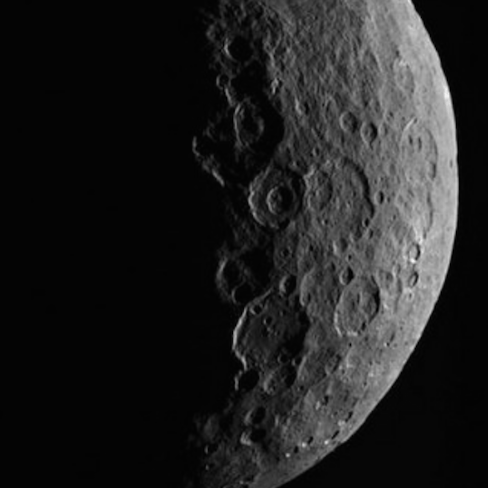
image of an asteroid

Did you think you’d be only a footnote for me when you were gone? It makes me sad all these years later, even though you didn’t choose me, even when the details of your face, your head, your ears begin to dim. But maybe we both believed the other could only love us a fraction of how much we loved them. Heartbreaking at first thought, neither of us believing we were worthy of that much love. But maybe instead what it points to is the enormity of the love we felt. If it was so huge, so surprising, even unfathomable how much I loved you or how much you loved me, then maybe it makes sense. Because even a fraction of that love would be immense. And ours was never a typical relationship, at any rate. We were never a couple. We didn’t celebrate our romance. We weren’t the kind to name an asteroid after ourselves or write I love you across the sky. But if I could go back now and name an asteroid for you, I’d do it. I’d want you to know you could never be a footnote. I didn’t think for one second you were a saint, though I know you thought I didn’t really see you with all your human flaws and ugliness. (Later, I think you knew I did, knew I saw you and still loved you.) But I would gladly name an asteroid for you, so you’d know where you fell on the wheel of my life. I’d spend hours poring over the sky chart to choose the best one, maybe somewhere in the top left corner. I’d make this grand-ish gesture so you’d know I never felt anything close to what I felt with you, drifting at the edge of sleep, warm skin to warm skin, the place it took me, that deep peace. So you would know I still think about you in odd moments, like Sunday mornings when I linger over the newspaper and wonder what it would be like to do that with you, to decide together what our next move would be. Pancakes or a nap? I’d gladly name an asteroid for you so you could know you are not a footnote. You are a bonfire.

[Editor’s note: This was written per the Day 4 prompt in the Two Sylvia’s Press advent calendar. “Write a poem in which you name an asteroid for someone you know. Use several or all of the following words: chart, fraction, saint, skin, bonfire, wheel, breakfast, dim, footnote.”]

To You on this Day of Gratitude (37)

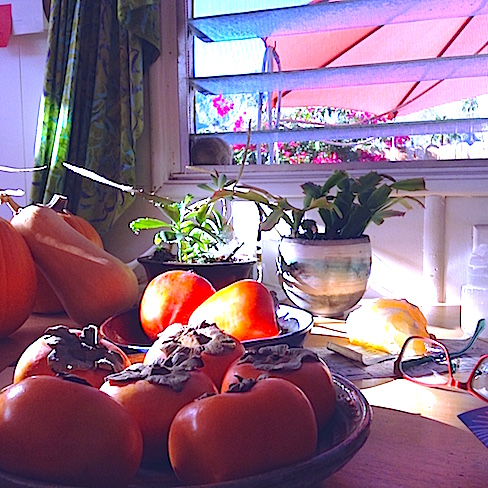
Persimmons, cactus, glasses on the messy kitchen table

Today’s my father’s birthday. He’d be 83. (Funny, isn’t it, how we do that with our dead?) When I was young, I always spent Thanksgiving with him. Maybe he somehow got that in the divorce. I remember his wife Jeannie and I laughing in the kitchen of their Sylmar home, black olives on the tips of all my fingers. Later, I brought my braided garlic French bread and tomato pesto soup to a Thanksgiving celebration at Colleen’s house in Sunland when we were young adults, and once in Sacramento, just the two of us that day, giddy on our pretend wine. And even later, Thanksgivings with Meri and her first husband, six or eight of us at the kitchen table playing Pictionary and rolling in the aisles. But decades ago it became a day I looked forward to spending alone. I like to let the day unfold, knowing there are three more days that follow, all without work, without plans. For years this was often my first day off in the fall semester, and even now these four days stand like a beacon, the blessing of a real break. I love knowing I can do what I feel like in each moment, the hours stretching like magic, like summer days in childhood, knowing I have no deadlines, no need to be ready to leave the house at a particular time. People often don’t understand my choice, and even now there’s a small voice in me who asks, “Is there something wrong with me?” For seeking solitude on a day when most people want to gather? So I’m making peace with this now, trying to trust it’s okay for me to make this choice. I turned down a chance to be with people I love today, nearby at Chimney Ranch. When I think of them together, part of me longs to be in their midst. Maybe it’s because I’m an only child, but today being alone calls me. It’s how I am able to have a sustained connection with myself, with this earth. I want to keep moving through the quiet of my day, the happy bird sounds in the courtyard, the soft sweater against my skin, the persimmons ripening on the blue plate my mother made, the changing slant of the sunlight as it moves with the day. I want to relish the bougainvillea blossoms, expand at the sight of the San Jacintos before me. And later in the afternoon I want to walk for hours in the stillness of this day, returning again and again to my glad and grateful heart. May those same moments of remembering to return come to you, too, to each of us over and again, today and always.

Happy Day of the Dead (34)

I am taking my first MOOC (massive open online course). It is presented by the International Writing Program at the University of Iowa. The first week before I wrote my own assignment, I read an incredible piece by one of the other participants. In a thousand words she’d built a whole compelling and creepy dystopian world, and made me care about the mother and daughter who lived there. It made it hard for me to write my own assignment. I couldn’t stop comparing my own writing to hers. It troubled me. I loved her piece for itself and for her sake, for the evidence that she’d so clearly entered in, had experienced the magic of fiction unfolding. It thrilled me for her. But I let it make my own writing feel pale and weak. It couldn’t stand up to hers. I am rusty at writing fiction, and in the first two assignments that magic hasn’t happened for me yet. But I haven’t given up, so that is something to feel grateful for, and maybe a little proud, too. I am being a writer. And it reminds me, too, that being a writer does not often match up with the easy, romantic image we have built. It means writing and even submitting work that is only the best we can do in the time allowed. It means envying a classmate for writing “so much better” than we can. It means slogging through a writing task when our critic keeps yelling at us to stop, to give up, to throw it all away. To take up house painting instead. But it also means getting to study craft, to listen to other writers talk about how they write. It means having a chance to practice even if it doesn’t always feel good, knowing it is all part of the writer’s journey. And it means always having the pleasure of reading the work of other writers, of being moved by their words, waking up. I read another piece by a classmate in this MOOC that will stay with me always. Her story doesn’t just lead me into the reality she builds or give me a glimpse into her characters. It changes my way of looking at the world. Hers is a conversation between two sisters in the spirit world visiting their family’s Day of the Dead altar. I’ve always thought about all these people making the offerings themselves, the favorite foods, the photographs. I’ve built my own altars, talked to my own dead. But until I read her piece, I never pictured these gatherings in the spirit world, how they might look forward to this event all year. Now I can see them whispering in anticipation, gathering to watch the altars being built here in our world. It brings things together for me, makes this a complete whole in a way it never was for me before. So, thank you, fellow writer. Y feliz día de los muertos a todos.