Om Mani Padme Hum (11)

I fall in love with chanting at the retreat. Our first sitting practice each day begins at 6am. The windows are all still open before the heat comes. I have a big screen door at my back. The desert is quiet in the early morning, the soft, steady cheep cheep cheep of a verdin, the rarer song of a house finch. Sometimes I hear the wind moving outside the zendo, or the louvered curtains knocking against each other. The teacher rings the bell three times at 6:45, and we begin to chant. There are teaching chants, monotones with dips and rises. Following them uses all of me, keeps me present. Sister Dhamma Dera has written songs, too, and plays for us on a beautiful wooden stringed instrument laid across her lap. I like the singing best, and watching her concentrate, her sweet heart leaping and shining. Singing with all these open-hearted people reminds me of Girl Scout camp. I come home with one chant in my head though I don’t know if I have the melody right. I Google it and discover it’s one of the most common. What I remember from our chant book is the “jewel of compassion.” I want that—for myself, for others.

I sing it when we leave at the end of the retreat, and the woman driving isn’t sure we are going the right way on the dirt road. She’s afraid of getting stuck in the sand, of dying in the desert, and I think heading out without knowing the directions is only asking for trouble. So I sing “Om Mani Padme Hum” because I don’t know her very well, and it’s all I can think of doing to get out of the way, to be of any help. Now, the chant comes to me in odd moments, its steady rhythm silent inside me. I sing it out loud after yoga when I’m riding my bike to go vote. I pass a man standing at a bus stop underneath a big tree. When he turns toward me I draw in my breath. His face is blackened by the shade, his eyes big, desperate. My heart goes out to him, but I am shocked, too. I hadn’t expected what I see in his face. I don’t stop. The next day I see him outside the grocery store peering in the open doors. “Can I get you something to eat?” I ask. He nods. I have to get him to tell me what he’d like. “A sandwich and a soda?” he asks. When I return, he thanks me. “I’ll pray for you,” he says. Twice. I thank him. I am glad to see him again, to have this chance to respond to what I saw in him the day before. His eyes seem less bruised today, less haunted. I hope it’s true. I sing the chant out loud again on my way home, my voice quiet and sure, the air warm against my skin as I ride. “Om mani padme hum, om mani padme hum, om mani padme hum om mani padme hum.”

Offerings (10)

I got home from my retreat yesterday afternoon, exhausted from a week of too little sleep. The inner work we did took great effort, too, and gave us great rewards. I can’t count the number of times I looked around the zendo, awed and grateful—all these brave people who had come to do this hard work together. On the last day we sat in our circle and focused on each person one at a time. We offered words or phrases that emerged for us, images of what we remembered or who we saw them to be. The one who was the center of attention just sat soaking it in, all these wonderful and sometimes funny things people believed or remembered about them. I was afraid when it was my turn no one would have anything to say. Or, maybe even worse, people would say a few things, and then there’d be silence until the rest of my time ran out, and the quiet bell rang. Instead when it came around to me, the words were steady, plentiful. I only wish I could remember more of them so I could hold them to me now and then for comfort, reassurance, hope. I remember things said about my big heart and sitting there receiving each one as it came. At the end someone said, “Devoted.” The last word spoken was Susan’s. “Impeccable,” she said, and met my eyes. I think I raised an eyebrow at that. Me? I was grinning through my tears while they showered me with shining things they saw in me. They drifted into me as they fell, warm, delicate, like sacraments, like blessings.

Salud (9)

I didn’t plan it. It just turned out this way, a surprising convergence of energies as if in preparation for my Vipassana retreat. I leave tomorrow, seven days in the high desert, silence, insight dialog, lots of sitting practice. I finished the semester’s grading late last night. On Monday I met my vow this year to get my home together inside and out before the heat of summer when (I finally understand) you have to just hunker down, get through the brutal heat, expect yourself to do only what is required. I wiped down books and boxed them, stacked things in the bathroom in the in between time. It was a lot like moving only not being forced into the work of it. And for nine days now I’ve been only eating watermelon and salads of cucumber, radish and tomatoes. (I’d been eating badly and too much. I needed this, my own odd twist of a fruit and vegetable fast.) But I didn’t plan to do it as preparation for my retreat. Like I didn’t plan to become newly freed from the awful weight of my messy, filthy trailer just before I left, or to be able to wrap up my semester, say goodbye to my students, post the final grades. But here I am, poised to go on my first retreat longer than one day. And thanks to the kindness of the universe, my house is in order, both literally and figuratively. I feel freed up, ready, eager, a little afraid. And oh so grateful I am arriving clean. Here’s to what’s to come.

May 4th 2016 or Decades of Doglessness (7)

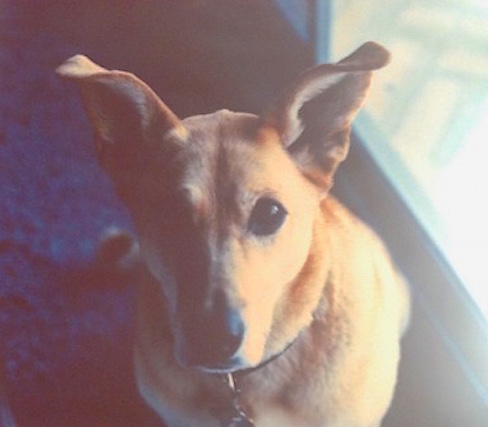
my dog Sanji, photo taken at my mom's house by Phil when I was away

My dog Sanji died 31 years ago today. She was born in 1976, part Great Dane and part German Shepherd, the runt of eleven. A woman I worked with then at the secret shopper spy job told me sanji means female bear in Tibetan. I don’t know if that’s true, but I liked the sound of it. I used to say she was part deer and part fish. She had a tender spirit, and she loved any kind of water, would leap with pure dog joy into the swimming pool. She loved going to the beach in Alameda when we lived in Oakland. After she died I wished I’d taken her there more often. She chased the seagulls along the wide sandbar, ears laid back in the wind, big grin on her beautiful face. It seems impossible she’s been dead so long. I can’t believe I’ve been dogless for three decades now. If a psychic had predicted this, that 27-year-old me wouldn’t have believed another word she said, convinced she was a fraud. And to think I’ve spent such a big chunk of my life without a dog seems unbelievably sad. But life unfolds as it will, and this was all about the timing.

Sanji and my cat Trair and I made this little family. When Sanji died Trair and I were left alone together. I knew she didn’t want another dog. When Trair died 12 years later, my landlord wouldn’t let me get a dog, so I got Sofia instead. Doglessness continued from there until now when both Sofia and Sable have so newly left me catless, too. I still cry now and then when I think of Sanji, but after all this time they are grateful tears more than anything, the memories dreamy and good. I remember our back-house cottage in Highland Park where she died of cancer and how she and Trair and I used to hang out together in our little backyard there. I would sit between the bougainvillea and the lemon tree on the small patch of grass I cut on rare occasions with an old rusty hand mower. Trair would land in my lap as soon as I settled in the chair, my joint resting unlit with a box of wooden matches in the clean blue enamel ashtray, my Marlboro Lights and my ice cold Corona beside them. When Sanji got tired of fetching, or more often when I got tired of throwing the slimy green tennis ball, she’d sprawl beside us on the grass. I marveled over our sweet little family of three. If you paid attention, you could hear traffic a block away on the old highway 11. But in our tiny yard tucked away from the world the three of us would rest together in a different kind of quiet, bask together in a deep and lucky peace.

Seeing What Comes (5)

This morning I wake up on my back and see the half moon framed in the southwest clerestory window. I feel greeted by magic. I remember Mami’s trouble breathing in the night, our fears on the phone, and I say metta for us all. May all beings everywhere be safe and free from harm. I go out to feed the birds. The hummingbird feeder is full of ants. I dump it in the weeds and use the hose with care to rinse it out, hoping some ants might survive. I think, oh, is this the way the day is going to go, filled with annoyance? After, I am standing in the kitchen and see a black-headed grosbeak join the mourning doves in the small tray feeder. He is startling beside them in his vivid orange, black and white. I’ve seen him in my garden three times in as many days. This grosbeak was one of the first birds I identified over a decade ago from my big stone porch in Hopland, so I have a fondness for them. Today I stand there watching him through the kitchen window and another strange bird emerges on a nearby sunflower, having made her way up from below to nibble on the broad leaves. It takes me a moment to make sense of her. She seems so big, so foreign. It’s only the little goldfinch who I see eating the sunflowers. But she’s a black-headed grosbeak, too. They are a pair. I am dancing inside. I’ve only ever seen one at a time before. Then three more males arrive. I have five grosbeaks, four boys and a girl, in my garden. I can’t stop grinning. It comes to me then my morning echoes life as a whole: lingering night fears, the daylight waning moon, messy, inconvenient ants, five beautiful grosbeaks—all unexpected visitors, the lot of them. Here’s to surprise guests everywhere.

Only Quiet Ghosts Today (4)

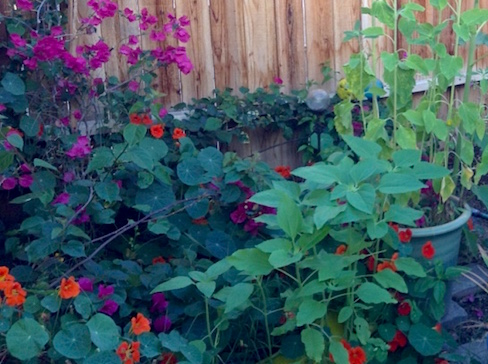
nasturtiums, bougainvillea and sunflower greenery in my garden

Guess where I am? It is Sunday, and I am sitting in my courtyard drinking my morning tea for the first time in five months. I am so grateful I was able to trust myself, to be gentle, to not push myself back out here before I was ready. I have been afraid of this day, of being here without my cats. I was afraid I would feel too small, unmoored, alone. I was afraid their ghosts would be too glaring, to have them not lying nearby on their pillows, or Sable underneath the honeysuckle, Sofia stretched out on the cement beside the gate, rolling on her back in cat abandon. I was afraid it would hurt too much to even reach for my own pleasure here in my garden. And I think if I had tried it any day before today it might have been true. But I have spent hours and hours moving everything into summer places, putting in an odd and goofy watering system. There are pots of dirt beside the sliding glass door waiting for carrot and beet seeds. I pulled out one “field” of sunflowers, their gorgeous disks drying now in a yellow bucket. I moved both umbrellas, bought new chairs and put them on the other side of the table. I rigged new spots for some of the bird feeders. I have touched every part of the courtyard in the last three days, and it changed me in the process. Not only that, but now there is almost nothing that’s the same except the birds are here, and the mountains, and me. My furred ones are not, and never will be again, but it’s a deep and quiet ache, not a wrenching agony. And it’s laced with wonder at the newness of everything around me, eased by the comfort of the mourning dove cooing from the fence and the soft pecking sounds of everyone eating breakfast. I count fourteen house finch again and again while I sip my tea and marvel.

Mockingbird Practice (56)

I have a mockingbird this spring who comes nearby and sings to us during the night. He seems to be a bit awkward about it. I think he might be young, just learning how to mimic, still growing into his song. His repertoire seems limited, his delivery stilted. It doesn’t flow from one sound to the next. I picture him out there practicing, trying hard to get each sound right. Maybe in the longer pauses he tries to remember a new sound to do next. It makes me smile, imagining. I hope it is a good effort for him, the kind of concentrating on something we love that requires all of our attention but can feel almost effortless. I hope he feels like that, all intense focus and deep joy and nothing of angst, of worrying he may not be as good as his cousin or as quick to learn. I hope he is pleased with his efforts. I’ve never noticed a mockingbird learning his song, though maybe even the adults practice to master new sounds. It make me feel a little vulnerable, my heart softened for him in his youngness, his big fresh desire, his newness in this world of ours. May he be well loved along the way, and may his songs unfold over time, seamless and soulful in the dark, quiet night.