Mexicans Are (31)

It’s some strange hubris of travel to think we know a country or a people because we came and saw a slice of it, of them. How many different versions of the United States do you imagine foreign visitors carry home? Did they stay with family in the Appalachians? Visit a dude ranch in Arizona? Make a wrong turn into Watts one afternoon when they were looking for the Hollywood hills? My Mexico was made up of poor villagers. They are the bedrock on which I base my sense of who the Mexican people are. They are quick to laugh, treat their burdens with a light touch, pay a man to rake the dirt road in front of their home because he needs the pesos even more than they do.

I met a handful of wealthy Mexicans, came to know two handfuls of people who struck me as part of a burgeoning middle class, enough to understand some of the differences between the socioeconomic strata there, how education and money shape their world. Enough to know better than to base my assumptions about life on Mexico on the lives of poor people in rural villages. But not enough to keep me from doing it anyway. I still remember the look on my Senor Soto’s face when I made this mistake, embarrassed myself. “Es raro, no?” I asked him. That’s unusual, isn’t it? He’d just mentioned he and his wife had two children. I was surprised, though looking back on it now I realize all the middle class families I knew there had only two children. He was driving the taxi, so he couldn’t stop to stare at me, but I remember his piercing look. His voice was kind, but there was steel beneath it.

“You can’t do that,” he told me in Spanish. He’d agreed to let me practice my Spanish even though he was fluent in English. (He even taught me the difference between the words “writer” and “author.”) “You can’t make assumptions about all of us like that.” His gaze moved between me and the highway. I was sitting in the passenger seat. We were on our way to the airport in Guadalajara. “Many people have only one or two children,” he said. “It just depends.” I had known it, seen it already, and yet I blundered in, two feet in my mouth, insulting this well-read man who was fluent in two languages, whose son was attending the university, whose wife and he had practiced family planning. I nodded, blushing.

“Entiendo,” I said. I understand. “Lo siento.” I’m sorry. His kindness never faltered, but he’d put me in my place, and I was glad he did. If I might muster even a faint echo of his grace the next time I need to speak up, I’ll be grateful. I have his business card tucked in my wallet. The day I return, I’ll call to see if he can pick me up from the airport. Or maybe I’ll email him ahead of time, so I can know Senor Soto will be waiting for me there.

Mango (25)

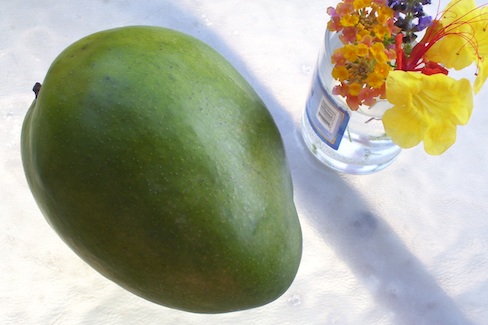
I pick the big green mango up from the counter, cradle it in my cupped hands. I probe the sides with gentle fingers. I am surprised by how quickly it has softened, even in our late summer heat, becoming almost ripe while I was away overnight celebrating Mami’s birthday. Yesterday in the late afternoon I placed it on the patio table beside a tiny vase of blossoms from my garden to honor the equinox.

green mango with tiny vase of mixed blooms beside it

Now without knowing, I have brought the mango to my face. The sweet, spicy, astringent smell drifts across me. Tears fill my eyes like a yawn, that quick stretching yearning. For one long moment, the scent takes me to Todos Santos. I am sitting at my tall round wrought iron table in the courtyard at Las Flores, marveling over the ripe red mango that has appeared there as if conjured. Later, Alfredo mimes peeling and eating one, not even trying to name it for me, not knowing the word is the same in English except for our terrible American “a” that butchers its beauty. There are three little trees behind the main house. I pass them when I go to use the washing machine. Alfredo brings me more as the weeks go by, sharing the largesse as the season swells and ends. Always they appear on my little courtyard table like sweet offerings to the gods. Sometimes, when he has borrowed my binoculars to look for whales from the steps at the other side of the inn, he will return them to my table with a mango beside them. Back in my desert kitchen, a world away, I roll the big green mango in my palms, my thumbs brushing across it. I press my nose to the firm skin, inhaling, my lips touching, too, my pose a prayer.

Refrigerator Blues (21)

When I moved into La Casa Azul, the refrigerator was filled with old food. It was sitting, skewed, on top of two old wooden pallets, and there was mold and rust everywhere. I threw out the food, scrubbed each surface with soap. When I brought its condition up with the man who handled the rental for the famous Mexican artist who owned the blue house, Umberto looked blank and suggested I paint over it. I didn’t let this mar my new dream home. The building was alive with color and light. I felt like I could spend the rest of my life there. I’d never felt that way before. When I moved into my current home, my landlord emphasized the importance of the hedges being watered, of my not interfering with the automatic timer. When I discovered the timer didn’t work, I told my landlord. “Do you have a hose?” he asked. Last year he stopped having the hedges trimmed, though I’ve fought for them to be done again twice now in the past six months. But the pyracanthas have been getting more and more bare, my privacy in my courtyard garden now more illusion than real. And then my refrigerator died, and he wheeled a “new” one for me upright down the road from around the block, rattling and bumping along the asphalt. My jaw dropped. I spent three hours cleaning it out and trying to get the marks out of the floor, only to discover it didn’t work anymore. It shouldn’t have been a surprise.

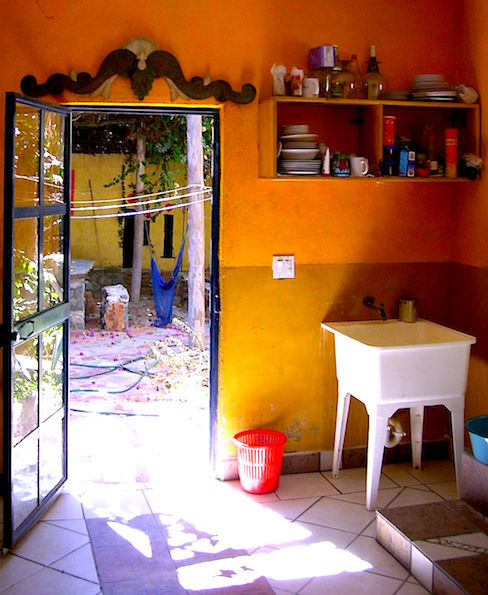
kitchen of La Casa Azul, door open to the patio, orange walls

But it wasn’t just the hassle of the refrigerator. It was cumulative. The hedges might be dying. Could it really be from lack of water? “Do you have a hose?” rang in my mind. “Puedes pintarlo,” Umberto had said. You can paint it. And before I left Todos Santos, the refrigerator stopped working all together. I didn’t even ask them to fix it. Things had deteriorated beyond that. I lived out of my two little ice chests. I felt helpless in Todos Santos, trapped. In the end I fled my beloved Casa Azul. I’ll always be glad I did, and I’ll always regret it couldn’t have worked out differently. When the wealthy Mexican artist refused to give me back the $700 he owed me from my deposits, the bad fridge was one of his reasons. The memory still brings me to wall of anger, the stone cold against my fingers. So when I found myself living out of my ice chests again here, I know the rest of this was at work beneath the surface. I was desperate to get away, out of all proportion to the circumstances. I threw myself once more into looking for a mobile home, contemplating buying a trailer, even looking at other rentals. But then my landlord gave me his refrigerator, and the panic eased. I am now soaking the hedges every other day, hoping they’ll revive. And I’m thankful I’m not fleeing. I know when the day comes, it will be hard to leave my enchanted courtyard garden. I don’t want it to come in haste, unsettled, my need to escape eclipsing everything. I want the peace of mind to cherish what I have through that last day, still obscured in mist, be it in two months or twelve years. If I could do it over again, I would stroll through the kitchen at La Casa Azul with all my gladness and all my gratitude sitting there beside my grief. I would run my hand against the orange wall, take in the sunlight and the colors and relive that last goodbye without the taint of despair, my clear heart cheering in a loud and grateful voice.

Where I Belong (20)

Today I cross the carretera, choose the little bus that goes through the village first. I like the little bus best. It’s more simple, more bare bones, has no curtains, no cushions. All the windows are flung open, and kids in their school uniforms chatter and laugh and shout. Older Mexican women get on with their heavy groceries, sometimes only riding for a few blocks along the narrow cobblestone streets. I like being drenched in the bustle. By the time we get back up to the highway again, things have quieted. The after-school flurry is over.

The bus heads west. I breathe in wet earth from last night’s rain. I settle into my seat. I am going again to the next town over, to San Juan Cosolá. The wind blows in, making straight dark hair dance against the backs before me. The driver has the radio up loud, and ranchera music washes around us like the summer air. In the midst of all that is familiar, that for all its foreign-ness has become home to me, I am overcome. It happens to me often on this stretch of road, a kind of Mexican enchantment, I think. But still I am surprised. I am taken by a big burst of joy to be living here in Mexico, joy washed by gratitude that makes my eyes brim.

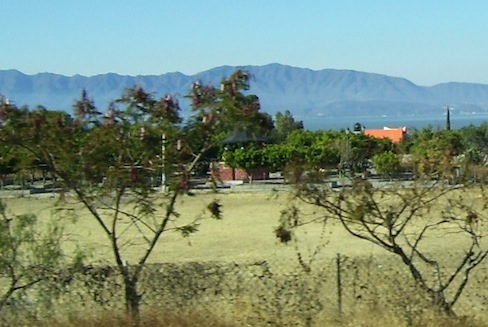
glimps of Lake Chapala

I look out the window, my throat tight, my heart pushing against my ribs. I watch the hills, a swathe of color on my right. I catch glimpses of the lake in the distance on my left. My mouth is open now, my jaw loose, half taking it all in, half awe. I wonder if part of what overtakes me on these bus rides is that seated on the bus among these dark-headed people, I feel a part of things. We are in this together, this riding on the bus with the air rushing in and the music resonating in our bones. On the bus, I feel like I belong.

La Milpa (18)

One time when I did say yes to Mexico, I got to visit Rodolfo’s milpa, the one south of the carretera, the highway, just west of Ajijic. We rode the bus together, Ana and Rodolfo and their daughters Isabel and Mariane and I. Milpa translate’s literally as cornfield, but Rodolfo grew other vegetables, too. They were all nourished by the nightly summer rains. Every year at harvest they had a gathering at his other milpa, north of the highway somewhere. They roasted elote over a big open fire, the corn in their husks, drank tequila, danced. I don’t know how I missed it, but it breaks my heart now to think I may have passed it up. I hadn’t been there long yet, so I maybe I was too shy, but I know I would have done anything to get there in that second summer. But I left that year when the corn was still growing.

The milpa was a few blocks more to the south, between the carretera and the lake. We walked together on the country road in the late summer afternoon. I remember being transported when I followed Rodolfo through the rows of corn. They must have been twelve feet tall. It was another world inside them, all pale green light, moist earth and growing things. He brought us to a makeshift table in the distant heart of the field. Rodolfo picked a handful of pepinos, cucumbers, and washed them with a gallon of water he’d carried with him on the bus. He had a knife to slice them, and Ana produced limes and salt and chile. We ate pepinos picados in our little spot carved out from the forest of corn, and I remember being charmed and oh so grateful they had wanted me to come.
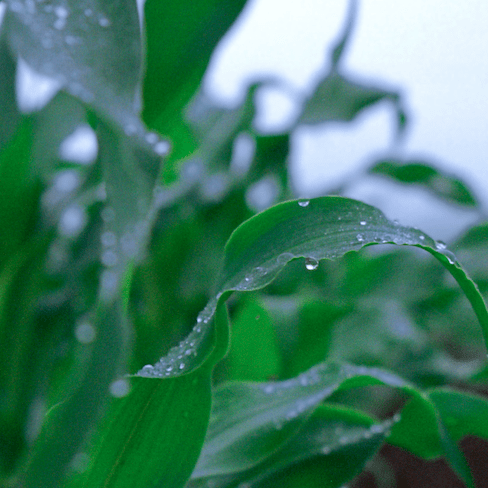
corn plant leaves with raindrops © Tomo Yun

It began to rain, and I licked lime and salt from my fingers. We grabbed everything and ran down the road, laughing, the rain coming down in fat drops, pelting us as we ran. Rodolfo led us to a half-built home a block away. We stood in an unfinished room while the rain beat down on the metal roof, nibbling on brownies I had bought from a cafe in town and crunching crisp red apples. I have always loved the sound of rain on a metal roof, the smell of the first drops hitting dusty earth. I was glad for the water going to the milpa.

Rodolfo talked about the half-built home, abandoned now. It belonged to a friend of his, and when he looked around, I could see in his eyes the way he imagined it in his mind, picturing it fixed up, livable. But Ana only rolled her eyes. She was not eager to live in the country. Over my dead body, she might have said. But I could see it, too, the place restored, the dream of it. Rodolfo and I looked at each other and smiled. Who knew?

[Cornfield photograph cropped from the full version, © Tomo Yun at www.yunphoto.net/en/. Used with permission.]
The Trouble with Attachments (14)

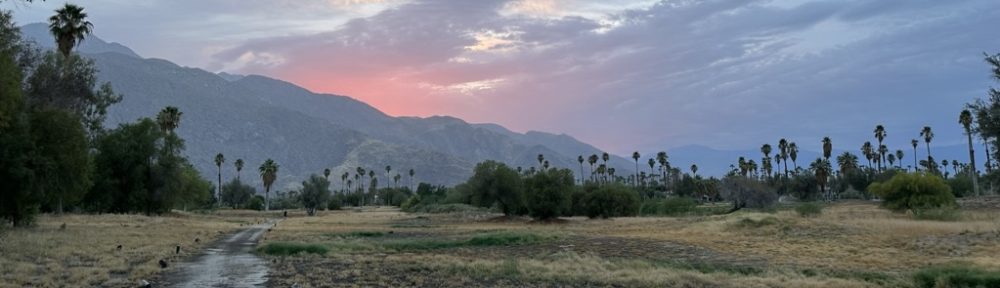
Three years ago on the first of July I was driving west across northern Mexico in the late afternoon. I planned to spend my last night in the country near the little border town of Sonoyta. I wanted to cross into Arizona early the next morning. The weather had been kind to us, clouds hugging our toll road for the past three days, but it was still hot. Undeveloped desert stretched in all directions. The night before, we stayed at a wonderful motel, but I can’t remember where it was. I only remember there were big trees and grassy areas, wild ferns, lush growth in contrast to the sparse desert. I walked to see the nearby river from the overpass, and on my way back to my room a big truck drove past me. It was filled with pigs. They were screaming, as though they knew where they were going. I’ll never forget the sound or the feeling of helpless terror it conveyed. I remembered reading (in a romance novel!) that pigs are almost as intelligent as dolphins. Now when I miss bacon I remember their screams.

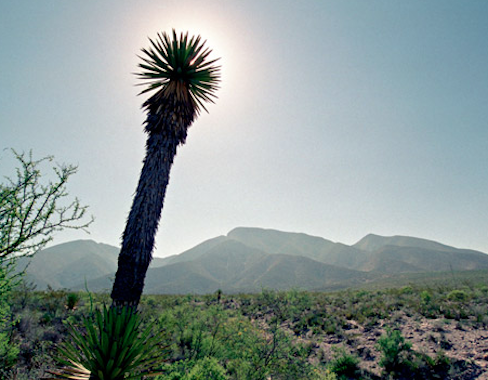
Desert and mountains copyright Tommy Huynh

Later, I ate dinner on the patio. I lingered through the late afternoon and evening by the pool. It was safe and soothing, my oasis in a stressful journey from Jalisco with my two cats. But as is my wont, I decided I would try to repeat this luxury the following night. This is where I went astray. In the afternoon when I was about an hour or so from the border, I saw a motel in the middle of nowhere, sitting alone on the right-hand side of the highway. It was new, and the man in the office was warm and kind. But I had it in my head I wanted a pool. He told me about a motel with a pool in the next town (whose name also escapes me now, and no staring at my worn and folded map evokes an answer), so I thanked him and drove on. I found the motel and checked in. And little by little I discovered this was where the army stayed. There was a pool, all right, but it was crowded with young army men on their off shifts. I was damn well going to swim anyway, and swim I did, weaving in and out of the boisterous young men. I chatted with one, treading water in the deep end, and that’s when I got the skinny on the place. It turned out they came and went all night long.

It wasn’t only the incredible, constant noise that marred my night. It was the energy of the military outside my door and the sight of all those young men carrying machine guns, that even after almost two years in Mexico I never learned to see without a little skip in my heart. To this day I am convinced my last night on the other side of the border would have been filled with big sweetness if I’d only stayed at the place that caught my eye, not had my heart set on a pool at all costs, been content with my previous night’s oasis without being greedy and trying to grab after more. But there was sweetness in the early morning hours there. I couldn’t get Sable out from under the bed when I was ready to leave, and one of the army guys who was out by the pool offered to help me. I couldn’t have done it alone, and I owe him a debt and my big gratitude. Maybe he was the reason I was there.

[Editor’s note: This photo is by Tommy Huynh. He holds the copyright, and you can find it on his website: http://www.lumika.org/mexico/natural_scenes/14.htm. Used here with his permission. And on another note, I got a chuckle out of my title here. I wondered if people would think I was going to talk about problems with attached files! ;-) ]

Alpiste (13)

“The pine tree is coming down in two weeks,” my landlord yelled at me. He was angry with me at the time. I’m hoping he didn’t really mean it, doesn’t follow through with his threat. Our pine tree has been through so much. She should never have been planted in this desert to begin with. Fierce wind took more than half of her away before I came. She was haggard, drying, teetering, it seemed, brushing close to death. But she rallied, and now the shade she casts is doubled, maybe tripled. And the spots for birds to perch or shelter have multiplied, as well. I pray she’ll be protected, pray she’ll thrive. I would hate to see her taken, a mean recompense for having grabbed onto life with such grit, such gusto. I’d be afraid, too, losing her would mean losing even more of the birds who like to linger in our little corner of the world.

Already there are fewer birds here than before. The bulk of the house sparrows have disappeared again, and the doves don’t fill the tray feeder in the mornings like they used to, all packed together, a picture I never did capture properly, all those pretty bird butts ringing the wooden frame. When I first began to notice their absence, in my usual fashion, I wondered if it was because of me. Had I been found wanting? Later, I considered other possibilities, but my first thought was I had not been enough in some way. Could it be the desert rats, cute little guys with big dark chocolate eyes, who eat the remaining seeds in the night? Do they eat bird eggs? Attack birds? I don’t know. I worry, too, it is because I switched to the cheaper bird seed. My new attempts at being frugal and the fact I can bring the twenty-pound bag home from True Value on the back of my bike has me using the dull, dusty feed with cracked corn and milo.

In Hopland I bought a hundred pounds or more at a time and blended them myself. It was cheaper that way, but it was a big procedure, up to my armpits in the plastic bags to mix them. But I loved the way the seeds moved through my fingers, rich with oils and colors. In Ajijic, I could walk to the next block over and buy my bird seed from my favorite tiendita there. They would scoop up the alpiste and weigh it in a plastic bolsa. I could get just half a kilo at a time, stroll home with it, so easy. I miss that. I always suspected folks were cooking with it, too, but I never asked. I know it can be used to make atole, a common hot drink, a comfort. But I trust many of my neighbors were feeding it to their birds, as well. On my block and the next, I would hear the exotic birds calling from the entryways of homes as I walked by. I didn’t know alpiste was canary seed until I moved back to the United States and went hunting it down for my bird seed blend.

view of Lake Chapala from my veranda

View of lake from veranda after sunset

I had sparrows in Ajijic, too, though never more than three or four at a time, and one dear hummingbird with a feather out of place. (He was the hardest to say goodbye to, after Ana and Rodolfo. I cried when I took his feeder down and left him with a paper cup of sugar water. He sat on the wire and watched me for a long time.) There were no trees on my block there, no real shelter, but still the sparrows would materialize at the tray feeder, eat the alpiste, chat among themselves. I’d sit on my veranda looking at the lake and listening to their quiet exchange.

Now in my courtyard I think again about buying a more expensive seed blend. Maybe I’ll offer it as a special treat from time to time. Or maybe I’ll begin winning more writing contests, left and right and left again, and I won’t even blink at the idea of returning to the rich, pretty birdseed my birds here became accustomed to. I hear the house sparrows behind me now, soft, muted, rounded sounds, satisfied from a midday snack, enjoying the shade of the pyracanthas and the cooling mist the dry, hot wind wafts their way in small puffs.

The sun reaches my feet, burns my right arm and hip as I write, but I keep going, leaning, crooked, toward my remaining shade. I remember the quiet chatter from my sparrows in Ajijic. I relish them in memory even as I savor the soft murmurs behind me now in the hedge. And even though the heat is still climbing, and even though I have much to do still as the day unfolds, I stop, linger, feeling oh so lucky, loving our little desert courtyard, this small oasis on a hot, busy day.