July 31st (21)

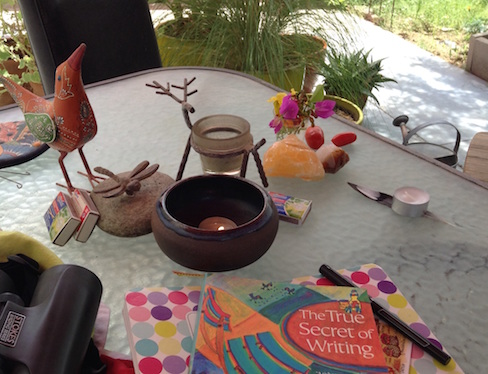
book, notebook, binoculars, candles, altar things on patio table

It’s July 31st. I hear Carole King singing in my head and dream of waking up beside the man I love on the first day of August. Hers is a love song to summer. It’s not yet noon, over 100 degrees, muggy. Clouds piled against the mountains move toward us. One good thing: this weather gives us cleaner air. Second good thing: cicadas loud in the two trees. They change pitch, volume, breath, weave sound in and out, insect orchestra. I have just read the chapter of Natalie’s book where she talks about teachers, about Wendy. She is right. Wendy’s rich prose makes me envious. But right before, she tells us to copy Hemingway, to write a piece in one or two syllable words. I think: I do that. I don’t need to practice that. It’s organic, what comes to me. Today is the eve of the halfway point between midsummer and the fall equinox, the veil between the worlds thin. I make a small altar on the courtyard table: two tomatoes grown in the big terra cotta pot, bougainvillea, tecoma and Mexican birds of paradise from our garden, orange calcite, yellow citrine. I light one candle for this harvest time, for this turning of our world, and a second candle for all the beings I know who’ve died in recent months, feline, human, canine: Sunny, Auntie Christel’s brother in Germany, Bob, Colleen’s father, Annie. I ask for blessings on their spirits, on the ones left behind, still in bodies. May we honor both sides of this thinning veil. I take a deep breath, hear small chirpings in our tree. A verdin, I think. One lone dove sits on the wooden fence, Boo sprawled beneath the apricot mallow. Sofia comes outside, drinks water. Everything goes still. And then the cicadas begin to buzz again, and I draw another breath, keep my pen moving across the page. Sweat rolls down my right temple. My stomach growls. I twitch a fly off my forearm. I am in love with the last day of July.
Lazy Summer Day (16)

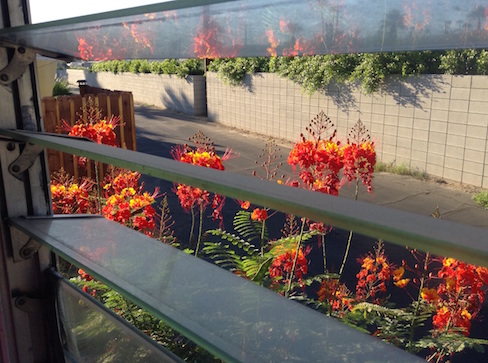
mexican birds of paradise through the open louvered windows

I don’t go to yoga this morning. Instead, after I water the front I weed the bed with the tecoma bush. The Mexican bird of paradise there has taken off. It’s taller than I am. When I begin weeding, I know I’m not going to yoga. I want the luxury of being able to putter, to not rush through my morning chores to hurry across town. I do the rest of the watering, and then I end up clearing away all the things that have collected on the floor, the ice chest and remains of our picnic a week ago, the cans of tuna and cat food from Trader Joe’s. I wash the bamboo plates and spoons. (Yes, I am terrible. They have sat there for a week wrapped up in flowered cloth napkins, crusts of hummus on them.) I take a photograph of the birds of paradise through the open louvered windows with the morning sun falling on them. I talk to my friend Meri on the phone for a long time. In the early afternoon, I reread three chapters of Natalie Goldberg’s latest book about writing. I eat Brazil nuts and a big bowl of cherries. The mourning doves are eating fallen seeds. Sable is still outside with me, so every now and then I wiggle my foot or wave a pillow at them to get them off the ground. “There’s a cat,” I say. I point to Boo snoozing in the shade under the honeysuckle. The birds watch me, expressionless. (Who is this crazy person? What is she saying?) The flies annoy me, insisting on touching my face, my calves, landing on my ears. I want them to go away. Cicadas buzz from my neighbor’s tree. They are one thing I love about summer in Palm Springs. I have a goal now to make a list of more things I love so I’ll remember not to hate summers here. After I write I’m toying with the idea of excavating the tabletop, maybe finishing assembling the shelves so I can remove the tall stack of books from the kitchen chair. I have not yet figured out how to live in 340 square feet. Maybe, I think, I will even wash the floor today. Or maybe I will make scrambled eggs and turn the misters on and sit here reading my latest novel about Valdemar. It’s easy to call the odds for this one as soon as the idea surfaces. But you never know. It’s Day Three of my holiday. Anything can happen.

Mudballs (15)

It’s crazy hot. I’m dripping with sweat but reluctant to go inside. I’ve become attached to reading Natalie Goldberg and doing my “morning writing” on the patio, even on days when morning becomes late afternoon. Today she talks about being lonely, how Katagiri Roshi says we must stand up in it, not let ourselves be “tossed away.” I think of Bernardo. I saw him on the creek path last week. He told me how lonely he is, how women won’t engage with him because he is not wealthy, because he is short. I talked about how we often don’t get things we are too attached to wanting. It’s the way the universe works. I used my writing contests as an example, how I may be too attached to wanting to win. But my heart went out to him. Today my horoscope says that empathy is underrated but much needed, great for actors, parents. Teachers? Writers, too. But it isn’t always an easy gift. Empathy hurts. I know deep loneliness. Maybe without knowing I learned to stand up in it. I made my peace with it. Bernardo hasn’t, I don’t think. He’s hoping someone will come along to make it go away. It’s why I’ve always felt uncomfortable in our exchanges even though I like him and enjoy our talks. I sensed this, a kind of energetic grasping. Of course, there’s a hunger for connection, for physical closeness, too. It’s different from loneliness but a close cousin, all fruit of feeling alone in the world. Feeling connected to the planet helps. I miss walking every day for that, for the big picture connection. But even here in the courtyard I have my mountains, our palo verde, the birds, the moon, the wind that picks up now as I write, wanting to be included on my list. I feel lonely, yes, but not like years ago. Bernardo’s is a deep ache. I ache for him, for all of us, stumbling along being in bodies, saddled with the illusion we are all alone and separate, our odd human condition. We fumble, tumble into each other, mudballs all—stars inside us.

Become Big, or When I Write (13)

Natalie Goldberg says in Writing Down the Bones, “Become big and write with the whole world in your arms.” I love that. I love the way it makes me feel. When I write I am my mother who cleaned the house every Friday when I was little. Daddy brought home Bob’s Big Boy that night for dinner, the combination plates, so she didn’t have to cook. When I write I am my 4th-grade self walking down the hallway in my stepfather’s house in East Granby, Connecticut, when I heard the radio saying Kennedy had been shot. When I write I am big like the San Jacinto mountains that right now are diminished by the smog between us, but I am big like their massive shoulders, big like they are when the air is clean and you think you can reach out and stroke the ridge line like a sleeping bear. When I write I am the African on a crowded raft hoping to reach Italy alive. I am lost treasure at the bottom of the sea beneath him, gold doubloons among the old white bones. When I write I am the breeze that moves across my skin and still cools me in the early summer day. I am the wind that breaks my green umbrella. When I write I hold the field of sunflowers in my arms beside the path to Santiago de Compostela. When I am big I write with Hitler and George Bush (the son) and Glinda from The Wizard of Oz—they are all in my arms. And Toto, too. When I write I am clouds, streetlights, 4711 cologne, Stalin, Ray Bradbury, Natalie Goldberg. I hold rain and starlight, yerba maté with coconut milk and honey, exhaust fumes from the diesel truck my neighbor drives, eggshells in the trash wet with the whites I have syphoned off for the egg yolks I fed the cats. When I write I hold you and Aunt Doris and Huckleberry Finn in my arms. I hold myself in my arms. I learn to be tender with myself. When I write, I hold you, too, and try to be honest and kind.

Too Many Lonely Dogs (5)

I read in the newspaper there is now a “movement” to have one day each week free from technology. (It also said most people in the United States check their cell phones 150 times a day. Gasp. Choke.) Because of time spent engaged with technology, the article went on, kids feel their parents aren’t present. I tend to see this in the grocery store, the child trying (and failing) to get their mother’s attention while they wheel the cart down the isle one-handed, talking on the phone. This isn’t anything new. It’s been going on for a long time now. I see dogs suffering when they’re out for a walk. The people on the other end of the leash are on their cell phones, talking or texting. The dog walks beside them. You can feel their sadness, their loneliness, their longing for their human. It’s supposed to be a special time to be together, connected in those quiet moments of mutual pursuit. Instead, I watch the dog walking alone, their human miles away. I’ve watched this for years with my students, too. The moment they step out of the classroom, their cell phones come out. If they have ten minutes to get to their next class, they fill it up. “Hi,” they say. “Where are you?” Too many people are never alone with their thoughts. They are listening to music, talking, texting. It’s rare to see people sitting on the bus just taking things in. Once in a while I see someone reading a real book, and it makes me glad. The act of reading is alive with imagination, and it can be looked up from, left in intermittent moments to become immersed in the environment. It doesn’t separate us in the same way. If there is truly a movement to leave technology behind one day a week, I’m all for it. I’ll even vote for two days. Because this trend has worried me for years. If we can’t be alone with our thoughts, can’t be comfortable in silence, what kind of life does that leave us? And I don’t think it’s only troublesome in terms of its toll on heart and soul. What about the vanishing attention span? I’m afraid we’re creating people who won’t be able to focus on one thing long enough for complex thought. And, well, too many lonely dogs.

German Healers Triptych (47)

Last December I met three women in my quest for healing. I knew I wasn’t completely well, wasn’t thriving. I’d found Adrienne, but she only came to Palm Springs once a month. I had insurance now that paid for acupuncture, so I looked through the provider list and found Beatrice (Beatrice Moncrief, Garden of Wellness). She is warm and generous, and German. This was unexpected, but because that is the bulk of my own ancestry, it made sense. (When I was five I decided I was three-quarters German.) The first time I met her, she suggested I may want to give up eating grains. I was already gluten free and mostly vegan, so I balked. I was defensive and cranky at the thought of giving up anything else, but she was kind and patient. Now when I lie facedown during the restorative part of my treatment, I go somewhere deep and watery and return restored. She tells me I’m always happier when I leave, and I know it must be true. One day I want to be able to be less depleted when I get there. And Beatrice led me to Michale (Michale K. Cashe, Herbal Wellness Center). Like me, she is the daughter of a German immigrant. She is warm and assertive. She reminded me of Auntie Gardi’s daughter Luisa who is another strong German-American woman with a wonderful big laugh. Michale smiles like Luisa, too, so I liked her straight off. She does this very cool biofeedback test and a voice analysis that I was especially fond of. She is the reason I am doing the toning to heal my thyroid and my kidneys. And in December when Adrienne didn’t show up, I had a healing and laying on of stones with Gitte (Europa Gitte). She told me I have something in me that resists my efforts to change. I remember standing in the back of the store after the healing and asking about her accent. When she told me she was German, the pattern was hard to miss. “I seem to have a theme of German healers in my life right now,” I said. And I am grateful for each of them, and to the universe for bringing me this triptych of German women helping me along the way. So thank you, Beatrice, Michale and Gitte. Here’s to you. And here’s to thriving.

She Walks Away (40)

In a dream a woman is walking down the street, heading south. We are in a foreign city. The homes and stores share a common wall along a narrow sidewalk where I stand watching her go. Mexico, maybe, or Italy. Greece. I begin to yell. “You—” I want to scream obscenities at her back. I stop myself. “You are—” I stop again. “Unkind,” I say at last, the word crisp inside my mouth, the taste of charred paper. Then I shout, “I love you.” She stops. She doesn’t turn around but looks over her shoulder. She scowls, annoyed. Conflicted, maybe. Impatient.

“Thank you,” she says. And then she walks away.