Mexicans Are (31)

It’s some strange hubris of travel to think we know a country or a people because we came and saw a slice of it, of them. How many different versions of the United States do you imagine foreign visitors carry home? Did they stay with family in the Appalachians? Visit a dude ranch in Arizona? Make a wrong turn into Watts one afternoon when they were looking for the Hollywood hills? My Mexico was made up of poor villagers. They are the bedrock on which I base my sense of who the Mexican people are. They are quick to laugh, treat their burdens with a light touch, pay a man to rake the dirt road in front of their home because he needs the pesos even more than they do.

I met a handful of wealthy Mexicans, came to know two handfuls of people who struck me as part of a burgeoning middle class, enough to understand some of the differences between the socioeconomic strata there, how education and money shape their world. Enough to know better than to base my assumptions about life on Mexico on the lives of poor people in rural villages. But not enough to keep me from doing it anyway. I still remember the look on my Senor Soto’s face when I made this mistake, embarrassed myself. “Es raro, no?” I asked him. That’s unusual, isn’t it? He’d just mentioned he and his wife had two children. I was surprised, though looking back on it now I realize all the middle class families I knew there had only two children. He was driving the taxi, so he couldn’t stop to stare at me, but I remember his piercing look. His voice was kind, but there was steel beneath it.

“You can’t do that,” he told me in Spanish. He’d agreed to let me practice my Spanish even though he was fluent in English. (He even taught me the difference between the words “writer” and “author.”) “You can’t make assumptions about all of us like that.” His gaze moved between me and the highway. I was sitting in the passenger seat. We were on our way to the airport in Guadalajara. “Many people have only one or two children,” he said. “It just depends.” I had known it, seen it already, and yet I blundered in, two feet in my mouth, insulting this well-read man who was fluent in two languages, whose son was attending the university, whose wife and he had practiced family planning. I nodded, blushing.

“Entiendo,” I said. I understand. “Lo siento.” I’m sorry. His kindness never faltered, but he’d put me in my place, and I was glad he did. If I might muster even a faint echo of his grace the next time I need to speak up, I’ll be grateful. I have his business card tucked in my wallet. The day I return, I’ll call to see if he can pick me up from the airport. Or maybe I’ll email him ahead of time, so I can know Senor Soto will be waiting for me there.

If Looks Could Kill (29)

When I first moved to Todos Santos I bought my produce from a place on the main drag, the road the two-lane highway became as it zagged through town. The woman there was never kind to me, a rarity in Mexico. I annoyed her with my questions and my faltering Spanish. She answered me in a sharp, curt voice. She looked at her friends, rolled her eyes, said things I couldn’t understand and laughed. I don’t know how long it took me to stop going there. I found a new place in the north of town, a kind of glitzy store for the expatriates, but the staff were sweet and helpful. I bought produce from a local organic farmer, an estadounidense who camped out on the sidewalk downtown two mornings a week. Once I bought a bag of arugula from him–huge dark green leaves like I’ve never seen before or since. I brought it to my friend Iris at Il Giardino, and someone at the restaurant sauteed it with a little oil and garlic. It’s still a favorite meal of mine, especially with the brown rice pasta I’m in love with now.

streets and shops in downtown Todos Santos

One day when I walked past the produce place where I used to shop, the woman made a point of glaring at me. I remember the way she held my passing glance, her head moving, slow and deliberate, to keep me in her gaze as I walked past the open air stall. For a moment, I wondered if she was angry with me because I stopped buying from her. But that was only my logic, only me trying to make sense of what was happening. But logic wouldn’t help me here. Because as I watched her, she bared her lips in a snarl and her cheeks pinched up. It was more fierce than a wild animal might have been, cornered and terrified, lashing out. The look in her eyes was pure hatred, her face made grotesque by it. I scuffed my toe on the pavement, stumbled, her venom like a blow. I turned my back and kept walking. My arms trembled, my cloth shopping bags suddenly too much to keep upright. I let them dangle as I climbed the hill toward home. I wondered how she could hate me that much. She didn’t even know me. But to her I was the ugly American. To her, I was the reason her once-tiny fishing village teetered on an unknown brink, invaded by foreigners building palatial homes north of town, the growing middle class of Mexicans only beginning to get their footing, the huge disparities creating terrible tension just beneath the surface of her world. To her, I was to blame for everything that was wrong with her life. I’ll never forget the look on her face or the shock of that poison spewing out at me.

Where I Belong (20)

Today I cross the carretera, choose the little bus that goes through the village first. I like the little bus best. It’s more simple, more bare bones, has no curtains, no cushions. All the windows are flung open, and kids in their school uniforms chatter and laugh and shout. Older Mexican women get on with their heavy groceries, sometimes only riding for a few blocks along the narrow cobblestone streets. I like being drenched in the bustle. By the time we get back up to the highway again, things have quieted. The after-school flurry is over.

The bus heads west. I breathe in wet earth from last night’s rain. I settle into my seat. I am going again to the next town over, to San Juan Cosolá. The wind blows in, making straight dark hair dance against the backs before me. The driver has the radio up loud, and ranchera music washes around us like the summer air. In the midst of all that is familiar, that for all its foreign-ness has become home to me, I am overcome. It happens to me often on this stretch of road, a kind of Mexican enchantment, I think. But still I am surprised. I am taken by a big burst of joy to be living here in Mexico, joy washed by gratitude that makes my eyes brim.

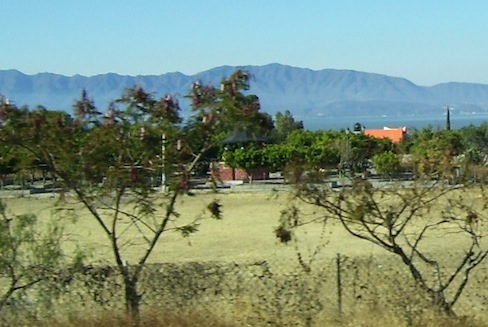
glimps of Lake Chapala

I look out the window, my throat tight, my heart pushing against my ribs. I watch the hills, a swathe of color on my right. I catch glimpses of the lake in the distance on my left. My mouth is open now, my jaw loose, half taking it all in, half awe. I wonder if part of what overtakes me on these bus rides is that seated on the bus among these dark-headed people, I feel a part of things. We are in this together, this riding on the bus with the air rushing in and the music resonating in our bones. On the bus, I feel like I belong.

The Boy with the Scary Skin (19)

I walk down my hill to the carretera, the highway, two short blocks from my home. I never have to wait long for a bus here in Ajijic, only five or ten minutes. But I have yet to be able to distinguish between the different buses from a distance, the one that turns at my corner and goes through town, the one that stays on the carretera. So I get nervous waiting. I am self-conscious flagging down the driver, boarding the bus. I feel conspicuous, the one estadounidense in the midst of the Mexicans whose world this is. I place my coins in the driver’s outstretched hand. “San Juan Cosolá,” I say, flustered, sure every eye is on me, certain the driver is only tolerating my foriegn-ness.

But once I find a seat toward the back and settle in, I begin to relax. I’m on one of my favorite outings, going to the next town over to indulge in the waters, the natural hot springs, the balnearios. The bus continues west on the highway, and I wonder if I’ll see the two little boys today. I have asked their names before but never remember them. I am bad with names. They are brothers or maybe neighbors, best friends. They are little, wiry, filled with restless energy. The one the other defers to, the oldest, I think, has a terrible skin ailment that covers his face. There are patches on his arms, his hands.

I give them coins because they do not demand them, do not treat me as though I must, as though it is their due, and I must be rich because I’m from the United States. Usually I give them 10 pesos each, maybe a little more or a little less, depending on whether or not I have remembered to prepare for them. Once I gave the one in charge a 200-peso bill, just less than twenty dollars. I asked him if he would share it with his mother. I believed him, his solemn nod. I could feel the shock of it in both of them, but they didn’t say a word, didn’t betray any emotion, only in the still way they held themselves did I know what it meant to them. Another time I was walking up the short hill to the highway on my way home when the bus appeared. I was too far away, but I started to run. The older boy saw me and raced hard for the bus. He got the driver to wait for me. I could have kissed him. And the sweetest thing was knowing he hadn’t done it for the coins. He was only being kind, generous. He would grow up to be a good man, I thought.

I waved to him as the bus pulled away, grateful and touched by his gesture, and aching for the kind of poverty he knew, the kind that left him stranded in his skin, his old soul eyes meeting mine as I left him behind.

Salsa that Sings (17)

Sortera gave me some extra ripe heirloom tomatoes at the farmer’s market Saturday morning. “¿Para mi?” I asked, surprised, pleased. She nodded.

Para salsa.

Ah, muchas gracias,” I said. “¡Que bueno!” I thought for a moment. I big grin came over my face, the child who has figured out something wonderful. “Tengo chips!” I declared, and she smiled back at me. What luck.

I was so glad she offered them to me again. The last time I had hesitated, demurring, suggesting she might want to make salsa from them. (So dumb, this one—of course she could have all the tomatoes she wanted. This was her family’s business.) I know I upset her. I was able to convince her I’d love to have the tomatoes. But in Mexico there should not be any hesitation, only the resounding “Yes.” You accept all that’s offered.

I’m not sure I could ever learn to do that. I know when I lived there I turned things down, begged off because of my work, my lack of time. On New Year’s Eve in Todos Santos, I called Iris to tell her I wouldn’t be coming to their family celebration after all. I felt terrible about it, but I didn’t want to drive past all the bonfires in the streets, through all the fireworks. I was afraid, hid out at home instead. In Ajijic, I turned down more than one invitation to visit my neighbor Ramona, though I don’t think she ever took offense. I think I may have even bowed out once from attending the harvest celebration at the milpa, and I’d undo that in a heartbeat now if I could.

The truth is I was working a lot–too much still then, I think–so much of my time in Mexico spent at home, hunched over my laptop. Though that work allowed me to be living there, so my lament can’t be too strong. Still, I regret not learning more, not leaving with more knowledge, not bringing back more concrete memories. I wish I’d asked Ramona to show me how to make salsa in her molcajete, her basalt mortar. She worked for hours in her dark kitchen, making almost everything from scratch, filling the traditional female role for her big family. She would have been happy to teach me, I think. It would have given us something to do together, too, would have been better than our awkward but heartfelt greetings, our shy but regular exchanges of small gifts, our attempts at chatting when I say with her family in their living room.

And Rodolfo would have permitted me to watch him cook, I’m sure. I know he loved for me to get so much pleasure from what he prepared. I could have learned how to make pipian from a master. And when I made salsa from Sortera’s tomatoes now in my southern California home, even if I made it in the blender, it would sing to me of Mexico. Instead, it makes me miss it more.

Banished Again (16)

Almost a third of my year is already over, and still I struggle with my chosen focus for this year’s blog. My friend Colleen once suggested I could stick with it for awhile and then abandon it at some point later in the year. “But I don’t want to abandon it,” I told her. My tone was cranky, miffed, defensive. I had made this choice, and there were endless possibilities to write about within it. There was no reason to give up on it. There was every reason to persevere. But in the time since our conversation, her suggestion whispers in my ear from time to time. It tries to seduce me. Stubborn creature that I am, I shush it. I turn my head away, present it with my back. I refuse to listen. And yet, when the whisper comes, when I feel the warm breath on my ear, it is a siren call. Today, I even counted on my fingers. If I stayed with Mexico for six months, when would half a year arrive? October? It wasn’t soon enough.

“But I don’t want to abandon it,” I say again out loud. There is no icky tone now, no crankiness, no bridling at a sibling’s suggestion. I really don’t want to abandon it, even as the idea of letting it go calls to me, full moon to high tide. But I am afraid. I was out of town, two short trips back to back, weeks lost to preparations, to journeys, to recovery. I am a week behind on my blog, me who wanted not to fall behind this year, not to spend time playing catch-up. But I know there is more than the ordinary resistance to writing behind my delay. I glimpse part of my problem–trying to write about all things Mexico is not only my fear of failure, of not doing it justice. I think fear lives in the fact it is so complex. It is not simple for me to think about Mexico. I can’t make broad, clear claims because it is all too layered, too complicated for that. My mind is always studying the complexity, weighing the distinctions, wondering about the reasons. I become overwhelmed. How do I capture the intricacies? I know in my heart I need to write about the specifics, not worry about whether or not the largeness of things seeps in. But my head worries about oversimplifying, about getting it wrong.

How do I write about the racism I felt there? Will my readers understand how tiny the percentage of people were who faced me with resentment, even hatred? How can I tackle something like that without talking about all the reasons their feelings are understandable, without comparing it to what people of color face every day in the United States? How do I take on something so big in one blog post? How do I explain my longing for life among Mexicans, for their natural grace, that warm and gracious generosity? Will my readers believe I think people in the United States can’t be as welcoming? Do I really want to try to dissect our stereotypes in 500 words? And what about the idea that most of what I know about the Mexican people comes from only one strata of society? People make claims all the time that are not true for all of Mexico. It is not one thing. It is not only Baja California Sur and Jalisco. The United States is not only Alaska and New Jersey.

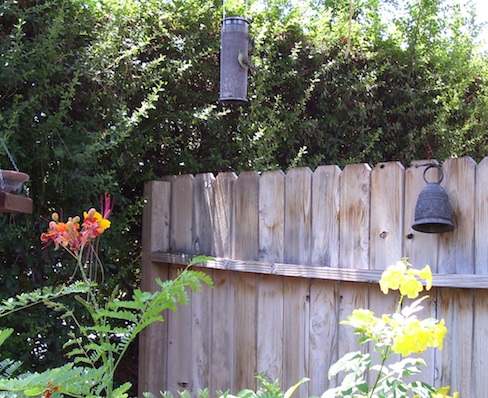
Goldfinch on tube feeder with Mexican birds of paradise and tecoma blossoms

I sigh and take a sip of water, set the glass on the patio table beside me. I listen to the quiet sound of the misters, watch a goldfinch alight on the thistle feeder. “No,” I say, a laugh in my voice now, “The United States is not only Alaska and New Jersey.” I shake my head, a small smile on my face. I am satisfied in the aftermath of release, my fears banished again in the act of relinquishing them to the page, a second exorcism on this chosen path. Mexico is not only Baja California Sur and Jalisco, but I will write about them anyway. I will write what I know. I will write what I believe, what I think, what I wonder, and I will trust my readers with the rest.

Exorcising Demons (7)

It’s my seventh week, and still I’m afraid each time I won’t have anything “good” to write. I worry I won’t be able to enter in, that “having” to tie my post to Mexico will make it boring or contrived. I worry because I think I have already told you all my good stories about Mexico, my first whale, my magic walking loop in Guanajuato. What else? I have brainstormed lists of things I can write about, and still every week I’m afraid. And I don’t want to spend all year afraid. I want to break through this. Surely I can find things I want to say about a place that goes so deep in me, whose images swim through my days, wade through my sleeping dreams, whose people live inside me–vivid, dark skinned, brown eyes alert and present. I want to find my way in and stay there, watch my blog grow, be happy with what I touch, excited about what’s to come, each new waiting post a pleasure, another chance to write about what I love, what moves me, makes me feel, come alive. I want to banish the damn fear once and for all. (Does it ever work that way?)

Brian laughed at me when I told him. “I’m sorry, ” he said, still laughing his wonderful laugh. “I’m afraid you simply can’t feel that way.” He was teasing but not teasing. I know it defies logic, is ludicrous in light of my scribbled lists of topics. But each week I become tight, braced, hands out in front of me, warding off monsters. Nothing to say? Nothing worth reading? Nothing I can remember well enough? So make it up, I think. You told your readers you might write fiction. So, write fiction, then. Easier said. Maybe I’m really afraid I can’t do Mexico justice. How can I bring Ana to life, laughing in the living room on Aldama? Rodolfo, offering me a taste of his exquisite pipián, eager, watching my reaction? Iris, a wonderful sly smile on her face, bringing me my birthday dinner at Il Giardino? How can I let you know what they meant to me, alone in a strange country, my lifelines there? How can I explain why I almost never call them, how even now my heart breaks a little and my eyes fill? How they weren’t only my anchors, my buoys in a foreign land, but they seemed to love me so completely, took me just as I was, found joy in me?

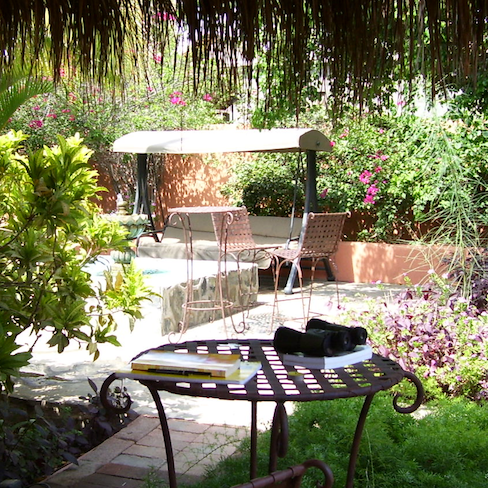
patio at Las Flores Posada in Todos Santos, my writing notebook on the table

I wipe tears away with the back of my hand from where they pool above my upper lip. One stray one slides down my left cheek. The misters cool the pre-dusk air, and a hummingbird alights on one pointy tip of the big cactus, taking in their moist cloud. For now, my fears abate, chased off by this release, I think, and because I’ve touched these memories for myself, even if I am no more confident of presenting them to you. I breathe, and sigh, sip my water, listen to the evening chatter of the house sparrows in the hedge behind me, the pwitter of the mourning dove’s wings as he flutters to the ground from his perch atop the wooden fence in search of fallen thistle seeds. Maybe, I think, I only need to become present to do this without fear. And maybe that’s where I’m afraid of failing.

[Editor’s note: This photo shows my writing notebook and binoculars on the patio at Las Flores in Todos Santos, Baja California Sur.]