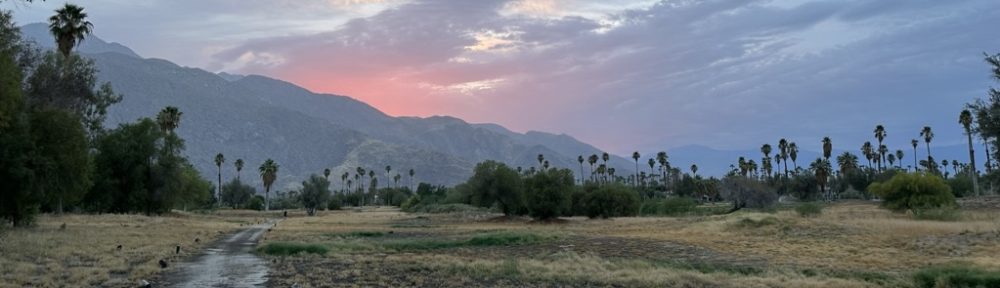
I love being in bed like this, all the windows and the sliding glass door open, my birds busy at their morning feeding, the mountains close and comforting, my tea warm beside me, sunlight on the blankets, knowing my writing time and my sitting practice lie before me. It makes me think maybe I could use this as a lure, as a reward, a way to become more productive in my day. If you get the essays graded, you can have a second set of writing and sitting practice today. A bribe, really. I moved these two to the very beginning of my day to mark their priority and to be certain they didn’t go undone in the course of endless busy weeks. It began as a commitment, an effort, and now it is a pleasure, a gift, even. It makes me wonder what other things might transform themselves. Dishes, sweeping, making the bed, taking out the trash, cooking–when I don’t feel the need to rush through them I don’t mind them at all, can even enjoy them. In fact, that may be the secret to this morning time, too. It is not that I didn’t already like writing, like sitting practice, but they didn’t have the pull of pure pleasure, like the appeal of reading a novel. So even though I enjoyed them, I didn’t long for them, didn’t reach for them in a busy busy day, didn’t always manage to carve out an hour or so for them like I would for a meal and a good book. But now that I’ve provided this time at the beginning of each day, there is all this room in them. Sometimes I have to be somewhere early in the morning, so I set my alarm. I might have less than an hour, their time curtailed. But most days, like not rushing through sweeping the courtyard or feeding the birds, I can take an hour, even a little longer, before I need to move on to my paid work. So I can let the writing come as it will, allow the sitting practice to unfold. And there is luxury in that. So these two things I know I want to do, these two things that are good for me, that might otherwise be “shoulds” smooshed into a too busy day, instead each morning before the busy-ness they beckon, lull, invite me to open my selves to them, filled with ease and promise.
Category Archives: Reading
The Vernal Equinox (52)
On Saturdays when time allows I like to read the “Saturday” section of the L.A. Times and the weekly forecast on Astroblogick. My paper was still stopped yesterday, but I read about this week’s celestial events on my mini iPad. It looks like a busy week for the planets, and we have a full moon eclipse coming, too. But the part that fascinated me is that at the exact time of the vernal equinox, “the principles of duality . . . are temporarily suspended,” and that “being centered in this fleeting moment seems to carry a sacred significance.” It reminded me of C.J. Cregg on The West Wing determined to set a raw egg upright on the table during that moment (and succeeding only after the poker game had broken up and everyone left the room). I didn’t give it another thought until this morning. This week part of my homework for my mindfulness based stress reduction class is to record the details of one experience each day on our “Pleasant Events Calendar.” So last night I wrote about eating sushi. I was intrigued by the mystery of the event, the unusual feelings it evoked in me. It wasn’t until this morning I put it together in my head with my vision of the clock beside my bed when I began eating last night. It was maybe 20 minutes after 9:00pm. (The exact time for the equinox was 9:30pm.) I’d gone downtown, picked up an avocado roll with extra ginger on my way home. I took a quick shower, climbed into bed, lamented eating so late, and relished every morsel of my sushi. I licked the wasabi and gluten free tamari from my fingers and thumbs. I cringed and savored the heat in my sinuses. And after, I sat there gazing at nothing, the empty container balanced on my belly. I felt clean and clear. Relaxed. Satisfied. Calm. Soothed. For a moment I wondered if it was the drug of the wasabi. But now I think it may have been the exact moment of the equinox working on me, all unknowing. I recorded that I felt quiet inside, hollow but not empty (the duality suspended). I felt whole. Knowing or unknowing, these moments twice each year can only do us good, I think. Happy spring equinox, everyone.
My Day of Poetry, My Poem (32)
Today I had the great honor and gift of taking a class titled “Ways Poetry Can Enliven, Illuminate, and Improve Your Prose” with poet and professor Julie Paegle. At one point, she gave us each a poem on a small sheet of paper that we can carry with us out in the world to memorize. Mine was “The Reassurance” by Thom Gunn. (I think it may have been her intention or prayer to participate with the universe when she handed them out. Each one was different, and more than one person said she must be psychic.) In one exercise we were told to read the poem she picked for us, choose something we loved or hated about it and take that with us into a poem we wrote ourselves. This is the poem that came to me.
I remember
the first time you came back
after you died.
We were sitting
outside a prison
at a round stone picnic table
near a chain link fence.
I said,
“What are you doing here?
You’re supposed to be dead.”
You smiled,
nodded.
I remember waking up
still shocked by your presence
not sure if I was glad
or annoyed
to know you could appear like that
so alive
anytime you wanted.
The Church of Writing (30)
It isn’t fair. I try reading other books about writing from my odd “moving to Mexico” collection. But how can any book follow Natalie Goldberg’s? I give it almost two weeks, plodding through the pages, duty and stubbornness combined, hope dwindling. I give up, return to the Ray Bradbury. I’d only read it once years ago, but already, in the first chapter, it makes me cry. It seems unbelievable how lucky I am, to have these two writers who talk about the writing process, who both move me to tears. But it’s a mystery. The other three books don’t touch me, not even Annie Dillard’s whose prose is so lush. So I wonder what it is. Is it like acting? Does the actor need to feel the emotion he’s portraying in order to affect the audience? Is the emotion of the writer able to move into us when we read their work? Is there some mix of mind, heart, body, spirit, the writer’s integrated presence, that hugs their words? Are our words infused, like magic, with how or who we were when we wrote them? Are we transported by a writer who takes us to a world of their own making because the writer was wholly planted there when the words flowed through them, feet buried in the earth? I think so. And I love the idea that our own energy might travel unseen with our writing, ghosts on a night train, lighting people up all over the planet. No wonder libraries are sacred. Holy houses, resonant with this collected energy, like centuries-old cathedrals, dust swirling in the air, caught by the late afternoon sunlight, the smell of old paper, the feel of warm wood beneath your palm, like a prayer.
The Girl Next Door (28)
Last week I began to read Ray Bradbury’s Zen and the Art of Writing for the second time. I tried to resist, read pieces of the Bonnie Friedman, the Annie Dillard. But they didn’t move me. The first day I read the Bradbury it made me cry. Goldberg’s work makes me cry, too. Today I read Bradbury in the courtyard in the late afternoon with the sun in my eyes. He says in order to feed your muse, “you should always have been hungry about life since you were a child.” I wonder if this is true for me. I kind of think not. But maybe so—just a quieter version than I feel from him. And I have imagined for a good while I’d like to be more avid, more eager, more vibrantly alive. Might I be on the road to that even now as I move my pen across the page? I think, too, he grew up in a different world, one I was lucky enough to touch when I was a little girl, like the last sip on the tip of my tongue. The carnival came to his town, real people who talked to him. The magician sent him home with the rabbit from his show. The world was smaller then. It makes me wish I’d been the girl next door—oh, that’s Ray’s friend Riba. I wish I’d felt the silky fur of that magician’s rabbit underneath my hand, that I was sprawled on the ground with the other neighborhood kids listening to his father’s voice in the dark, telling stories of his own childhood when there were no roads heading west, only dirt tracks and the new railroad, or lying on our backs looking up at the sky filled with stars and tasting awe for the first time in our young lives.
Book Company (24)
I must have been in a weird place when I read Natalie Goldberg’s Thunder and Lightning the first time. Because I remember being disappointed, and I’m loving it this second time through. I am using it the way I’ve been rereading her other books, a chapter or sometimes two before I do my daily writing. I’ve described this before, I think. Letting myself read about writing carves out time and space for me to be a writer. It makes me feel like I am part of the conversation, one writer among many. Now that I feel good about Thunder and Lightening, too, it means I have four books of hers to reread. But I will need to take a break from them when I’m done with this one. I need to read the other books I have on writing, the small collection I bought before I moved to Mexico. I don’t know what possessed me. At that time before I left the country I must have still been reading a chapter every morning, Natalie Goldberg or Ray Bradbury or even Dorothea Brande or Brenda Ueland, four of my favorites. So I combed bibliographies and bought more books about writing, consumed with preserving this ritual in foreign lands. In Hopland, where it began for me, I would sit outside on my stone porch that looked across a big field, a craggy rock embedded in the hillside. I would read first, and then I’d write a page of my novel, my answer to unearthing time for my writing even though I was still in my first years of teaching when there was no time. I promised myself I would write for eleven minutes each day. And the time before the writing, immersing myself in the world of the writer, was sheer joy.
When I’m finished reading Thunder and Lightning, I tell myself now, I will tackle one of the new books. I tried reading a few of them before, but I never made it very far. Now I am determined to read them all. Maybe there will be another gem or two I can add to my “real” collection. If I can grow it a bit larger, if I find enough of them that feed me the way my favorites do, then by the time I finish the last one in my set I can just begin again with the first, Writing Down the Bones. The thought delights me, even if it makes me sound insane. Because no matter how many times I reread them, I’m always reminded of something I’ve forgotten, something timely to my life right now. I see things I missed before, too, or I understand them in a new way. And always in returning to one of these books there is that joining in, that sharing of the writer’s life, the comfort of the writer’s voice like reuniting with an old friend, like sliding into my old, worn sweater, the color of wine, the one with the holes in it I love to dig out at the first hint of chill in the fall air. So, I’m going to read the books I haven’t read but carried with me for eight years, go looking for new old friends. But maybe, before I begin, I’ll first let myself return to Ray Bradbury’s Zen and the Art of Writing. Because it’s been a long, long time, and the thought of his sweet, kind, vibrant being draws me back again.
Two Hemingways (22)
I just read the chapter in Natalie Goldberg’s book where she visits Ernest Hemingway’s house in Key West. She describes his attic studio with big windows and a “palpable presence.” She hears tourists gasp behind her. They feel it, too. Now that my short story has won his granddaughter’s contest, I feel connected to Hemingway, as well. I didn’t remember this chapter, but now it lights me up. Natalie talks about how he “cared about the sun and the gradation of light,” and I think: me, too. Me, too. I’ve bought his granddaughter’s memoir, Walk on Water. It’s sitting by the window on my kitchen table. And I will need to read the grandfather’s work now, as well. It is his name, his blood, that is my entrance into the literary world. I want to honor it. I want to know them both, fellow writers. I didn’t know he killed himself, or I’d forgotten. I only know I’ve had a great fondness for him for almost 40 years, ever since I fell in love with Gertrude Stein. I adopted her love for Hemingway. Now I take on Natalie Goldberg’s, too. I want direct knowledge. I want to stand in that attic studio with the Florida light falling through the windows. Maybe I will go to Idaho and stand beside his grave. Or maybe I will read The Sun Also Rises when I am walking the camino de Santiago across northern Spain, and I will visit Pamplona and stand in the room where he wrote and feel him there, this century later. And I will whisper to him that I used to think I was Gertrude Stein in another life. I will tell him about the uncanny light I fell in love with in the mountains of Jalisco. And I will thank him again and again for Lorian, for this granddaughter who loves my work.